


The US government has signed defense cooperation agreements with Japan and the Philippines to boost the deterrence capabilities of countries in the first island chain, a report by the National Security Bureau (NSB) showed.
The main countries on the first island chain include the two nations and Taiwan.
The bureau is to present the report at a meeting of the legislature’s Foreign Affairs and National Defense Committee tomorrow.
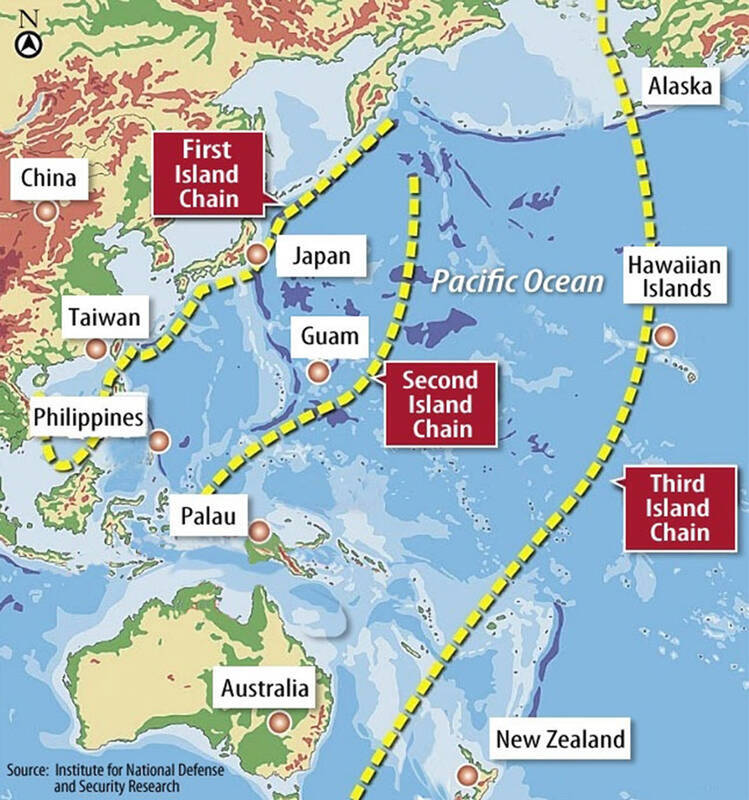
The US military has deployed Typhon missile systems to Japan’s Yamaguchi Prefecture and Zambales province in the Philippines during their joint military exercises. It has also installed NMESIS anti-ship systems in Japan’s Okinawa Prefecture, Miyako Island and Ishigaki Island, as well as Batan Island in the Philippines, it said.
Meanwhile, Japan is planning to deploy Hyper Velocity Gliding Projectiles (HVGP) for “island defense” in Kyushu and Hokkaido islands, while the Philippines intends to station BrahMos anti-ship missiles in western Luzon and Palawan province.
“These stated military deployments have greatly enhanced a key maritime denial capability of the US and its allies in the first island chain,” the report says.
The report provides a map illustrating the locations of these military deployments, showing that the range for HVGPs could reach 900km.
The NMESIS and BrahMos anti-ship missile systems have a range of approximately 290km, covering a large part of the waters surrounding the first island chain, the report says.
To further defend the first island chain, the US has also partnered with other allies, including Canada, the UK, France, Germany, Australia and New Zealand, the report says.
The US’ latest National Security Strategy report issued on Dec. 4 positions the Asia-Pacific region as the focal theater for US global competition, the report says.
The US strategy also identifies three core priorities: maintaining the openness of critical sea lanes, strengthening US forward deployments in the Indo-Pacific region, and sharing defense responsibilities with allies, it says.
US Indo-Pacific Commander Admiral Samuel Paparo said in a testimony before the US Senate Committee on Armed Services on Dec. 7 that China’s expanding fighter force and missile systems significantly complicate US air operations, making denial defense a strategic reality within the first island chain, the report says.
As Paparo said, the US urges allies to jointly enhance defense capabilities to deter the threat from China, the report says.
The US and 18 other countries — along with NATO, the EU and the G7 — have reiterated multiple times this year the importance of peace and stability in the Taiwan Strait, the report says.
The EU and Germany said in August and October respectively that the Taiwan Strait is subject to the UN Charter principle prohibiting the use of force.
Both call for China to jointly maintain world peace as a permanent member of the UN Security Council, the report says.
Support for Taiwan continues to rise as the status of the Taiwan Strait is key to the safety of the Indo-Pacific region and the international community, it adds.

‘WIN-WIN’: The Philippines, and central and eastern European countries are important potential drone cooperation partners, Minister of Foreign Affairs Lin Chia-lung said Minister of Foreign Affairs Lin Chia-lung (林佳龍) in an interview published yesterday confirmed that there are joint ventures between Taiwan and Poland in the drone industry. Lin made the remark in an exclusive interview with the Chinese-language Liberty Times (the Taipei Times’ sister paper). The government-backed Taiwan Excellence Drone International Business Opportunities Alliance and the Polish Chamber of Unmanned Systems on Wednesday last week signed a memorandum of understanding in Poland to develop a “non-China” supply chain for drones and work together on key technologies. Asked if Taiwan prioritized Poland among central and eastern European countries in drone collaboration, Lin
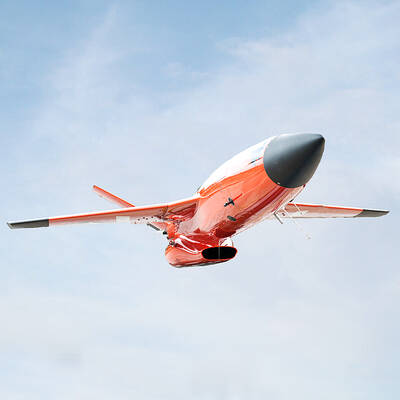
The Chien Feng IV (勁蜂, Mighty Hornet) loitering munition is on track to enter flight tests next month in connection with potential adoption by Taiwanese and US armed forces, a government source said yesterday. The kamikaze drone, which boasts a range of 1,000km, debuted at the Taipei Aerospace and Defense Technology Exhibition in September, the official said on condition of anonymity. The Chungshan Institute of Science and Technology and US-based Kratos Defense jointly developed the platform by leveraging the engine and airframe of the latter’s MQM-178 Firejet target drone, they said. The uncrewed aerial vehicle is designed to utilize an artificial intelligence computer

Renewed border fighting between Thailand and Cambodia showed no signs of abating yesterday, leaving hundreds of thousands of displaced people in both countries living in strained conditions as more flooded into temporary shelters. Reporters on the Thai side of the border heard sounds of outgoing, indirect fire yesterday. About 400,000 people have been evacuated from affected areas in Thailand and about 700 schools closed while fighting was ongoing in four border provinces, said Thai Rear Admiral Surasant Kongsiri, a spokesman for the military. Cambodia evacuated more than 127,000 villagers and closed hundreds of schools, the Thai Ministry of Defense said. Thailand’s military announced that

CABINET APPROVAL: People seeking assisted reproduction must be assessed to determine whether they would be adequate parents, the planned changes say Proposed amendments to the Assisted Reproduction Act (人工生殖法) advanced yesterday by the Executive Yuan would grant married lesbian couples and single women access to legal assisted reproductive services. The proposed revisions are “based on the fundamental principle of respecting women’s reproductive autonomy,” Cabinet spokesperson Michelle Lee (李慧芝) quoted Vice Premier Cheng Li-chiun (鄭麗君), who presided over a Cabinet meeting earlier yesterday, as saying at the briefing. The draft amendment would be submitted to the legislature for review. The Ministry of Health and Welfare, which proposed the amendments, said that experts on children’s rights, gender equality, law and medicine attended cross-disciplinary meetings, adding that


 RSS
RSS