


Faced with the military threat of the Chinese Communist Party (CCP) — and for the sake of security across the Strait, in the region and around the globe — an adequate budget is crucial to ensuring the smooth operation of the Ministry of National Defense (MND), the army, the navy and the air force.
Opposition lawmakers, in particular the Chinese Nationalist Party (KMT), are proposing a NT$1.8 billion (US$54.7 million) reduction to the indigenous submarine project, leaving only NT$200 million for this year. In addition, they have proposed freezing 70 percent of the MND’s operational budget, equivalent to NT$178.1 billion.
KMT caucus secretary-general Lin Szu-ming (林思銘) also proposed slashing the entire NT$76.25 million budget for an Aerospace and Drone Industry Park in Chiayi County. He later said the caucus would instead propose a freeze of 50 percent of the budget in a statement released after the party was slammed for weakening national defense.
Deputy Minister of National Defense Po Horng-huei (柏鴻輝) said the budget cuts and freezes would delay or have a severe impact on the military’s schedule for stepping up its combat readiness. The indigenous submarine project, Hai Kun (海鯤), is crucial to Taiwan’s underwater security, while its minelaying ships project, the production of modern rifles and the development of the Aerospace and Drone Industry Park would all be important during a potential conflict.
Hai Kun is the first indigenous submarine project implemented by the navy. Objectively, the initial construction and research phase will take a long time. A stable and predictable budget is necessary for the project to operate smoothly. If the submarine project does not receive sufficient funds, it would undermine the navy’s underwater combat capability.
Although minelaying ships are not considered capital ships within the navy, the military’s emphasis on innovative and asymmetric warfare capabilities means that they are essential to impeding the Chinese People’s Liberation Army’s ability to land on Taiwan. When it comes to stepping up the navy’s combat readiness, the military power of traditional large battleships, as well as smaller and medium-sized ships, are all critical to ensuring that the navy is as strong and effective as possible.
The production of modern rifles and their distribution to the armed forces on the frontline are also key to national defense. Equally important is whether the military could acquire a sufficient number of domestically produced drones, which would depend on the development of the Aerospace and Drone Industry Park.
The importance of using drones to gather military intelligence and attack enemy targets during combat has already been demonstrated in the Ukraine war and the armed conflict between Azerbaijan and Armenia.
The domestic production of drones would not only allow the military to keep up-to-date with new technologies, but would promote the development of relevant industries in central and southern Taiwan.
An adequate and stable defense budget is essential to safeguarding national security and improving the combat readiness of the military, regardless of whether the emphasis is on traditional or asymmetric warfare.
National defense is a public good. Enhancing national security through boosting the strength and capabilities of the military is beneficial to everyone in our country. The MND’s advice should be heeded.
Ray Song is a doctoral student at Tamkang University’s Graduate Institute of International Affairs and Strategic Studies.
Translated by Fion Khan
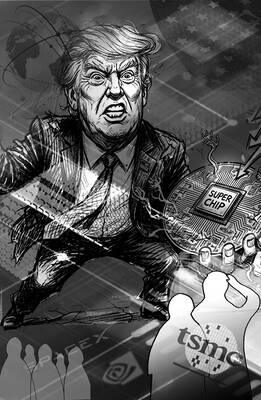
The White House’s decision to take a 9.9 percent stake in Intel Corp is looking like very shrewd business indeed. Since the government bought in at US$20.47 a share last August, the US chipmaker’s surging stock price has delivered the US a US$43 billion return. One of the reasons the investment has so far proved so sound is that the White House has made sure of it. According to The Wall Street Journal, Howard personally pushed deals on Intel’s behalf with some of the most lucrative clients imaginable. They include Nvidia Corp, the company at the heart of the AI
The Ministry of the Interior, working with the navy and coast guard, is organizing Taiwan’s first joint exercise simulating escort tankers carrying liquefied natural gas (LNG) and oil through a Chinese blockade. The drills simulate fuel transport along three maritime corridors leading toward Japan, the Philippines and the US. Deputy Minister of the Interior Sawyer Mars (馬士元) said that a blockade of the Taiwan Strait would amount to “almost a 100 percent blockade of the regional energy supply.” Minister of National Defense Wellington Koo said planning to counter a blockade is standard practice in Taipei. While the exercise is limited in
A single photograph can cut through a lot of noise, but it can also be used to misrepresent the truth. At the very least, it can concentrate the mind on something that requires further investigation. On Monday last week, Ma Ying-jeou Foundation CEO Tai Hsia-ling (戴遐齡) and former National Security Council secretary-general King Pu-tsung (金溥聰) held a news conference in which they showed a photograph of former foundation CEO Hsiao Hsu-tsen (蕭旭岑), now Chinese Nationalist Party (KMT) deputy chairman. In the image Hsiao is seated next to Xiamen Taiwan Businessmen Association chairman Han Ying-huan (韓螢煥). The two men were holding
I first met Professor Ray Jiing (井迎瑞) as a film and documentary student at Shih Hsin University’s (SHU) Department of Radio Television and Film in 1988. The following year, he went on to become the director of the Chinese Taipei Film Archive — forerunner of the Taiwan Film and Audiovisual Institute (TFAI). Over his eight-year tenure, Jiing rescued and restored over 200 classic Taiwanese films. In 1997, he established the Graduate Institute of Studies in Documentary and Film Archiving at Tainan National University of the Arts (TNNUA), and I joined the program in his third cohort of students. Beyond a


 RSS
RSS