


Curtailed flight schedules, security worries and a fear of severe acute respiratory syndrome (SARS) are draining first-class travelers from the major commercial airlines. But those problems have indirectly benefited several new companies that sell multiple flights on private jets.
Marquis Jet Partners, Sentient and the Delta AirElite subsidiary of Delta Air Lines are among the companies selling these private-jet membership services. These companies essentially sell prepaid blocks of travel on small aircraft -- like Cessna Citation jets that seat six and Gulfstream IVs that seat 14 and can accommodate a flight attendant.
Prices vary and can be difficult to compare, but they generally start at about US$100,000 for about 25 hours of flight time. Gourmet catering is included.
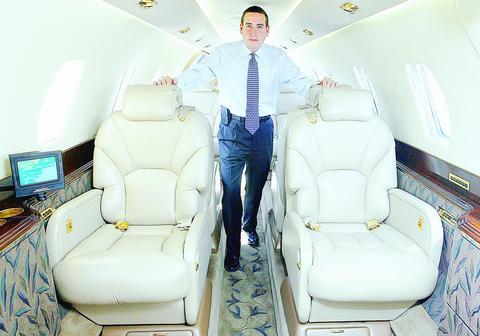
PHOTO: NY TIMES
While those prices average out to well above first-class fares on scheduled airlines, the companies promote their services as a novel way, amid a sluggish economy and corporate belt-tightening, to fly privately without some of the expense of owning a jet outright or having a fractional share in one. They also bill their newer and plentiful planes as better alternatives to those of traditional charter services.
Sentient, based in Norwell, Massachusetts, said it signed up over 200 more customers in March than it did in the same month last year.
The company, which T.H. Lee Putnam Ventures, a New York investment firm, bought this month from a unit of Credit Suisse First Boston and other investors, now has 1,300 customers, divided almost equally between corporations and wealthy individuals. Harvey Golub, the chairman of T.H. Lee Putnam Ventures, is a former chief executive of American Express.
Sept. 11 effect
"People are really looking for security and convenience," said Mark Stone, the chief executive of Sentient, which was formerly known as eBizJets. He said the company's total revenue since the week after Sept. 11, 2001, has been about US$100 million, and that the company has been profitable since the second half of 2001.
He declined to provide further details, saying only that sales for last year rose 78 percent from the previous year.
Marquis, a privately held company based in New York, said its sign-up rate for new members more than tripled in March from the month a year earlier. The company says that it has 600 customers -- about 500 of them individuals and the rest corporations -- and that it became profitable last month, ahead of its year-end target.
Total revenue since it opened for business in June 2001 has been about US$105 million, said Kenneth Austin, the executive vice president. He added that the company was nearly "one year ahead" of its original revenue projections, but declined to disclose further details.
He said Marquis had been growing so fast because "people just can't get from here to there commercially anymore."
Or at least not as quickly. Major airlines have been paring back their schedules to save money, making commercial flights less convenient for some frequent travelers. Delta Air Lines, for example, cut its regular service by 12 percent last month.
In addition to offering service on demand, private jet services also help travelers avoid airport delays. The services, including Delta's own, often fly to many of the nation's 5,000 tiny municipal airports and airfields, away from congested commercial-airline hubs and clogged security checkpoints.
Delta AirElite, based in Cincinnati, declined to disclose its revenue or to say how many customers it had enrolled since introducing its membership program in January. The company said only that it had received more than 900 inquiries. Cameron Gowans, Delta AirElite's director for sales and marketing, said the company hoped that its private-jet membership service, which it calls "fleet" membership, would replace charters as its flagship product.
Buying time
Sentient, whose clients include sports stars like Shaquille O'Neal of the Los Angeles Lakers and Alex Rodriguez of the Texas Rangers, does not own any planes; instead, it can charter as many as 1,400 as it needs them. Delta owns four planes, leases five more, operates 20 aircraft owned by others and charters an additional 200 jets through various charter operators.
By contrast, Marquis offers 400 planes through a sub-leasing arrangement with NetJets, the leading seller of fractional shares of aircraft and a unit of Berkshire Hathaway.
Under fractional ownership, customers buy a partial interest in a jet. For around US$600,000, for example, they can buy a one-sixteenth share of a small jet, entitling them to about 50 hours of flying time a year. They also pay management fees, typically at least US$10,000 a month, and flying fees, usually starting at US$1,400 an hour.
Some industry analysts say that they wonder if Sentient and Delta AirElite are really just souped-up charter services, unable to guarantee high-quality planes.
"There's a lot of range of what you probably get in terms of the age and capabilities of planes" with both of the companies, said Barry Justice, an aviation consultant in Grapevine, Texas.
Chartered planes can be new aircraft with leather seats, laptop hookups and DVD players, or low-technology jets that have been in service for decades.
Starting next month, Stone said, Sentient's new quality-control team will make quarterly, sometimes monthly, inspections for eyesores like coffee spills. The company has also hired a second, independent safety-auditing firm. Sentient and Delta AirElite also say that they charter their planes only from reliable, well-vetted sources.
S. Jerry Glauser, the owner of a Mercedes-Benz dealership in Sarasota, Florida, said he had flown dozens of times on his US$100,000 Sentient card in the last 10 months, including trips to to Aspen, Colorado, New York and the NCAA basketball championship in New Orleans.
"It can certainly be luxurious if you want it to be," he said. "Everything has been extremely pleasant, very easy," he said.
Marquis may have an edge with its fleet, but some industry analysts question how much the company actually saves some customers. For a corporate client whose executives take trips that require them to stay at a destination for several days, "you might want a fractional instead," said Joseph Moeggenberg, of the Aviation Research Group/US, an aviation consulting firm in Cincinnati.
Pricing strategy
Marquis charges from US$109,900 to US$299,900 for 25 hours of flight time, depending on the size of the jet. It requires notice of 10 hours to send in a plane to pick up passengers.
By contrast, Delta AirElite charges from US$99,500 to US$245,500 for 25 hours. But members can earn up to 7-1/2 free hours if they always fly round-trip, so the pilot can wait at the destination. The company guarantees a plane on 12 hours' notice.
Sentient, using a different pricing model, sells travel cards for US$100,000 to US$500,000, and then debits them at US$3,100 to US$7,100 a flight hour, depending on the size of the plane and whether the trip's length is short enough so that the pilot can wait for the return.
On a small jet, Sentient's US$100,000 card can buy more than 32 flight hours of one-way trips or nearly 49 hours of round trips. Sentient says it needs booking notice of only five hours.
For all the companies, the most popular destinations are the Northeast, California, Florida and the Caribbean, but they occasionally fly farther overseas, through affiliate charters.
Stone of Sentient predicted that revenue from private-jet membership services would overtake those of fractional jet ownership, a fast-growing business itself, in five to seven years.
But John Olcott, the president of the National Business Aviation Association, a trade group for the private-jet industry, disagreed.
"To expect the same level of service and efficiency as in a corporate or private jet," he said, referring to private aircraft owned by the traveler, "is probably unrealistic," he said.

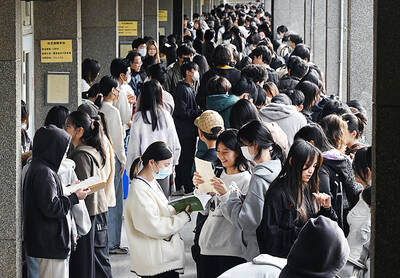
A global survey showed that 60 percent of Taiwanese had attained higher education, second only to Canada, the Ministry of the Interior said. Taiwan easily surpassed the global average of 43 percent and ranked ahead of major economies, including Japan, South Korea and the US, data from the Organisation for Economic Co-operation and Development (OECD) for 2024 showed. Taiwan has a high literacy rate, data released by the ministry showed. As of the end of last year, Taiwan had 20.617 million people aged 15 or older, accounting for 88.5 percent of the total population, with a literacy rate of 99.4 percent, the data
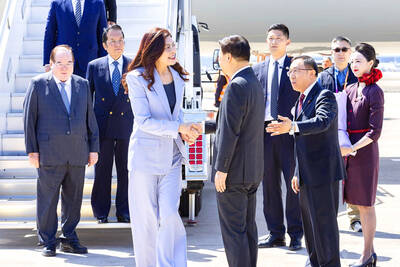
CCP ‘PAWN’? Beijing could use the KMT chairwoman’s visit to signal to the world that many people in Taiwan support the ‘one China’ principle, an academic said Chinese Nationalist Party (KMT) Chairwoman Cheng Li-wun (鄭麗文) yesterday arrived in China for a “peace” mission and potential meeting with Chinese President Xi Jinping (習近平), while a Taiwanese minister detailed the number of Chinese warships currently deployed around the nation. Cheng is visiting at a time of increased Chinese military pressure on Taiwan, as the opposition-dominated Legislative Yuan stalls a government plan for US$40 billion in extra defense spending. Speaking to reporters before going to the airport, Cheng said she was going on a “historic journey for peace,” but added that some people felt uneasy about her trip. “If you truly love Taiwan,
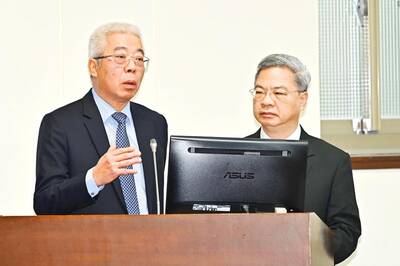
Taiwan has arranged for about 8 million barrels of crude oil, or about one-third of its monthly needs, to be shipped from the Red Sea this month to bypass the Strait of Hormuz and ease domestic supply pressures, CPC Corp, Taiwan (CPC, 台灣中油) said yesterday. The state-run oil company has worked with Middle Eastern suppliers to secure routes other than the Strait of Hormuz, through which about 20 percent of the world’s oil and liquefied natural gas typically passes, CPC chairman Fang Jeng-zen (方振仁) said at a meeting of the legislature’s Economics Committee in Taipei. Suppliers in Saudi Arabia have indicated they

NEW LOW: The council in 2024 based predictions on a pessimistic estimate for the nation’s total fertility rate of 0.84, but last year that rate was 0.69, 17 percent lower An expected National Development Council (NDC) report expects the nation’s population to drop below 12 million by 2065, with the old-age dependency ratio to top 100 percent sooner than 2070, sources said yesterday. The council is slated to release its latest population projections in August, using an ultra-low fertility model, the sources said. The previous report projected that Taiwan’s population would fall to 14.37 million by 2070, but based on a new estimate of the total fertility rate (TFR) — the average number of children born to a woman over her lifetime — the population is expected to reach 12 million by


 RSS
RSS