


The kudos on the weekend talk shows were deafening: All hail, Greenspan, thou shalt be King hereafter! Politicians, economists and charlatans were gaga over the Maestro's latest surprise move. The deed was done, the reasons were evident, the timing superb, the benefits to be delivered.
Wouldn't it have been more instructive to sort out why the guidance from Federal Reserve policy-makers, right up to last Wednesday's 50 basis-point rate cut, had been horribly misplaced? "My own view on this is that rate cuts -- I should say rate changes -- should be made at meetings, as a general matter," St Louis Fed President William Poole said two weeks ago. "Most of the time, in most circumstances, I think it makes sense to move at the regular meetings." Poole was one of many Fed policy-makers downplaying the desirability, not to mention the need, for an inter-meeting move.
Of course, Poole's economic research department just put out an article entitled, "What Accounts for the Reduced Frequency of Fed Actions?" in the April issue of Monetary Trends, comparing the changes in policy before and after glasnost. (It was in 1994 that the Fed started announcing its policy changes rather than letting the market second-guess its actions.) According to the article, between January 1994 and January 2001, policy changes averaged once every four months compared with once every 1 1/2 months from 1987 through 1993.
Since January, the Fed has made one change every 3 1/2 weeks, putting even the earlier period to shame (and the changes -- 50 basis points -- have been larger).
This going-for-growth-at-any-cost is starting to get some attention. Jim Bianco, president of Bianco Research in Barrington, Illinois, sends out financial and political clips, organized according to subject, daily to his clients. Today's financial clips featured a section of "stories about inflation." "It's the first time in the nearly two years I've been doing this that I've had an inflation section," Bianco said.
To be sure, price cuts, not increases, are the story in the technology sector, as producers try to sell what they can before it becomes obsolete. So far that constitutes a relative price change. Deflation, or a decline in the general price level, is only a forecast right now.
Right alongside the stories about cuts in computer prices are articles about soaring gas prices. The national average price of a gallon of unleaded gasoline is up 11 percent in the last four weeks while unleaded futures are up 15 percent since the end of March. In Chicago, drivers are already paying US$2 a gallon at the pump for government-mandated reformulated gasoline.
Demand for gasoline in the first quarter of the year was higher than in the same period a year earlier, according to the American Petroleum Institute (all those folks driving to find new jobs, no doubt).
The notion that inflation is "only energy" is belied by the rise in core inflation measures, excluding food and energy.
"As far as the Fed is concerned, rising price pressures are a problem for another day," said Lou Crandall, chief economist at Wrightson & Associates. "For now, the central bank is focused exclusively on avoiding a meltdown in the real economy. It will run greater inflation risks -- and tolerate worse inflation news -- than would otherwise be the case." Dallas Fed President Robert McTeer, a New-Economy kind of guy, said as much on Friday.
"We've got to put our concerns about inflation on the back burner and save the economy from the `R' word," McTeer said.
"That's the one thing every bond investor hates to hear from a central banker," Crandall said. "The burner is turned up pretty high." This Friday, when the government reports gross domestic product for the first quarter, the GDP deflator is expected to show an outsized increase of 3 percent compared with 1.9 percent in the fourth quarter.
That will be dismissed as old news, which it is. But the rapid growth in the money supply looks to be locking in higher future inflation.
The deterioration in inflation hasn't gone unnoticed by TIPS, a species of Treasury securities that protects investors from inflation. This much maligned asset class "had its best quarter in their four-year existence in the first quarter," said Henry Willmore, senior US economist at Barclays Capital Group.
The break-even inflation rate on 10-year TIPS -- the inflation rate at which TIPS and nominal bonds produce the same return -- has widened 30 basis points in the past month and 60 since the start of the year.
At 1.92 percent, the break-even rate might seen unrealistically low. Still, the recent performance of TIPS suggests investors don't expect global deflation. Compare that with the 1998 death spiral, when the breakeven rate fell to 0.66 percent.
Why Fed officials went from seeing the glass as half-full (second-half recovery) to fearing a half-empty tumbler is unclear.
Part of the reason for the cross signals between word and action may have to do with the structure of the Fed. Official communication between the Federal Reserve Board in Washington and the satellite banks is limited to FOMC meetings every six weeks and the daily conference call (the banks take turns participating on the call, along with the Federal Reserve Board and New York Fed, whose open market desk buys and sells securities on the Fed's behalf).
The disciples were still preaching the gospel as told to them at a time when their leader rewrote his sermon. Plain and simple, no one told them until their conference call last Wednesday.
This latest episode illustrates yet again the extent to which Greenspan is the Fed. Whether it's respect, admiration or deference to his position, he can pretty much engineer any outcome he desires.
That's a pretty powerful position to be in. It's also a pretty lonely one, if and when things go awry.

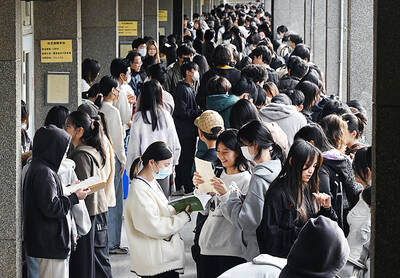
A global survey showed that 60 percent of Taiwanese had attained higher education, second only to Canada, the Ministry of the Interior said. Taiwan easily surpassed the global average of 43 percent and ranked ahead of major economies, including Japan, South Korea and the US, data from the Organisation for Economic Co-operation and Development (OECD) for 2024 showed. Taiwan has a high literacy rate, data released by the ministry showed. As of the end of last year, Taiwan had 20.617 million people aged 15 or older, accounting for 88.5 percent of the total population, with a literacy rate of 99.4 percent, the data

CCP ‘PAWN’? Beijing could use the KMT chairwoman’s visit to signal to the world that many people in Taiwan support the ‘one China’ principle, an academic said Chinese Nationalist Party (KMT) Chairwoman Cheng Li-wun (鄭麗文) yesterday arrived in China for a “peace” mission and potential meeting with Chinese President Xi Jinping (習近平), while a Taiwanese minister detailed the number of Chinese warships currently deployed around the nation. Cheng is visiting at a time of increased Chinese military pressure on Taiwan, as the opposition-dominated Legislative Yuan stalls a government plan for US$40 billion in extra defense spending. Speaking to reporters before going to the airport, Cheng said she was going on a “historic journey for peace,” but added that some people felt uneasy about her trip. “If you truly love Taiwan,

NEW LOW: The council in 2024 based predictions on a pessimistic estimate for the nation’s total fertility rate of 0.84, but last year that rate was 0.69, 17 percent lower An expected National Development Council (NDC) report expects the nation’s population to drop below 12 million by 2065, with the old-age dependency ratio to top 100 percent sooner than 2070, sources said yesterday. The council is slated to release its latest population projections in August, using an ultra-low fertility model, the sources said. The previous report projected that Taiwan’s population would fall to 14.37 million by 2070, but based on a new estimate of the total fertility rate (TFR) — the average number of children born to a woman over her lifetime — the population is expected to reach 12 million by
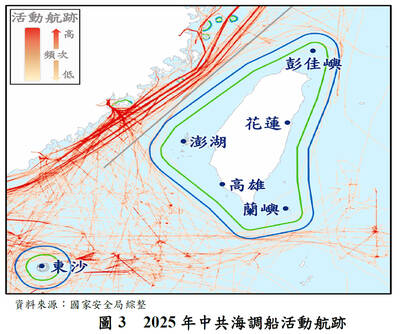
INTENSIFYING THREATS: Beijing’s tactics include massive attacks on the government service network, aircraft and naval vessel incursions and damaging undersea cables China is prepared to interfere in November’s nine-in-one local elections by launching massive attacks on the Taiwanese government’s service network (GSN), a report published by the National Security Bureau showed. The report was submitted to the Legislative Yuan ahead of the bureau’s scheduled briefing at the Foreign Affairs and National Defense Committee tomorrow. The national security team has identified about 13,000 suspicious Internet accounts and 860,000 disputed messages, the bureau said of China’s cognitive warfare against Taiwan. The disputed messages focus on major foreign affairs, national defense and economic issues, which were produced using generative artificial intelligence (AI) and distributed through Chinese


 RSS
RSS