


Taiwanese consumers were more upbeat this month on the economy and spending, with optimism toward the stock market and risk appetite climbing to record highs, a sentiment survey released on Wednesday by Cathay Financial Holding Co (國泰金控) showed.
The improvement in confidence came as a ceasefire between the US and Iran eased concerns over geopolitical tensions and helped lift global financial markets, the online survey of 13,227 respondents conducted from May 1 to 7 showed.
Meanwhile, the government’s March business climate monitoring indicators remained in the “red” zone, signaling continued economic expansion.
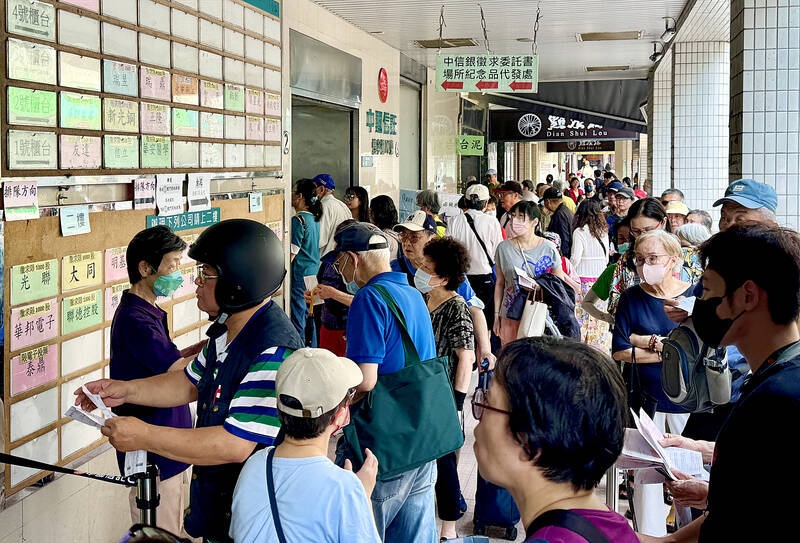
Photo: CNA
Although leading indicators edged down slightly, coincident indicators continued to rise, suggesting growth momentum remained resilient, Cathay Financial said.
Against that backdrop, the survey showed the public’s optimism index on the economy rose, while expectations for the economic outlook also improved.
Consumers appeared more willing to spend, as the index measuring willingness to make big-ticket purchases rose, while sentiment toward buying durable goods also strengthened, the survey showed.
Despite the improving mood, inflation concerns remained elevated, and respondents were somewhat more cautious on growth and inflation. Respondents projected economic growth of 6.79 percent and inflation of 2.25 percent, with 58 percent expecting inflation to remain above the central bank’s 2 percent alert mark, the survey found.
However, investor sentiment strengthened notably as local stocks rallied last month, thanks to strong earnings growth tied to artificial intelligence development, combined with easing geopolitical tensions. The survey’s stock market optimism index jumped to 45.5, while the risk appetite index climbed to 34.4, both reaching record highs.
The survey showed growing interest among investors in participating in this year’s dividend payout season, as many listed companies are scheduled to hold shareholder meetings this quarter and finalize dividend policies.
About 48 percent of respondents said they planned to participate in dividend and stock payouts this year, up from 37 percent last year, while only 7 percent expressed no interest.
The findings suggested some investors might consider taking profit ahead of tax season to reduce income tax burdens.
However, most investors indicated they do not plan to significantly reduce their holdings, as about 63 percent said they intended to maintain similar equity positions before filing income taxes, and about 20 percent said they might sell part of their holdings before tax season, slightly higher than the 15 percent recorded a year earlier, the survey found.

NEW MARKET: The partnership opens up India to the Dutch company, which already has a strong hold in the semiconductor market of South Korea, Taiwan and China ASML Holding NV entered into a partnership agreement with Tata Electronics Pvt Ltd aimed at ramping up India’s goal to develop domestic chip-manufacturing capabilities. The Dutch company’s technology would help power Tata Electronics’ planned 300 millimeter (mm) semiconductor foundry in Gujarat, according to a joint statement from the two companies on Saturday. The signing of a memorandum of understanding coincides with a visit by Indian Prime Minister Narendra Modi to the Netherlands, which is looking to deepen bilateral relations with New Delhi. ASML, whose top customers include Taiwan Semiconductor Manufacturing Co (台積電) and Samsung Electronics Co, makes lithography machines that can print

Tokyo Electron's Taiwan unit today said in a written response that it respects the judicial process, takes the court ruling seriously and would not appeal in the Taiwan Semiconductor Manufacturing Co (TSMC, 台積電) trade secrets case. Last month, a court fined the Taiwan unit of Japan's Tokyo Electron NT$150 million (US$4.74 million) in a case involving trade secrets related to TSMC's sensitive chip technology.
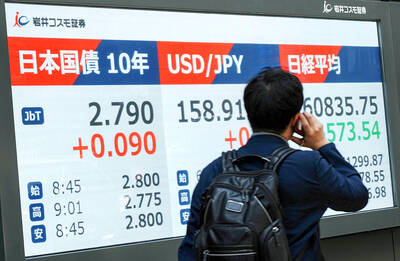
ROUGH RECORDS: Bonds in Japan, as well is in New Zealand, Australia and the US, are seeing the effects of a nervy market as stock exchanges across Asia edge down A deepening slump in Japanese government bonds added fuel to the selloff in global debt markets as rising oil prices stoked inflation fears and pushed yields to multi-decade highs. Japan’s 30-year yield yesterday surged as much as 20 basis points to the highest level since the tenor’s debut in 1999, before paring some of the move. Shorter-maturity Japanese debt was also under pressure, underscored by weak demand at a sale of five-year notes that offered a record-high coupon of 2 percent. Concerns over inflation and government spending rippling through markets including the US, Australia and New Zealand are being amplified in Japan,

Wall Street is licking its chops over an unprecedented slate of massive initial public offerings (IPOs) set to arrive in the coming months, beginning with Elon Musk’s Space Exploration Technologies Corp (SpaceX) next month. That is expected to be followed by artificial intelligence (AI) rivals OpenAI and Anthropic PBC. The trio of mega listings, each eyeing valuations around US$1 trillion or more, constitutes a heady period of elevated risk and reward. SpaceX is targeting an IPO that would raise up to US$80 billion — about double the funds generated from all IPOs last year. OpenAI and Anthropic are eyeing IPOs raising US$60 billion. “We’re


 RSS
RSS