


ASML Holding NV entered into a partnership agreement with Tata Electronics Pvt Ltd aimed at ramping up India’s goal to develop domestic chip-manufacturing capabilities.
The Dutch company’s technology would help power Tata Electronics’ planned 300 millimeter (mm) semiconductor foundry in Gujarat, according to a joint statement from the two companies on Saturday. The signing of a memorandum of understanding coincides with a visit by Indian Prime Minister Narendra Modi to the Netherlands, which is looking to deepen bilateral relations with New Delhi.
ASML, whose top customers include Taiwan Semiconductor Manufacturing Co (台積電) and Samsung Electronics Co, makes lithography machines that can print intricate patterns of transistors on silicon wafers to make cutting-edge semiconductors.
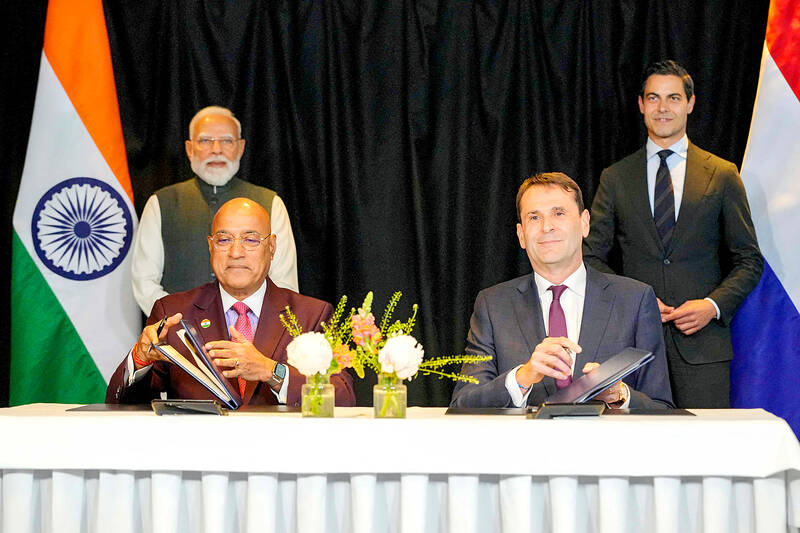
Photo: AFP
Last month, it raised its sales guidance for the year as chipmakers ramp up production to meet demand from big tech companies expanding their artificial intelligence (AI) computing capacity.
“India’s rapidly expanding semiconductor sector represents many compelling opportunities,” ASML CEO Christophe Fouquet said in the statement. “We are committed to establishing long-term partnerships in the region,” he added.
The move opens up a new market for ASML, which counts South Korea, Taiwan and China as its biggest markets. For India, the partnership ties in with the government’s aim to put the country on a par with major chip-making producers by 2032.
Tata Electronics is investing US$11 billion to build India’s first 300mm commercial fab in Dholera, Gujarat. The facility is to make semiconductors for applications across automotive, mobile devices and AI segments, the statement said.
ASML and Tata Electronics would also cooperate to train talent for India’s semiconductor industry, develop a supply chain as well as research and development infrastructure to support the fabrication plant, the companies said.
Modi is on five-nation tour across the United Arab Emirates and Europe. His visit to the Netherlands comes after the EU and India entered into a free-trade agreement in January that is expected to double goods exports from the bloc to the South Asian nation by 2032.
Modi headed to Sweden yesterday, where he was to address a European business leaders’ forum alongside European Commission President Ursula von der Leyen, before heading to Norway today for an India-Nordic Summit.
Modi’s final leg would be Italy on Tuesday next week, where Modi is to meet Italian Prime Minister Giorgia Meloni — with whom he has a close friendship.

Taiwanese firms have increased investment in the Philippines in recent years as Manila’s ties with Washington deepen and global supply chains continue to shift away from China, an expert at the Chung-Hua Institution for Economic Research (CIER, 中華經濟研究院) said yesterday. The Philippines had not been among Taiwanese investors’ top choices in Southeast Asia, CIER Taiwan ASEAN Studies Center director Kristy Hsu (徐遵慈) said at a seminar in Taipei. However, Taiwan’s investment in the country has grown significantly since the COVID-19 pandemic, reaching US $257 million last year, a high in recent years, she said. Although Taiwan’s total investment in the Philippines still lags

Intel Corp regards Taiwan Semiconductor Manufacturing Co (TSMC, 台積電) as a longstanding partner, as the US chipmaker would continue outsourcing production of advanced chips to TSMC, Intel chief executive officer Lip-Bu Tan (陳立武) said yesterday. “I don’t look at people as competitors. I look at the collaboration... Nvidia is also, you know, a good friend,” Tan told a news conference following his keynote speech at the Computex trade show in Taipei. “It’s a very trusted partnership for us... We are a big, top customer for them, and we’re going to continue doing that,” he said, referring to TSMC, the world’s largest foundry
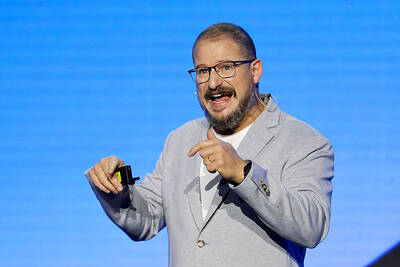
Artificial intelligence (AI) agents would supplant smartphones as the center of people’s digital lives, fundamentally reshaping personal devices and driving a major computing upgrade cycle, Qualcomm Inc CEO Cristiano Amon said yesterday. In his keynote speech for this year’s Computex trade show in Taipei, Amon said that the rise of "agentic AI" — AI systems capable of reasoning, planning and carrying out tasks autonomously — would transform how people interact with technology across phones, PCs, vehicles and wearable devices. Describing the technology as the next major evolution in computing, Amon said that "2026 is the year of agents.” For decades, smartphones have sat
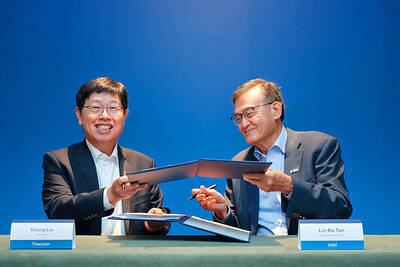
Hon Hai Precision Industry Co (鴻海精密) yesterday said it would work with US chipmaker Intel Corp to jointly develop and deploy next-generation artificial intelligence (AI) infrastructure and intelligent computing platforms in a move to capture booming demand for AI computing systems. Hon Hai, also known as Foxconn Technology Group (富士康), said in a statement that the partnership would combine its global manufacturing scale, system integration expertise and AI data center deployment capabilities with Intel’s strengths in processor architecture, silicon technologies and software ecosystem. The companies said they plan to work on equipment used in AI data centers, including server racks powered by


 RSS
RSS