


A deepening slump in Japanese government bonds added fuel to the selloff in global debt markets as rising oil prices stoked inflation fears and pushed yields to multi-decade highs.
Japan’s 30-year yield yesterday surged as much as 20 basis points to the highest level since the tenor’s debut in 1999, before paring some of the move. Shorter-maturity Japanese debt was also under pressure, underscored by weak demand at a sale of five-year notes that offered a record-high coupon of 2 percent.
Concerns over inflation and government spending rippling through markets including the US, Australia and New Zealand are being amplified in Japan, where Prime Minister Sanae Takaichi has called on the Ministry of Finance to compile a supplementary budget in response to rising commodity prices. Last week, returns on Japan’s bonds saw their biggest weekly drop since April last year.
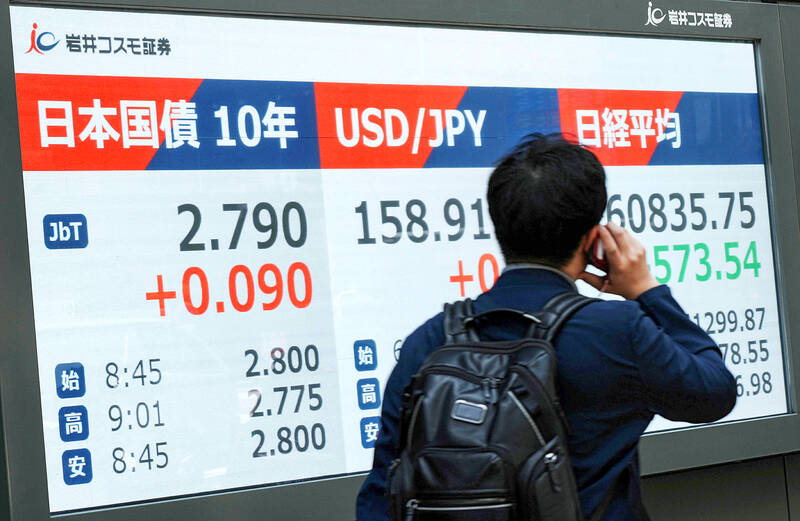
Photo: AFP
“Global yields are rising sharply and there is nothing at the moment to change the market mood from late last week when bonds were sold off on concerns over inflation and fiscal expansion,” Mitsubishi UFJ Morgan Stanley Securities Co senior fixed-income strategist Keisuke Tsuruta said.
Yields on 10-year US Treasuries advanced three basis points to 4.63 percent in Asia yesterday, the highest since February last year. Those on 30-year US bonds have risen above 5 percent and are near their highest since 2007. Australian and New Zealand bond yields advanced, while European bond futures were under pressure.
In stock markets, Asian equities mostly retreated and US stock futures fell yesterday.
Tokyo’s Nikkei 225 fell 1 percent to 60,815.95, a decline led by technology-related stocks, while Seoul’s KOSPI climbed 0.3 percent to 7,516.04 after trading lower earlier in the day.
Hong Kong’s Hang Seng lost 1.4 percent to 25,596.68. The Shanghai Composite index edged 0.1 percent lower to 4,131.53, after China reported weaker-than-expected retail data for last month.
The TAIEX dropped 0.68 percent, while India’s Sensex fell 0.1 percent and Australia’s S&P/ASX 200 declined 1.5 percent.
Oil prices rose after US President Donald Trump warned Tehran in a social media post on Sunday that “The Clock is Ticking, and they better get moving, FAST, or there won’t be anything left of them” following a call with Israeli Prime Minister Benjamin Netanyahu.
Brent crude, the international standard, gained 0.7 percent to US$110.05 per barrel. It was trading at roughly US$70 a barrel in February before the start of the Iran war. Benchmark US crude was trading 1 percent higher to US$106.49 per barrel.
“Re-escalation risks are increasing,” ING Bank NV commodities strategists Warren Patterson and Ewa Manthey wrote in a research note. While there has been a pick up on shipping activities over the past week around the Strait of Hormuz, they said, “this can change quickly.”
The pair said that the oil market was reacting to the lack of visible results on the Iran war after last week’s widely-watched summit between Trump and Chinese President Xi Jinping (習近平) in Beijing.
Taiwan Semiconductor Manufacturing Co (TSMC, 台積電) has approved a capital budget of US$31.28 billion for production expansion to meet long-term development needs during the artificial intelligence (AI) boom. The company’s board meeting yesterday approved the capital appropriation plan for purposes such as the installation of advanced technology capacity and fab construction, the world’s largest contract chipmaker said in a statement. At an earnings conference last month, TSMC forecast that its capital expenditure for this year would be at the higher end of the US$52 billion to US$56 billion range it forecast in January in response to robust demand for 5G, AI and
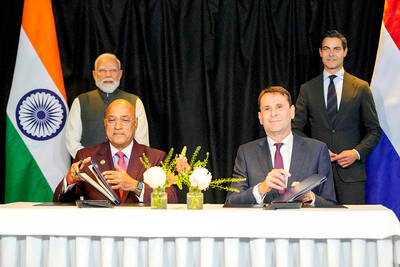
NEW MARKET: The partnership opens up India to the Dutch company, which already has a strong hold in the semiconductor market of South Korea, Taiwan and China ASML Holding NV entered into a partnership agreement with Tata Electronics Pvt Ltd aimed at ramping up India’s goal to develop domestic chip-manufacturing capabilities. The Dutch company’s technology would help power Tata Electronics’ planned 300 millimeter (mm) semiconductor foundry in Gujarat, according to a joint statement from the two companies on Saturday. The signing of a memorandum of understanding coincides with a visit by Indian Prime Minister Narendra Modi to the Netherlands, which is looking to deepen bilateral relations with New Delhi. ASML, whose top customers include Taiwan Semiconductor Manufacturing Co (台積電) and Samsung Electronics Co, makes lithography machines that can print
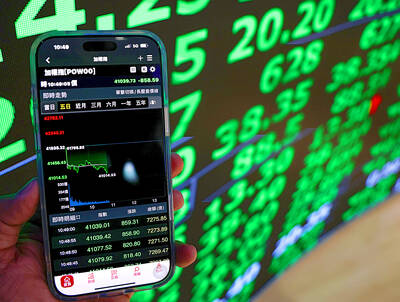
PORTFOLIO REBALANCING: The adjustments in three global equity indices reflect rising investor appetite for semiconductor and artificial intelligence-related stocks Taiwan’s weighting in major global equity indices compiled by MSCI Inc is to rise modestly following the latest quarterly review, underscoring the market’s expanding role in emerging-market portfolios, as global investors continue to favor the nation’s technology sector. Taiwan’s weighting in the MSCI Emerging Markets Index is to increase by 0.30 percentage points to 23.76 percent, after the changes take effect at the close of the May 29 session. Its weighting in the MSCI All-Country Asia ex-Japan Index is to rise 0.37 percentage points to 27.16 percent, while that in the MSCI All Country World Index is to edge up slightly to
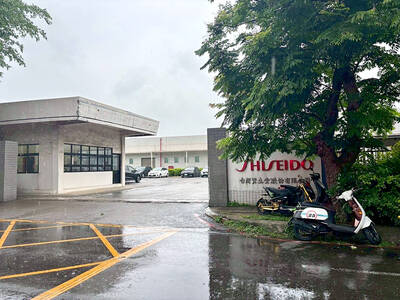
The Hsinchu County Government’s Labor Affairs Department yesterday said that it has received a plan from cosmetics brand Taiwan Shiseido Co (台灣資生堂) detailing mass layoffs at its plant in Hukou Township (湖口). While the labor authorities did not disclose the number of employees to be laid off, Japanese news media earlier in the day reported that the closure of the company’s factory in Hukou would result in 170 employees losing their jobs. Shiseido followed the law by reporting its layoff plan, the department said, adding that authorities would closely monitor negotiations between the management and affected employees and step in if any


 RSS
RSS