


Nanya Technology Corp (南亞科技) yesterday said more customers are tending to secure longer-term, or multiple-year DRAM supply contracts, suggesting the ongoing memory shortage could continue until the end of next year at least.
The company attributed the solid customer demand to explosive growth in artificial intelligence (AI) applications, as more DRAM chips are consumed amid AI’s evolution to offer agentic features.
Last month, four customers signed three-year supply agreements, the longest contracts inked in the past few years, along with subscriptions to Nanya Technology’s new shares via private placements, the company said.
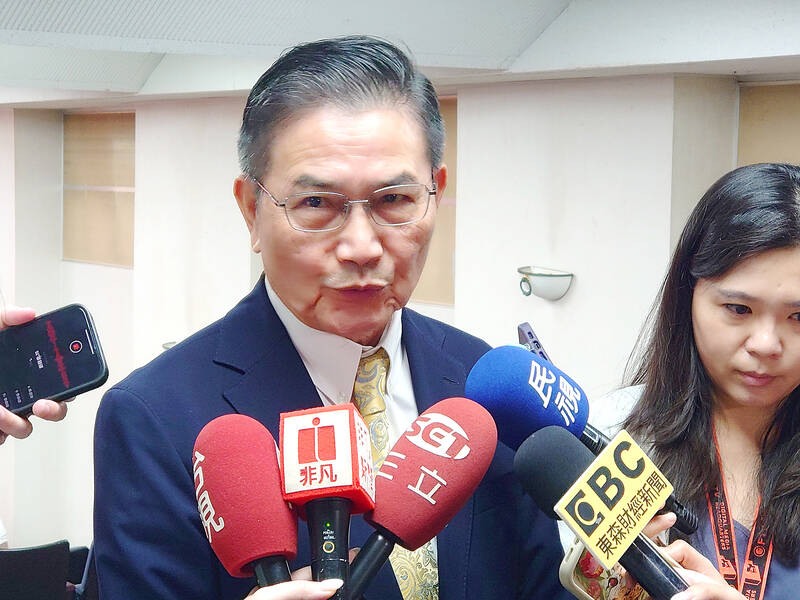
Photo: CNA
Those customers are SK Hynix Inc’s subsidiary Solidigm Inc in South Korea, Kioxia Corp of Japan, Cisco Systems Inc and SanDisk Corp’s subsidiary SanDisk Technologies Inc.
“Many other companies also intend to deepen cooperation with us,” Nanya Technology president Lee Pei-ing (李培瑛) told reporters on the sidelines of the company’s annual general meeting in Taoyuan.
“We basically cannot satisfy customers’ demand,” Lee said. “Such demand should be in place for a long period of time as numerous customers are seeking to sign long-term supply agreements, with most of them carrying more than two-year or three-year terms.”
Nanya Technology raised NT$78.7 billion (US$2.49 billion) through the private placements and plans to use the proceeds to fund the construction of a new plant in New Taipei City’s Taishan District (泰山).
The company is accelerating the plant’s construction and plans to start volume production in the second half of next year, Lee said.
The new plant is expected to expand the company’s capacity by 80 to 100 percent within three years, Lee said.
It would have an installed capacity of 30,000 wafers a month, he said.
Supply of DDR DRAM chips shrank significantly after the world’s major memory makers phased out production of less-advanced DRAM chips last year and allocated more capacity for high-bandwidth memory or advanced DDR5 DRAM chips for AI servers.
Due to the supply crunch in DDR4 and low-power DDR4 DRAM chips, the company expects chip prices to move even higher this quarter, benefiting its revenue outlook, Lee said.
DDR4 DRAM chips account for 60 to 70 percent of Nanya Technology’s revenue, and DDR5 DRAM chips make up 10 percent, the company said.
The company’s revenue last month grew 40 percent to NT$25.49 billion from NT$18.17 billion in the previous month, thanks to a rise in average selling prices, it said.
Shareholders yesterday approved the cash dividend distribution of NT$1.35 per share. That represented a payout ratio of 63.38 percent, based on the company’s earnings per share of NT$2.13 last year.
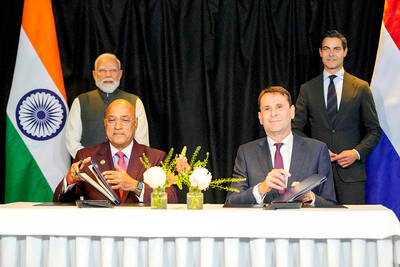
NEW MARKET: The partnership opens up India to the Dutch company, which already has a strong hold in the semiconductor market of South Korea, Taiwan and China ASML Holding NV entered into a partnership agreement with Tata Electronics Pvt Ltd aimed at ramping up India’s goal to develop domestic chip-manufacturing capabilities. The Dutch company’s technology would help power Tata Electronics’ planned 300 millimeter (mm) semiconductor foundry in Gujarat, according to a joint statement from the two companies on Saturday. The signing of a memorandum of understanding coincides with a visit by Indian Prime Minister Narendra Modi to the Netherlands, which is looking to deepen bilateral relations with New Delhi. ASML, whose top customers include Taiwan Semiconductor Manufacturing Co (台積電) and Samsung Electronics Co, makes lithography machines that can print
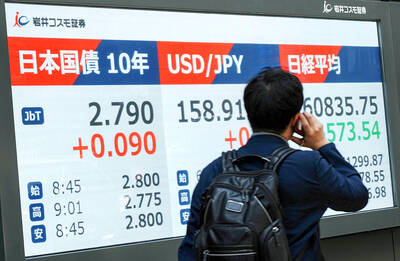
ROUGH RECORDS: Bonds in Japan, as well is in New Zealand, Australia and the US, are seeing the effects of a nervy market as stock exchanges across Asia edge down A deepening slump in Japanese government bonds added fuel to the selloff in global debt markets as rising oil prices stoked inflation fears and pushed yields to multi-decade highs. Japan’s 30-year yield yesterday surged as much as 20 basis points to the highest level since the tenor’s debut in 1999, before paring some of the move. Shorter-maturity Japanese debt was also under pressure, underscored by weak demand at a sale of five-year notes that offered a record-high coupon of 2 percent. Concerns over inflation and government spending rippling through markets including the US, Australia and New Zealand are being amplified in Japan,

Tokyo Electron's Taiwan unit today said in a written response that it respects the judicial process, takes the court ruling seriously and would not appeal in the Taiwan Semiconductor Manufacturing Co (TSMC, 台積電) trade secrets case. Last month, a court fined the Taiwan unit of Japan's Tokyo Electron NT$150 million (US$4.74 million) in a case involving trade secrets related to TSMC's sensitive chip technology.
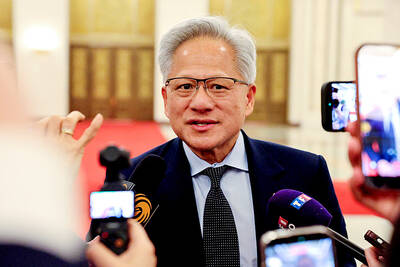
The US has cleared about 10 Chinese firms to buy Nvidia Corp’s second-most powerful artificial intelligence (AI) chip, the H200, but not a single delivery has been made so far, three people familiar with the matter said, leaving a major technology deal in limbo as chief executive officer Jensen Huang (黃仁勳) seeks a breakthrough in China this week. Huang, who was not initially listed in a White House delegation to Beijing, joined the trip after an invitation from US President Donald Trump, a source said. Trump picked him up in Alaska en route to a summit with Chinese President Xi Jinping


 RSS
RSS