


Taiwanese exports’ growth momentum is expected to remain high throughout this year, with full-year outbound shipments surpassing US$800 billion for the first time, despite concerns over global economic disruptions sparked by the US-Iran conflict, credit information agency CRIF Taiwan (中華徵信所) said yesterday.
As the demand for artificial intelligence (AI) applications would continue to underpin outbound shipments of electronic components (particularly semiconductors), information and communications technology (ICT) products, and audiovisual devices, the Middle East war is not expected to affect Taiwan’s export performance this year, CRIF said in a news release.
The agency’s optimism came as Taiwan’s exports set a new record last month at US$80.18 billion, with annual growth of 61.8 percent also far exceeding the market consensus of a 40 percent increase, the Ministry of Finance reported on April 10.
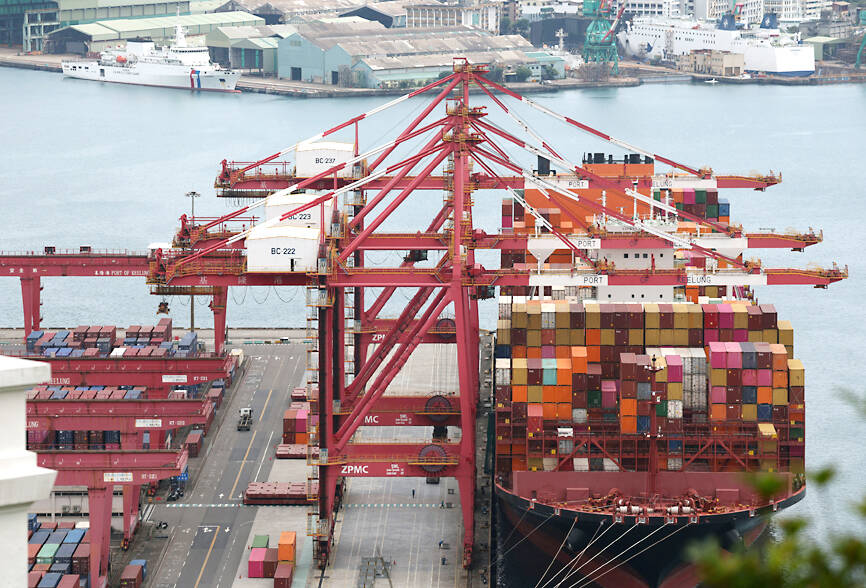
Photo: Edgar Su, Reuters
That brought cumulative exports in the first quarter of this year to US$195.74 billion, a record high and surpassing the government’s estimate by US$44.82 billion.
In addition, the 51.1 percent annual increase in exports during the quarter also dwarfed the 49.6 percent growth registered in the seasonally strong fourth quarter last year, ministry data showed.
The robust performance was supported by exports of electronics components, which rose 42.7 percent from a year earlier to US$65.58 billion in the quarter, and by combined shipments of ICT products and audiovisual devices, which surged 102.1 percent to US$87.95 billion, the data showed.
As the nation’s export structure has shifted toward the AI industry and the Middle East war has a relatively limited impact on AI development, CRIF forecast that Taiwan’s exports would exceed US$200 billion each quarter this year: US$211.3 billion in the second quarter, US$225.7 billion in the third and US$227.9 billion in the fourth.
It also predicted that full-year exports would surge 37.7 percent to US$860.6 billion, far higher than the Directorate-General of Budget, Accounting and Statistics’ estimates of a 6.3 percent increase to US$664.4 billion.
Meanwhile, the agency also projected that the combined revenue of listed companies in the semiconductor, computer and peripheral equipment, electronic components and other electronic products industries would grow 40 to 50 percent this year from last year.
The combined revenue of those companies in the first quarter totaled NT$8.1904 trillion, a 36 percent increase compared with the same period of last year, CRIF said.
As the peak season for the electronics industry has not arrived, and considering firms’ inventory replenishment seen so far, there would be no so-called off-season effect for those companies this quarter, it said, anticipating even stronger market demand in the second half of the year.
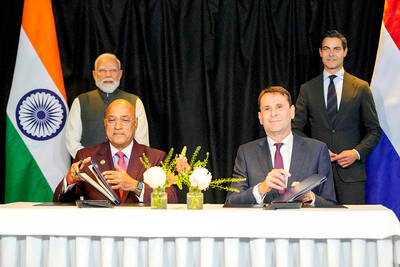
NEW MARKET: The partnership opens up India to the Dutch company, which already has a strong hold in the semiconductor market of South Korea, Taiwan and China ASML Holding NV entered into a partnership agreement with Tata Electronics Pvt Ltd aimed at ramping up India’s goal to develop domestic chip-manufacturing capabilities. The Dutch company’s technology would help power Tata Electronics’ planned 300 millimeter (mm) semiconductor foundry in Gujarat, according to a joint statement from the two companies on Saturday. The signing of a memorandum of understanding coincides with a visit by Indian Prime Minister Narendra Modi to the Netherlands, which is looking to deepen bilateral relations with New Delhi. ASML, whose top customers include Taiwan Semiconductor Manufacturing Co (台積電) and Samsung Electronics Co, makes lithography machines that can print

Tokyo Electron's Taiwan unit today said in a written response that it respects the judicial process, takes the court ruling seriously and would not appeal in the Taiwan Semiconductor Manufacturing Co (TSMC, 台積電) trade secrets case. Last month, a court fined the Taiwan unit of Japan's Tokyo Electron NT$150 million (US$4.74 million) in a case involving trade secrets related to TSMC's sensitive chip technology.
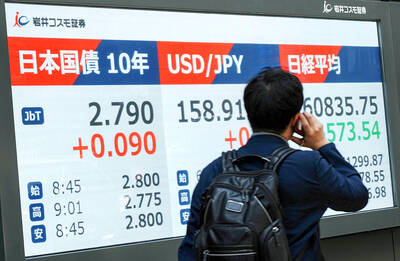
ROUGH RECORDS: Bonds in Japan, as well is in New Zealand, Australia and the US, are seeing the effects of a nervy market as stock exchanges across Asia edge down A deepening slump in Japanese government bonds added fuel to the selloff in global debt markets as rising oil prices stoked inflation fears and pushed yields to multi-decade highs. Japan’s 30-year yield yesterday surged as much as 20 basis points to the highest level since the tenor’s debut in 1999, before paring some of the move. Shorter-maturity Japanese debt was also under pressure, underscored by weak demand at a sale of five-year notes that offered a record-high coupon of 2 percent. Concerns over inflation and government spending rippling through markets including the US, Australia and New Zealand are being amplified in Japan,

Wall Street is licking its chops over an unprecedented slate of massive initial public offerings (IPOs) set to arrive in the coming months, beginning with Elon Musk’s Space Exploration Technologies Corp (SpaceX) next month. That is expected to be followed by artificial intelligence (AI) rivals OpenAI and Anthropic PBC. The trio of mega listings, each eyeing valuations around US$1 trillion or more, constitutes a heady period of elevated risk and reward. SpaceX is targeting an IPO that would raise up to US$80 billion — about double the funds generated from all IPOs last year. OpenAI and Anthropic are eyeing IPOs raising US$60 billion. “We’re


 RSS
RSS