


Two fully laden Chinese oil tankers are waiting near the Strait of Hormuz, putting them in a position to become the first such vessels to leave the Persian Gulf under a days-old US-Iran ceasefire, even as ship owners scrutinize the status of the narrow waterway.
The Cospearl Lake, a very-large crude carrier (VLCC) linked to China’s state-owned Cosco Shipping Corp (中遠海運), and the He Rong Hai, owned by a smaller entity, appeared to be traveling east early yesterday morning at near top speeds, according to ship-tracking data, before coming to a virtual halt. They were signaling Chinese ownership on their tracking systems, a move typically done for safety during Iran-approved transits.
The tankers are part of a growing armada amassing at the entrance to the strait, off the United Arab Emirates. A Saudi Arabian-flagged VLCC, the Jaham, has moved east toward a nearby holding area off Dubai. They join two Indian-flagged, fully-laden supertankers that have been in the area since late last month — the Desh Vibhor, which was off Ras Al Khaimah, and the Desh Vaibhav, which was near Dubai.
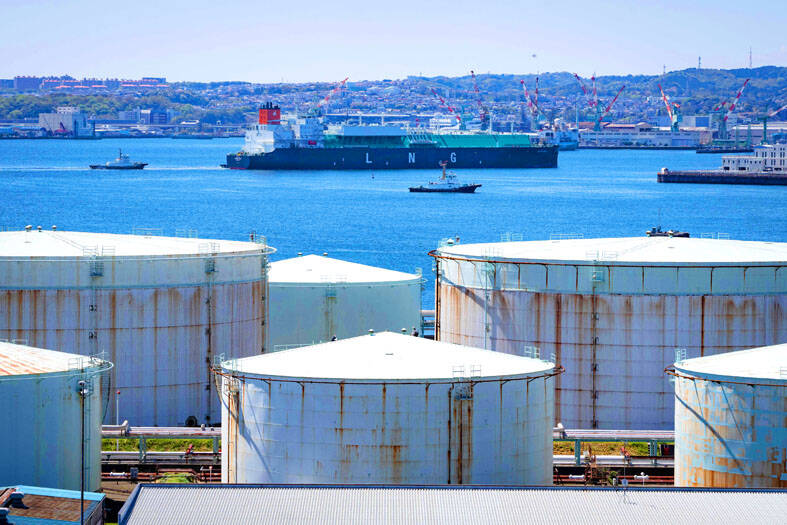
Photo: Yuichi Yamazaki, AFP
Iran and the US agreed to a pause in fighting in exchange for the opening of the strait, but there is still little clarity on details. Continued attacks — including Israeli strikes in Lebanon — have raised questions about the effectiveness of a ceasefire. Since the truce — and supposed opening of the strait — was announced two days ago, there has also been little change in traffic.
Ship owners yesterday said that they were still waiting on details on how safe passage can be carried out.
Iran on Wednesday warned vessels in radio transmissions that transits still required permission from Tehran, while Iranian media have also reported the country has designated routes for vessels to transit Hormuz, with inbound and outbound passages circumventing Larak Island in the strait.
Japan’s Mitsui OSK Lines Ltd (MOL), one of the world’s largest shipping companies, is among the groups trying to understand the fine print and arguing it needs to see “sustainable stability” before sending its vessels through.
“How it is implemented in the water, that is something we really need to understand,” MOL president Jotaro Tamura said.
MOL’s priority is the safety of each ship, he said, adding that the company was working with the Japanese government.
A liquefied natural gas tanker, partly owned by MOL, passed through Hormuz last week, the first time a ship with Japanese ties successfully made it through the waterway since the conflict started.
While some vessels were able to pass through, that is based on the ship’s “individual situation,” Tamura said.
The company needs to see “sustainable stability” in order to continue sending vessels, he added.
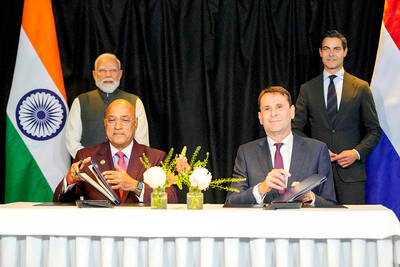
NEW MARKET: The partnership opens up India to the Dutch company, which already has a strong hold in the semiconductor market of South Korea, Taiwan and China ASML Holding NV entered into a partnership agreement with Tata Electronics Pvt Ltd aimed at ramping up India’s goal to develop domestic chip-manufacturing capabilities. The Dutch company’s technology would help power Tata Electronics’ planned 300 millimeter (mm) semiconductor foundry in Gujarat, according to a joint statement from the two companies on Saturday. The signing of a memorandum of understanding coincides with a visit by Indian Prime Minister Narendra Modi to the Netherlands, which is looking to deepen bilateral relations with New Delhi. ASML, whose top customers include Taiwan Semiconductor Manufacturing Co (台積電) and Samsung Electronics Co, makes lithography machines that can print

Tokyo Electron's Taiwan unit today said in a written response that it respects the judicial process, takes the court ruling seriously and would not appeal in the Taiwan Semiconductor Manufacturing Co (TSMC, 台積電) trade secrets case. Last month, a court fined the Taiwan unit of Japan's Tokyo Electron NT$150 million (US$4.74 million) in a case involving trade secrets related to TSMC's sensitive chip technology.
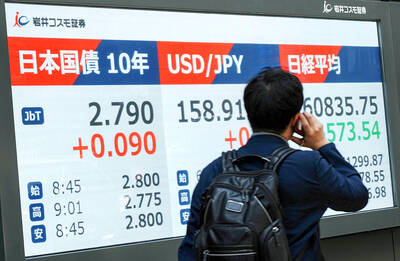
ROUGH RECORDS: Bonds in Japan, as well is in New Zealand, Australia and the US, are seeing the effects of a nervy market as stock exchanges across Asia edge down A deepening slump in Japanese government bonds added fuel to the selloff in global debt markets as rising oil prices stoked inflation fears and pushed yields to multi-decade highs. Japan’s 30-year yield yesterday surged as much as 20 basis points to the highest level since the tenor’s debut in 1999, before paring some of the move. Shorter-maturity Japanese debt was also under pressure, underscored by weak demand at a sale of five-year notes that offered a record-high coupon of 2 percent. Concerns over inflation and government spending rippling through markets including the US, Australia and New Zealand are being amplified in Japan,

Wall Street is licking its chops over an unprecedented slate of massive initial public offerings (IPOs) set to arrive in the coming months, beginning with Elon Musk’s Space Exploration Technologies Corp (SpaceX) next month. That is expected to be followed by artificial intelligence (AI) rivals OpenAI and Anthropic PBC. The trio of mega listings, each eyeing valuations around US$1 trillion or more, constitutes a heady period of elevated risk and reward. SpaceX is targeting an IPO that would raise up to US$80 billion — about double the funds generated from all IPOs last year. OpenAI and Anthropic are eyeing IPOs raising US$60 billion. “We’re


 RSS
RSS