


Taiwanese shares have outperformed their South Korean peers by the widest margin since 2009, underscoring their relative resilience as the Middle East tensions roil markets.
Last month, Taiwan’s benchmark TAIEX fell 10 percent, while South Korea’s KOSPI gauge plunged 19 percent. Taiwan’s largest equity exchange-traded fund was set for record inflows in the month as domestic investors piled into the technology-heavy product.
The more modest decline in Taiwanese shares also reflects their smaller gains of about 22 percent from the beginning of the year up to the start of the Iran conflict, compared with a 48 percent rally in South Korean stocks that made them the world’s best performers at the time.
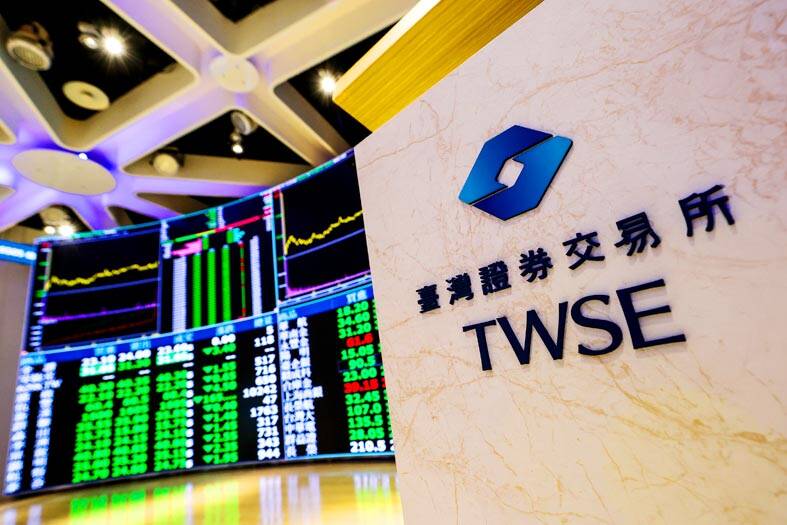
Photo: Ritchie B. Tongo, EPA
Investors remain broadly constructive on Taiwan given its key role in the global semiconductor supply chain. HSBC Holdings PLC upgraded the Taiwanese stocks to neutral to increase its exposure to the artificial intelligence (AI) theme in Asia.
“We prefer Taiwan over Korea as our primary AI-related equity exposure in the region,” with earnings expectations still among the strongest in Asia, HSBC strategists including Herald van der Linde wrote in a note yesterday. On the other hand, highly concentrated holdings in South Korea by global emerging market funds risks more outflows, he said.
Asian stocks were mostly lower on the final day of last month and first quarter yesterday as investors weighed a report indicating US President Donald Trump was willing to end the Iran war even if the key Strait of Hormuz remained closed but also threatened to strike its energy infrastructure if it did not make a deal.
Seoul led losses by shedding 4.3 percent and Taipei fell 2.45 percent. Tokyo, Shanghai, Singapore, Bangkok and Jakarta were also down.
The KOSPI extended its decline from a record high in late February to nearly 20 percent, the threshold typically considered a bear market. Samsung Electronics Co and SK Hynix Inc, the country’s two most valuable stocks, were the biggest drags, dropping more than 5 percent each.
South Korean equities were among the hardest hit in the month as fears of quicker inflation and higher interest rates led to doubts about the durability of the AI boom.
“Everyone’s attention is stuck on this war in the Middle East,” Reed Capital Partners Pte Ltd chief investment officer Gerald Gan (顏傑瑞) said in Singapore. “As long as there are no meaningful signs of both sides wanting to back down, more weakness will be reflected in the equity market, and that includes the big tech names in the KOSPI.”
Beyond geopolitics, investor unease has been compounded by Google’s new technology, which the company said can sharply reduce the amount of memory needed to train large language models — a development that may erode the pricing power of South Korean chipmakers if hyperscalers require fewer high-end components. Samsung Electronics and SK Hynix have seen multi-day selloffs.
“Investors are also worried about how the recent developments in Google’s TurboQuant could affect demand for memory chips, a core product of South Korea’s semiconductor industry,” Natixis SA senior economist Gary Ng (吳卓殷) said. “Investors can only ride the volatility until things become more certain.”
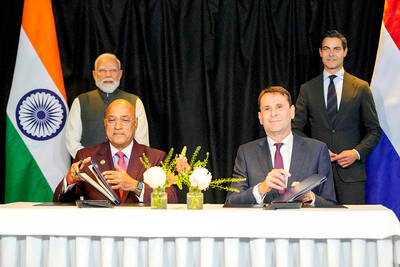
NEW MARKET: The partnership opens up India to the Dutch company, which already has a strong hold in the semiconductor market of South Korea, Taiwan and China ASML Holding NV entered into a partnership agreement with Tata Electronics Pvt Ltd aimed at ramping up India’s goal to develop domestic chip-manufacturing capabilities. The Dutch company’s technology would help power Tata Electronics’ planned 300 millimeter (mm) semiconductor foundry in Gujarat, according to a joint statement from the two companies on Saturday. The signing of a memorandum of understanding coincides with a visit by Indian Prime Minister Narendra Modi to the Netherlands, which is looking to deepen bilateral relations with New Delhi. ASML, whose top customers include Taiwan Semiconductor Manufacturing Co (台積電) and Samsung Electronics Co, makes lithography machines that can print
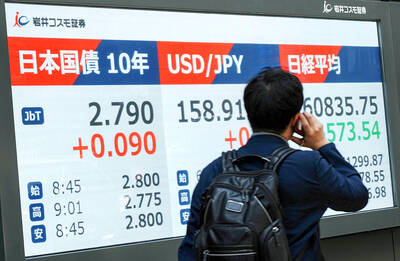
ROUGH RECORDS: Bonds in Japan, as well is in New Zealand, Australia and the US, are seeing the effects of a nervy market as stock exchanges across Asia edge down A deepening slump in Japanese government bonds added fuel to the selloff in global debt markets as rising oil prices stoked inflation fears and pushed yields to multi-decade highs. Japan’s 30-year yield yesterday surged as much as 20 basis points to the highest level since the tenor’s debut in 1999, before paring some of the move. Shorter-maturity Japanese debt was also under pressure, underscored by weak demand at a sale of five-year notes that offered a record-high coupon of 2 percent. Concerns over inflation and government spending rippling through markets including the US, Australia and New Zealand are being amplified in Japan,
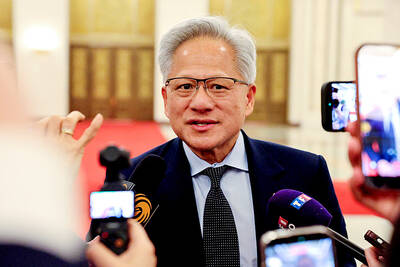
The US has cleared about 10 Chinese firms to buy Nvidia Corp’s second-most powerful artificial intelligence (AI) chip, the H200, but not a single delivery has been made so far, three people familiar with the matter said, leaving a major technology deal in limbo as chief executive officer Jensen Huang (黃仁勳) seeks a breakthrough in China this week. Huang, who was not initially listed in a White House delegation to Beijing, joined the trip after an invitation from US President Donald Trump, a source said. Trump picked him up in Alaska en route to a summit with Chinese President Xi Jinping
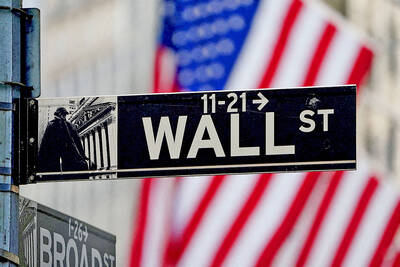
Wall Street is licking its chops over an unprecedented slate of massive initial public offerings (IPOs) set to arrive in the coming months, beginning with Elon Musk’s Space Exploration Technologies Corp (SpaceX) next month. That is expected to be followed by artificial intelligence (AI) rivals OpenAI and Anthropic PBC. The trio of mega listings, each eyeing valuations around US$1 trillion or more, constitutes a heady period of elevated risk and reward. SpaceX is targeting an IPO that would raise up to US$80 billion — about double the funds generated from all IPOs last year. OpenAI and Anthropic are eyeing IPOs raising US$60 billion. “We’re


 RSS
RSS