


Industrial computer maker Ennoconn Corp (樺漢科技) yesterday said it expects first-quarter revenue to remain flat from NT$34.47 billion (US$1.08 billion) a year earlier, as geopolitical uncertainties, sharp fluctuations in memory supply and prices are likely to defer some orders to the second and third quarters.
The company’s operations are expected to normalize next quarter, driven by North America and artificial intelligence (AI) infrastructure demand, Ennoconn chairman Steve Chu (朱復銓) said at an earnings conference in Taipei.
Additional momentum is to come from cybersecurity, AI cloud-edge integration and US semiconductor fab projects, as the second-phase expansion of Taiwan Semiconductor Manufacturing Co’s (台積電) US fabs is expected to begin contributing revenue through Ennoconn’s 47 percent-held subsidiary, Marketech International Corp (帆宣), in the second half of the year, Chu said.
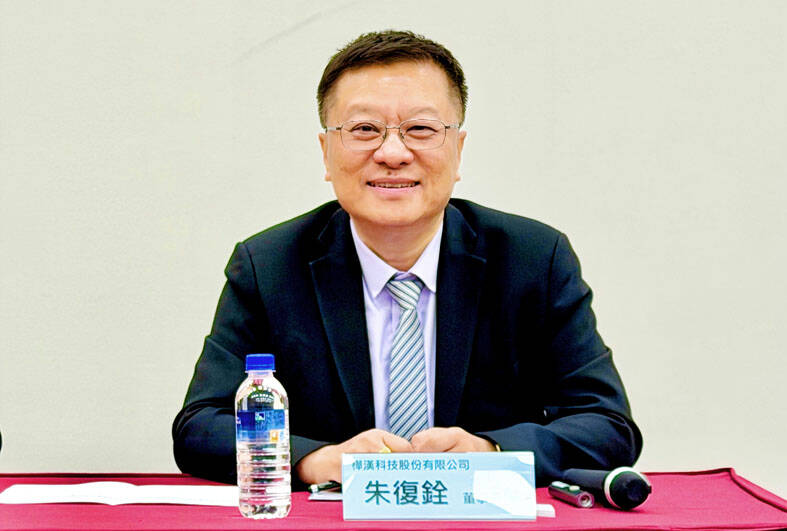
Photo: Huang Wei-chieh, Taipei Times
Ennoconn’s business is divided into three main segments: industrial Internet of Things, which accounted for 48 percent of total revenue last year; intelligent software and solutions (16 percent), and smart factory and facility management (36 percent).
Performance in the second half of the year is expected to outpace the first half, supported by a growing contribution from the intelligent software and solutions business, of which share rose to 16 percent last year from 12 percent in 2024, he said.
The intelligent software and solutions segment includes AI applications such as edge servers, agents and physical AI, and spans sectors from defense, transportation, retail to construction, he added.
Ennoconn recorded net profit of NT$3.21 billion last year, up 17.26 percent year-on-year and the second-highest on record, with earnings per share of NT$23.26. Full-year revenue was NT$142.29 billion, down 2.8 from a year earlier, company data showed.
Profit and revenue are expected to grow further this year, supported by strong and stable client demand, and more than NT$190 billion in orders, mainly driven by growth in the company’s intelligent software and solutions business, Chu said.
Orders from NCR Voyix Corp — a provider of retail, restaurant and digital commerce products— are expected to contribute about NT$12 billion in revenue this year, he said.
AI software, cloud-edge integration and increasing orders from North American clients are key to the company’s future growth, he said.
Ennoconn has about NT$20 billion in orders involving memory components, he said.
The company has secured supply in advance to ensure stable operations this year, he said.
To mitigate rising memory prices, the company has established cost pass-through mechanisms with clients, allowing price increases to be reflected in contracts or enabling customers to procure memory directly, Chu said.
Ennoconn has built a global supply chain network spanning the Americas, Europe and Asia, and has established a secondary operations hub in Singapore, allowing it to mitigate geopolitical and tariff-related risks, he added.
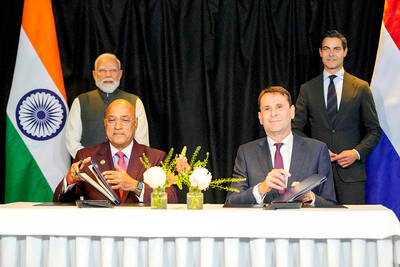
NEW MARKET: The partnership opens up India to the Dutch company, which already has a strong hold in the semiconductor market of South Korea, Taiwan and China ASML Holding NV entered into a partnership agreement with Tata Electronics Pvt Ltd aimed at ramping up India’s goal to develop domestic chip-manufacturing capabilities. The Dutch company’s technology would help power Tata Electronics’ planned 300 millimeter (mm) semiconductor foundry in Gujarat, according to a joint statement from the two companies on Saturday. The signing of a memorandum of understanding coincides with a visit by Indian Prime Minister Narendra Modi to the Netherlands, which is looking to deepen bilateral relations with New Delhi. ASML, whose top customers include Taiwan Semiconductor Manufacturing Co (台積電) and Samsung Electronics Co, makes lithography machines that can print
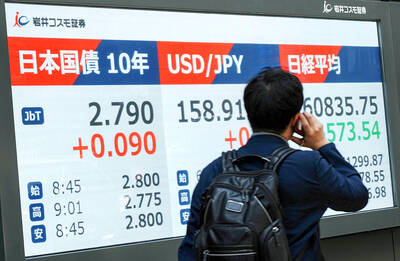
ROUGH RECORDS: Bonds in Japan, as well is in New Zealand, Australia and the US, are seeing the effects of a nervy market as stock exchanges across Asia edge down A deepening slump in Japanese government bonds added fuel to the selloff in global debt markets as rising oil prices stoked inflation fears and pushed yields to multi-decade highs. Japan’s 30-year yield yesterday surged as much as 20 basis points to the highest level since the tenor’s debut in 1999, before paring some of the move. Shorter-maturity Japanese debt was also under pressure, underscored by weak demand at a sale of five-year notes that offered a record-high coupon of 2 percent. Concerns over inflation and government spending rippling through markets including the US, Australia and New Zealand are being amplified in Japan,
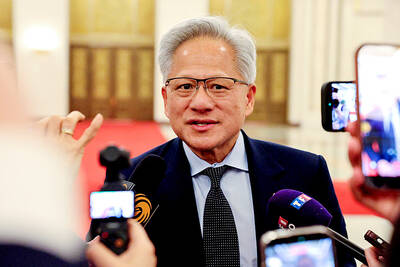
The US has cleared about 10 Chinese firms to buy Nvidia Corp’s second-most powerful artificial intelligence (AI) chip, the H200, but not a single delivery has been made so far, three people familiar with the matter said, leaving a major technology deal in limbo as chief executive officer Jensen Huang (黃仁勳) seeks a breakthrough in China this week. Huang, who was not initially listed in a White House delegation to Beijing, joined the trip after an invitation from US President Donald Trump, a source said. Trump picked him up in Alaska en route to a summit with Chinese President Xi Jinping

Wall Street is licking its chops over an unprecedented slate of massive initial public offerings (IPOs) set to arrive in the coming months, beginning with Elon Musk’s Space Exploration Technologies Corp (SpaceX) next month. That is expected to be followed by artificial intelligence (AI) rivals OpenAI and Anthropic PBC. The trio of mega listings, each eyeing valuations around US$1 trillion or more, constitutes a heady period of elevated risk and reward. SpaceX is targeting an IPO that would raise up to US$80 billion — about double the funds generated from all IPOs last year. OpenAI and Anthropic are eyeing IPOs raising US$60 billion. “We’re


 RSS
RSS