


Three Australian plants that provide about 8 percent of the world’s liquefied natural gas (LNG) have had their output curbed by a cyclone, in a further blow to mainly Asian buyers reeling from the halt of shipments from Qatar.
Karratha, the onshore processing facility that feeds Woodside Energy Group’s North West Shelf export plant in Western Australia, had a production interruption due to severe Tropical Cyclone Narelle, a company spokesperson said.
Meanwhile, Chevron Corp said one of the three production units at its Gorgon plant was stopped, as well as a platform that feeds its Wheatstone facility and domestic gas production.
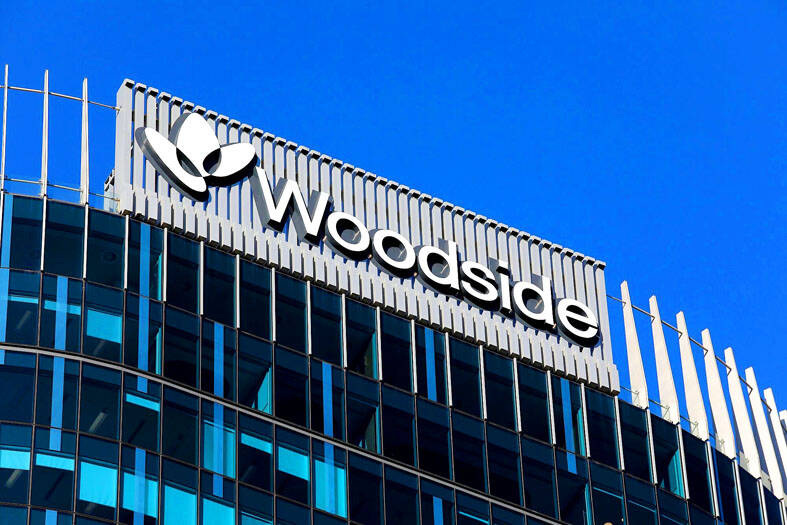
Photo: Bloomberg
The disruptions come at a precarious time in the global LNG market after the closure of the Strait of Hormuz and the halting of the world’s largest liquefaction plant in Qatar following attacks by Iran. Most of that supply went to buyers in Asia, who have been looking to offset the shortfalls and are also the most impacted by disruptions from Australia.
“Temporary shut-ins at Australian LNG plants come at the worst time for LNG buyers looking to replace supply from Qatar,” Institute for Energy, Economics and Financial Analysis lead analyst Josh Runciman said. “LNG spot prices are likely to increase on the back of the shut-ins, leading to further pain for buyers.”
LNG prices in Asia have risen more than 90 percent since the US and Israel first struck Iran at the end of last month. Gorgon, Wheatstone and North West Shelf accounted for almost half of Australia’s exports last month, or about 8.4 percent of global trade, according to advisory EnergyQuest.
North West Shelf’s offshore workforce was evacuated in line with cyclone preparation arrangements and production is expected to recommence after they return, the company’s spokesperson said. Output continues at the Macedon and Pluto facilities, and Woodside is continuing to supply domestic gas to its customers from its Western Australian portfolio, they said.
“Severe weather associated with the passing of Tropical Cyclone Narelle likely caused the interruptions to both Gorgon and Wheatstone operations,” the Chevron Australia spokesperson said in a statement. The Wheatstone outage occurred at 12pm local time on Thursday, while the Gorgon outage was at 3 pm local time, they said.
Meanwhile, a spokesperson for Santos Ltd said its Varanus Island gas processing facility off the Western Australia coast also “tripped” as Cyclone Narelle passed over the region. Varanus supplies major mining and industrial customers in Western Australia.
Narelle has had a long track from Queensland, over the Northern Territory, and then across Western Australia, forcing the temporary closure of mines. Cyclone Narelle is a category four storm, with wind gusts of 250 kilometers per hour, Australia’s Bureau of Meteorology said.
Weather models have shown Narelle shifting slightly more to the east as it travels down the coast, bringing the storm closer to the Chevron and Woodside LNG facilities and exposing them to more severe impacts, MetraWeather business manager for Australia Alex Zadnik said.
The system is expected to continue bringing destructive gusts and heavy rains in its wake. Precipitation over the state’s southwest, known as the Wheatbelt, could be beneficial for the planting season.

Taiwanese firms have increased investment in the Philippines in recent years as Manila’s ties with Washington deepen and global supply chains continue to shift away from China, an expert at the Chung-Hua Institution for Economic Research (CIER, 中華經濟研究院) said yesterday. The Philippines had not been among Taiwanese investors’ top choices in Southeast Asia, CIER Taiwan ASEAN Studies Center director Kristy Hsu (徐遵慈) said at a seminar in Taipei. However, Taiwan’s investment in the country has grown significantly since the COVID-19 pandemic, reaching US $257 million last year, a high in recent years, she said. Although Taiwan’s total investment in the Philippines still lags

Intel Corp regards Taiwan Semiconductor Manufacturing Co (TSMC, 台積電) as a longstanding partner, as the US chipmaker would continue outsourcing production of advanced chips to TSMC, Intel chief executive officer Lip-Bu Tan (陳立武) said yesterday. “I don’t look at people as competitors. I look at the collaboration... Nvidia is also, you know, a good friend,” Tan told a news conference following his keynote speech at the Computex trade show in Taipei. “It’s a very trusted partnership for us... We are a big, top customer for them, and we’re going to continue doing that,” he said, referring to TSMC, the world’s largest foundry

Hon Hai Precision Industry Co (鴻海精密) yesterday said it would work with US chipmaker Intel Corp to jointly develop and deploy next-generation artificial intelligence (AI) infrastructure and intelligent computing platforms in a move to capture booming demand for AI computing systems. Hon Hai, also known as Foxconn Technology Group (富士康), said in a statement that the partnership would combine its global manufacturing scale, system integration expertise and AI data center deployment capabilities with Intel’s strengths in processor architecture, silicon technologies and software ecosystem. The companies said they plan to work on equipment used in AI data centers, including server racks powered by

Artificial intelligence (AI) agents would supplant smartphones as the center of people’s digital lives, fundamentally reshaping personal devices and driving a major computing upgrade cycle, Qualcomm Inc CEO Cristiano Amon said yesterday. In his keynote speech for this year’s Computex trade show in Taipei, Amon said that the rise of "agentic AI" — AI systems capable of reasoning, planning and carrying out tasks autonomously — would transform how people interact with technology across phones, PCs, vehicles and wearable devices. Describing the technology as the next major evolution in computing, Amon said that "2026 is the year of agents.” For decades, smartphones have sat


 RSS
RSS