


Airline passengers should brace for more irritation in the next few months as carriers worldwide cancel flights and ground planes to cope with stratospheric increases in jet-fuel prices.
Dutch flag carrier KLM is the latest company to cut its schedule, saying on Thursday that it would scrap 80 return flights at Amsterdam’s Schiphol Airport in the coming month. That puts it in the same league as United Airlines Holdings Inc, Deutsche Lufthansa AG and Cathay Pacific Airways Ltd, which have all pruned itineraries to mitigate costs.
Global capacity for next month has been reduced by about 3 percentage points, with all but one of the 20 largest airlines slashing flights, according to data compiled by analytics firm Cirium Ltd. It is revising an initial prediction of 4-6 percent growth for the year and says a decline of as much as 3 percent is possible.
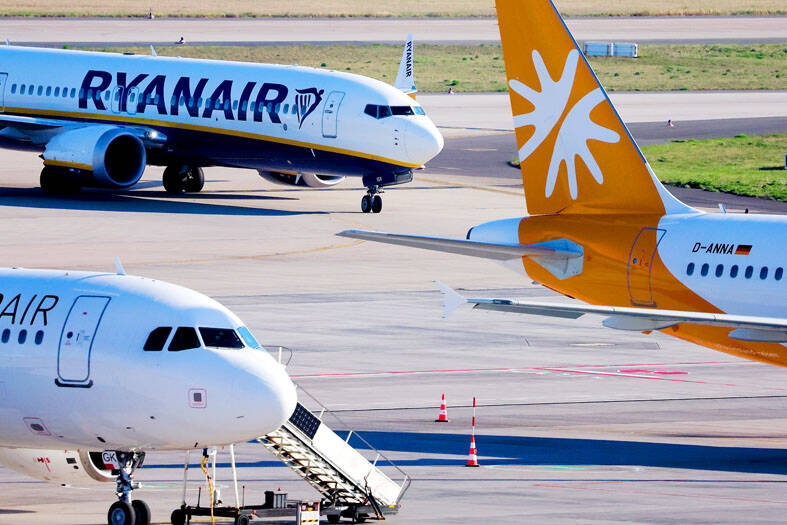
Photo: EPA
“It appears extremely likely that more reductions are ahead,” Cirium senior consultant Richard Evans wrote in a report released on Thursday.
The disruptions roiling the aviation industry after the US-Israeli war on Iran started were initially limited to Middle Eastern airlines, their airports and airspace. The turbulence has spread worldwide and threatens to upend the lucrative summer travel season globally. With the US naval blockade of the Strait of Hormuz cutting off Iranian oil shipments, there is no immediate end in sight.
Lufthansa, Europe’s biggest airline, took drastic measures this past week as it shut down the CityLine unit, withdrawing 27 planes from service and trimmed capacity across the rest of its network by grounding older, fuel-guzzling widebody jets.
“The package to accelerate fleet and capacity measures is unavoidable given the sharp rise in jet fuel costs and ongoing geopolitical instability,” Lufthansa chief financial officer Till Streichert said on Thursday.
Air Canada on Friday announced that it has canceled services from Montreal and Toronto to New York’s John F. Kennedy airport, although it would continue to serve Newark and La Guardia.
Norse Atlantic ASA, a Norwegian budget airline, halted all flights to and from Los Angeles. Virgin Atlantic Airways Ltd scrapped its London-to-Riyadh service after just one year in operation, and British Airways PLC dropped its Jeddah route.
Qantas Airways Ltd is reducing its flights to the US and is cutting domestic flight capacity by about 5 percent as it estimates an extra A$800 million (US$575 million) on its fuel bill in the second half of its fiscal year.
Cathay Pacific is cutting 2 percent of flight frequencies across the Asia-Pacific region from midway through next month to the end of June. Its money-losing budget unit, Hong Kong Express Airways Ltd, is implementing a steeper 6 percent pullback.
The cuts come after fuel levies of as much as US$400 were imposed on long-haul, round-trip services.
“We have pursued every suitable means to keep our flights operating as normal,” Cathay chief customer and commercial officer Lavinia Lau (劉凱詩) said in a statement on April 11. “However, these measures have not been enough to mitigate the significantly increased fuel costs.”
Many European airlines are well-hedged on fuel at least for the coming months, while most US airlines — the biggest carriers in the world by capacity — do not hedge and wind up facing the biggest bills.
United Airlines was among the earliest to earmark cuts, shaving 5 percent of capacity this year, with reductions through September. Delta Air Lines Inc is coping with its higher fuel bill by pushing through price hikes and making capacity reductions reaching about 3.5 percent.
“Any flying that we’re doing that’s on the margin, maybe not producing the yields we’d like, is likely going to be reconsidered,” Delta chief executive officer Ed Bastian said while announcing an extra US$2.5 billion in fuel costs this quarter. “This is going to be a test for the industry.”
Chinese airlines, which also lack fuel-hedging protection, are stepping up daily flight cancellations, according to a Bloomberg News analysis of data from Chinese provider DAST.
Compounding the challenge are concerns about whether there is even enough jet fuel to go around. The International Energy Agency says Europe has “maybe six weeks” of supplies left. The EU said it might face supply issues for jet fuel “in the near future.” The bloc is preparing a joint action plan in case the situation in the Strait of Hormuz persists, a spokesperson said on Friday in Brussels.


Taiwanese firms have increased investment in the Philippines in recent years as Manila’s ties with Washington deepen and global supply chains continue to shift away from China, an expert at the Chung-Hua Institution for Economic Research (CIER, 中華經濟研究院) said yesterday. The Philippines had not been among Taiwanese investors’ top choices in Southeast Asia, CIER Taiwan ASEAN Studies Center director Kristy Hsu (徐遵慈) said at a seminar in Taipei. However, Taiwan’s investment in the country has grown significantly since the COVID-19 pandemic, reaching US $257 million last year, a high in recent years, she said. Although Taiwan’s total investment in the Philippines still lags

Intel Corp regards Taiwan Semiconductor Manufacturing Co (TSMC, 台積電) as a longstanding partner, as the US chipmaker would continue outsourcing production of advanced chips to TSMC, Intel chief executive officer Lip-Bu Tan (陳立武) said yesterday. “I don’t look at people as competitors. I look at the collaboration... Nvidia is also, you know, a good friend,” Tan told a news conference following his keynote speech at the Computex trade show in Taipei. “It’s a very trusted partnership for us... We are a big, top customer for them, and we’re going to continue doing that,” he said, referring to TSMC, the world’s largest foundry

Hon Hai Precision Industry Co (鴻海精密) yesterday said it would work with US chipmaker Intel Corp to jointly develop and deploy next-generation artificial intelligence (AI) infrastructure and intelligent computing platforms in a move to capture booming demand for AI computing systems. Hon Hai, also known as Foxconn Technology Group (富士康), said in a statement that the partnership would combine its global manufacturing scale, system integration expertise and AI data center deployment capabilities with Intel’s strengths in processor architecture, silicon technologies and software ecosystem. The companies said they plan to work on equipment used in AI data centers, including server racks powered by

Artificial intelligence (AI) agents would supplant smartphones as the center of people’s digital lives, fundamentally reshaping personal devices and driving a major computing upgrade cycle, Qualcomm Inc CEO Cristiano Amon said yesterday. In his keynote speech for this year’s Computex trade show in Taipei, Amon said that the rise of "agentic AI" — AI systems capable of reasoning, planning and carrying out tasks autonomously — would transform how people interact with technology across phones, PCs, vehicles and wearable devices. Describing the technology as the next major evolution in computing, Amon said that "2026 is the year of agents.” For decades, smartphones have sat


 RSS
RSS