


Elon Musk’s lieutenants have reached out to chip industry suppliers, including Applied Materials Inc, Tokyo Electron Ltd and Lam Research Corp, for his envisioned Terafab, early steps in an audacious and likely arduous attempt to break into the production of cutting-edge chips.
Staff working for the joint venture between Tesla Inc and Space Exploration Technologies Corp (SpaceX) have sought price quotes and delivery times for an array of chipmaking gear, people familiar with the matter said. In past weeks, they’ve contacted makers of photomasks, substrates, etchers, depositors, cleaning devices, testers and other tools, according to the people, who asked not to be named.
The Terafab team also asked chip manufacturing partner Samsung Electronics Co for support. The South Korean company instead proposed allocating more capacity for Tesla at its planned factory in Taylor, Texas, according to the people.
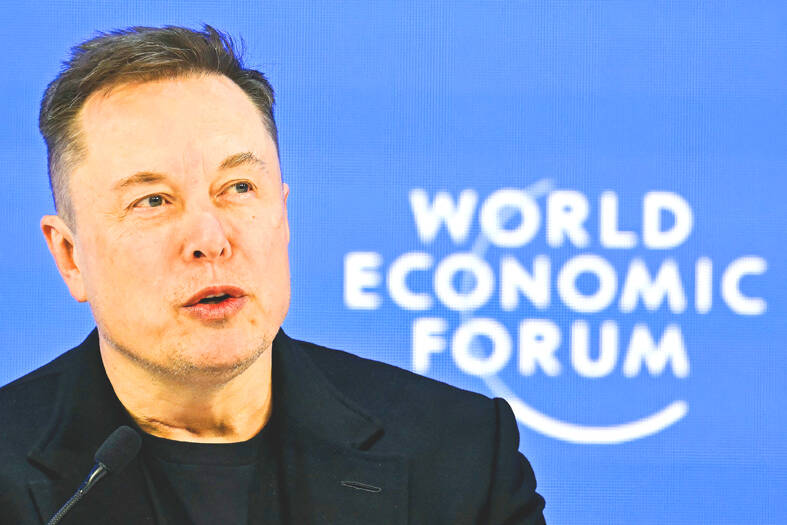
Photo: Fabrice Coffrini, AFP
The outreach suggests Musk is pressing ahead with Terafab in the face of skepticism from the semiconductor industry. The project, as envisioned, aims to reshape the chipmaking landscape and propel the world’s richest person into an arena dominated by Taiwan Semiconductor Manufacturing Co (TSMC, 台積電). Intel Corp said it will join the Terafab initiative, with chief executive officer Lip-Bu Tan (陳立武) posting a photo of Musk on a recent visit to the chipmaker’s Santa Clara office.
In addition to the US chipmaker’s expertise, Musk has been recruiting people with knowledge of many different facets of chip plant operations, from chip design to power management, construction and procurement. In the manufacturing sphere, offers have been made to engineers at companies including Applied Materials, Samsung and TSMC, the people said.
Musk’s representatives have asked equipment suppliers for speedy price estimates while providing minimal information about the products to be made. In one case, they asked a supplier on a holiday on Friday for an estimate to be delivered the following Monday, one of the people said. Musk wants to move at “light speed,” the person was told.
The Terafab project — which has a mind-boggling goal to supply 1 terawatt of annual computing capacity — is the latest ambitious undertaking by Musk. While Tesla designs its own autopilot FSD chips, Musk’s companies have never manufactured semiconductors. Yet he’s now proposing to make them at a scale that would dwarf the world’s current capacity, starting with a pilot line in Austin that taps Tesla’s existing electric vehicle (EV) factory and infrastructure.
The idea is that the chips would be used to support Musk’s artificial intelligence (AI) business xAI, a line of humanoid robots and data centers in space — ambitions that many in the semiconductor industry don’t take seriously. The ultimate scale of the project, and whether it expands into a single mega site or multiple locations beyond Texas remains unclear.
The project is offering to pay a considerable amount above the quoted figures if suppliers give Terafab priority, according to the people. No fixed orders have been placed as it’s not clear what technology will be used or where the chips will be made, but the first step will be construction of a pilot line to process 3,000 wafers per month, the people said. The goal is to begin silicon manufacturing by 2029 and then scale up, one of the people said.
The project would require something like US$5 trillion to US$13 trillion in capital spending, according to estimates from Bernstein analysts.
Musk in March outlined plans for the massive operation to build cutting-edge semiconductors for AI, robotics and space forays. In so doing, he would take on the best chip manufacturer in the world — TSMC. Such an endeavor will involve hundreds of steps that intersect multiple engineering fields, with collaboration from companies ranging from suppliers of industrial gases to testing equipment.
TSMC chief executive officer C.C. Wei (魏哲家) had a message for Musk during an earnings call yesterday. “It takes two to three years to build a new plant — no shortcut — and it takes another one or two years to ramp it up,” he said. “There are no shortcuts.”
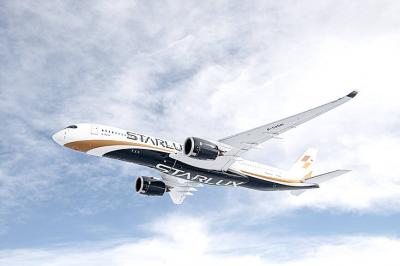
Starlux Airlines Co (星宇航空) today unveiled a long-haul network expansion plan at a shareholders’ meeting in Taipei, including direct flights to Barcelona, Spain, and Zurich, Switzerland, as well as a service connecting Taipei, Sydney and New Zealand. Starlux is to become the first Taiwanese carrier to offer non-stop services to the two European cities, while the inaugural oceanic route is expected to expand transit opportunities within the Australia-New Zealand market, Starlux said. Flight services to Chicago, Dallas, Washington and New York are under evaluation, the airline added. Prior to the shareholders’ meeting, the airline earlier this year announced that it would be
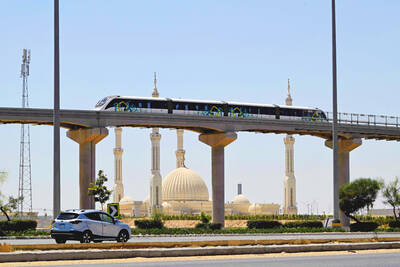
Cairo’s new monorail slices across the city skyline, running above the familiar chaos of blaring horns and aging buses’ exhaust fumes that mark rush hour below. The US$4.5 billion monorail, opened this month, is among Egypt’s most prominent new transport projects, part of a debt-funded infrastructure drive criticized for sapping state finances while bringing limited benefits to most of the country’s 109 million people. “It feels like you’re in a different country,” said Ramy Sayed, a restaurant manager, aboard a driverless Innovia 300 train. “No noise, no traffic, we’re not used to this.” The eastern line runs 56km from the bustling middle-class
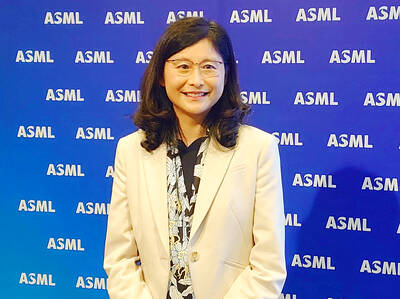
Netherlands-based semiconductor equipment supplier ASML Holding NV yesterday said that it is planning to hire an additional 1,000 people in Taiwan this year in response to growing demand from clients. ASML had previously planned to recruit 600 people this year, but that the plan has been adjusted upward, ASML vice president and ASML Taiwan general manager Grace Wang (汪佳慧) told reporters. ASML has a workforce of more than 4,500 in Taiwan, accounting for about 10 percent of its global total, Wang said. This year’s recruitment campaign would focus on adding people in the customer support, manufacturing and supply chain domains to assist ASML
Nvidia Corp yesterday announced that CEO Jensen Huang (黃仁勳) would attend an employee meeting in Taipei tomorrow to celebrate the launch of the company’s Taiwan headquarters project. Huang would attend a gathering at the site of Nvidia’s planned headquarters in Beitou Shilin Technology Park (北投士林科技園區), the company said in a statement. After arriving in Taiwan on Saturday last week, Huang told reporters that he plans to meet with Quanta Computer Inc (廣達) chairman Barry Lam (林百里) and Taiwan Semiconductor Manufacturing Co (TSMC, 台積電) chairman C.C. Wei (魏哲家), and would attend the groundbreaking ceremony for Nvidia’s Taiwan headquarters tomorrow. Nvidia has not yet applied


 RSS
RSS