


Hon Hai Precision Industry Co (鴻海精密), which assembles server racks for Nvidia Corp and iPhones for Apple Inc, yesterday said it aims to grow revenue by a double-digit percentage this year, thanks to a boom in artificial intelligence (AI)-related devices and a pickup in consumer electronics demand.
If there are no major external disruptions, this year should be “quite a good year,” supported by better-than-expected demand for consumer electronics and continued expansion in AI infrastructure investment, Hon Hai chairman Young Liu (劉揚偉) told reporters.
Demand for smartphones and other end devices remains stable, and the broader industry outlook should continue to improve, Liu said.
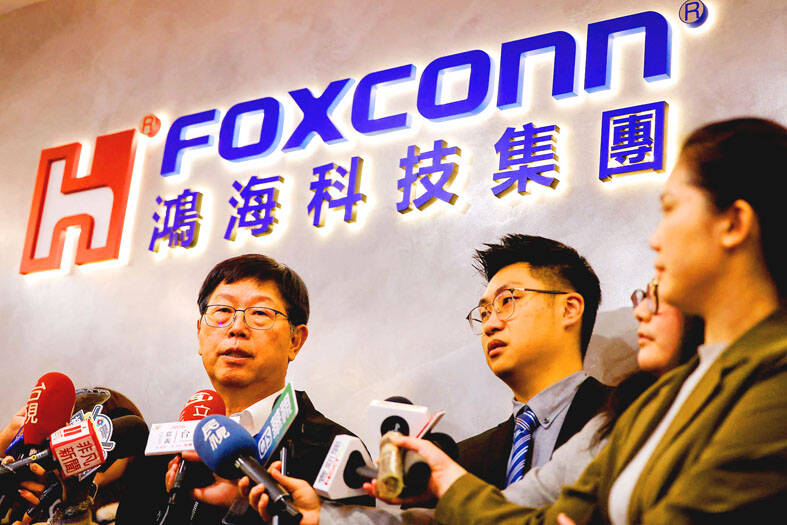
Photo: Ann Wang, Reuters
In the AI server segment, Hon Hai has deepened cooperation with customers in the past few years, participating not only in AI server system assembly, but also strengthening vertical integration in key components such as mechanical parts, thermal solutions and power systems, he said.
As its participation across the AI supply chain deepens, Hon Hai would gain an advantage in the next-generation AI server platform, Nvidia’s Vera Rubin AI server platform, he said.
Through stronger vertical integration with supply chain partners, Hon Hai’s overall deployment is expected to better position it for the Vera Rubin platform, he said.
Liu said he is optimistic about order share and shipments for the new platform, with results gradually materializing this year.
At the Nvidia AI global conference in California from March 16 to 19, Hon Hai plans to showcase solutions related to the new platform, including full server racks and key components such as cooling and power modules, demonstrating the company’s integrated capabilities in the AI server sector, he said.
On consumer electronics, smartphones remain one of the company’s key product lines, he said.
The company will continue to develop new products with major clients, including foldable smartphones that have drawn significant market attention, he said.
Development is ongoing, but launch timing would depend on product maturity to meet customers’ high design and quality standards, he said.
Foldable smartphones face higher technical barriers in design and manufacturing, including mechanical structure, durability and overall quality requirements, resulting in longer development cycles, Liu said, adding that the company could launch such phones depending on market demand.
Meanwhile, geopolitics and energy prices will continue to affect global economic conditions, he said.
Escalating tensions in the Middle East, for example, could push up oil prices and raise raw material costs, although the direct impact on contract manufacturers would be relatively limited, Liu said.
The bigger risk would arise if higher material costs weaken end-market demand, he said.
However, as most of Hon Hai’s customers are major global technology companies that continue to expand investments and product deployment, near-term demand momentum remains stable, he said.
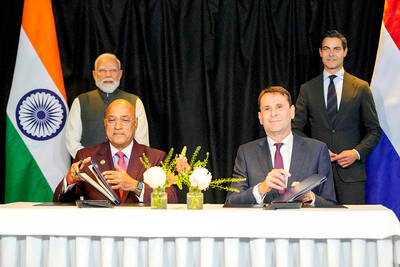
NEW MARKET: The partnership opens up India to the Dutch company, which already has a strong hold in the semiconductor market of South Korea, Taiwan and China ASML Holding NV entered into a partnership agreement with Tata Electronics Pvt Ltd aimed at ramping up India’s goal to develop domestic chip-manufacturing capabilities. The Dutch company’s technology would help power Tata Electronics’ planned 300 millimeter (mm) semiconductor foundry in Gujarat, according to a joint statement from the two companies on Saturday. The signing of a memorandum of understanding coincides with a visit by Indian Prime Minister Narendra Modi to the Netherlands, which is looking to deepen bilateral relations with New Delhi. ASML, whose top customers include Taiwan Semiconductor Manufacturing Co (台積電) and Samsung Electronics Co, makes lithography machines that can print
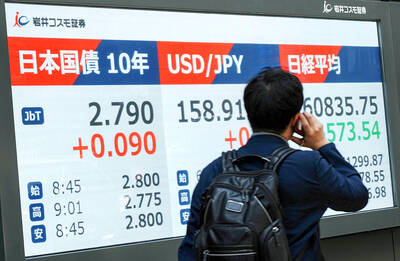
ROUGH RECORDS: Bonds in Japan, as well is in New Zealand, Australia and the US, are seeing the effects of a nervy market as stock exchanges across Asia edge down A deepening slump in Japanese government bonds added fuel to the selloff in global debt markets as rising oil prices stoked inflation fears and pushed yields to multi-decade highs. Japan’s 30-year yield yesterday surged as much as 20 basis points to the highest level since the tenor’s debut in 1999, before paring some of the move. Shorter-maturity Japanese debt was also under pressure, underscored by weak demand at a sale of five-year notes that offered a record-high coupon of 2 percent. Concerns over inflation and government spending rippling through markets including the US, Australia and New Zealand are being amplified in Japan,
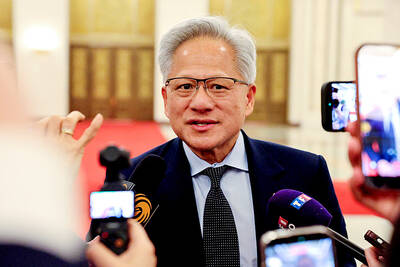
The US has cleared about 10 Chinese firms to buy Nvidia Corp’s second-most powerful artificial intelligence (AI) chip, the H200, but not a single delivery has been made so far, three people familiar with the matter said, leaving a major technology deal in limbo as chief executive officer Jensen Huang (黃仁勳) seeks a breakthrough in China this week. Huang, who was not initially listed in a White House delegation to Beijing, joined the trip after an invitation from US President Donald Trump, a source said. Trump picked him up in Alaska en route to a summit with Chinese President Xi Jinping

Wall Street is licking its chops over an unprecedented slate of massive initial public offerings (IPOs) set to arrive in the coming months, beginning with Elon Musk’s Space Exploration Technologies Corp (SpaceX) next month. That is expected to be followed by artificial intelligence (AI) rivals OpenAI and Anthropic PBC. The trio of mega listings, each eyeing valuations around US$1 trillion or more, constitutes a heady period of elevated risk and reward. SpaceX is targeting an IPO that would raise up to US$80 billion — about double the funds generated from all IPOs last year. OpenAI and Anthropic are eyeing IPOs raising US$60 billion. “We’re


 RSS
RSS