


The TAIEX yesterday tumbled 1,494.77 points, or 4.35 percent, to close at 32,828.88, marking the third-largest single-day decline on record as escalating tensions in the Middle East fueled a broad market sell-off.
After US President Donald Trump indicated he had not ruled out sending ground troops to Iran or taking more drastic measures, blue-chip and thematic stocks on the local main board were hit, driving trading turnover to NT$1.033 trillion (US$32.59 billion), suggesting liquidity remained robust despite the steep decline, Taiwan Stock Exchange (TWSE) data showed.
Institutional investors largely moved to the sidelines yesterday, with foreign investors selling a net of NT$96.47 billion, the third-largest daily net sale on record.
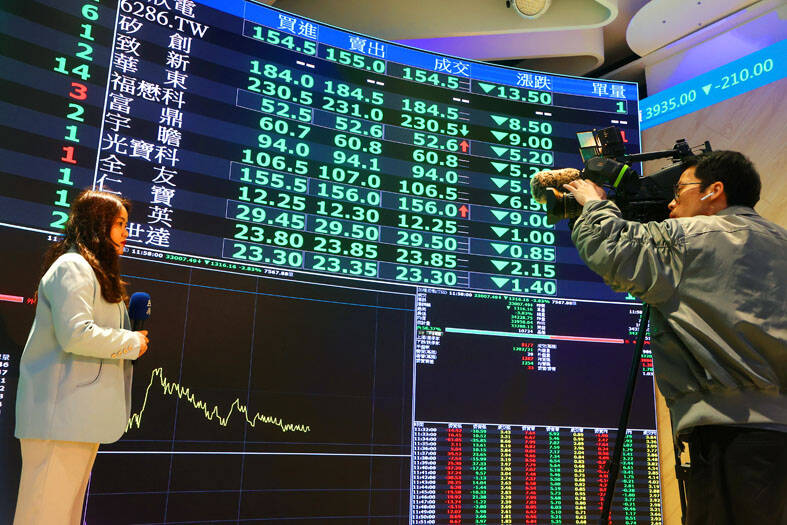
Photo: CNA
Proprietary trading firms deepened net sale to NT$40 billion, while domestic investment trust companies showed net purchases of NT$6.73 billion, exchange data showed.
Taiwan Semiconductor Manufacturing Co (TSMC, 台積電), which helped underpin the TAIEX rally prior to the Iran war, fell 3.62 percent and Hon Hai Precision Industry Co (鴻海精密) dropped 5.24 percent, while Delta Electronics Inc (台達電) plunged 6.34 percent and MediaTek Inc (聯發科) was down 5.23 percent.
The New Taiwan dollar yesterday also dropped sharply against the US dollar, approaching the NT$31.8 mark intraday and closing at NT$31.695 per US dollar, the lowest level in 10 months, following the central bank’s intervention to cap losses. Turnover at Taipei Forex Inc totaled US$4.13 billion, the fifth-largest on record, data showed.
Despite the turbulence, the TWSE said the local market is resilient, describing the decline as a normal correction amid geopolitical risks, adding that high trading values reflect strong liquidity.
The TAIEX has outperformed regional peers in the past few years, gaining 25.7 percent last year, thanks to the ongoing artificial intelligence boom. Taiwan’s GDP growth is projected at 7.71 percent this year, following an 8.68 percent rise last year.
This week, the TAIEX has fallen 7.3 percent, compared with about 8 percent decline in Japan’s Nikkei 225 and about 19 percent slump in South Korea’s KOSPI, the TWSE said.
In addition, corporate fundamentals remain solid, as total revenue for listed companies rose 30.71 percent year-on-year in January, providing underlying support for the market, the exchange said.
As market volatility would likely persist as tensions in the Middle East continue, Deputy Minister of Finance Frank Juan (阮清華), who also serves as executive secretary of the National Stabilization Fund, yesterday urged investors to stay calm.
The authorities are closely monitoring potential energy supply disruptions and are seeking solutions, Juan said, adding that the fund would convene an emergency meeting as soon as possible if irrational selling or market disruptions persist.
Concord Capital Management Corp (康和投顧) senior manager Lu Chin-wei (呂晉維) said the market was undergoing a technical correction after an extended rally and would need time to digest selling pressure.
The wide deviation from the annual moving average suggested further sector rotation and volatility before the broader market stabilizes, he said.
Although Middle East tensions have lifted oil prices, US Federal Reserve policy is unlikely to be as accommodative this year as last year, limiting the impact on the real economy, Lu said.
With TSMC and MediaTek having raised their full-year outlooks, Taiwan’s tech sector growth prospects remain intact, he added.
Additional reporting by CNA
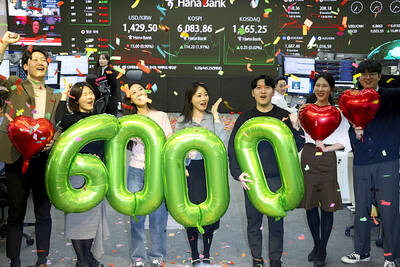
South Korea’s equity benchmark yesterday crossed a new milestone just a month after surpassing the once-unthinkable 5,000 mark as surging global memory demand powers the country’s biggest chipmakers. The KOSPI advanced as much as 2.6 percent to a record 6,123, with Samsung Electronics Co and SK Hynix Inc each gaining more than 2 percent. With the benchmark now up 45 percent this year, South Korea’s stock market capitalization has also moved past France’s, following last month’s overtaking of Germany’s. Long overlooked by foreign funds, despite being undervalued, South Korean stocks have now emerged as clear winners in the global market. The so-called “artificial intelligence
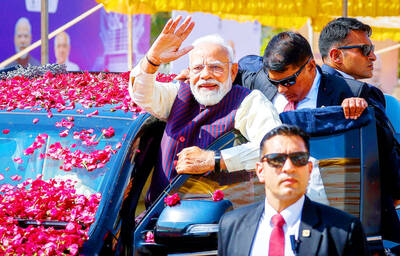
NEW IDENTITY: Known for its software, India has expanded into hardware, with its semiconductor industry growing from US$38bn in 2023 to US$45bn to US$50bn India on Saturday inaugurated its first semiconductor assembly and test facility, a milestone in the government’s push to reduce dependence on foreign chipmakers and stake a claim in a sector dominated by China. Indian Prime Minister Narendra Modi opened US firm Micron Technology Inc’s semiconductor assembly, test and packaging unit in his home state of Gujarat, hailing the “dawn of a new era” for India’s technology ambitions. “When young Indians look back in the future, they will see this decade as the turning point in our tech future,” Modi told the event, which was broadcast on his YouTube channel. The plant would convert
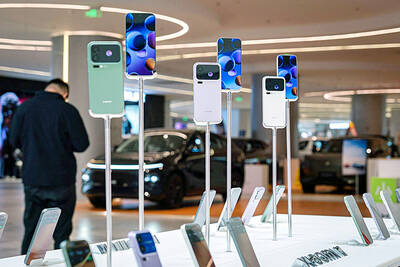
‘SEISMIC SHIFT’: The researcher forecast there would be about 1.1 billion mobile shipments this year, down from 1.26 billion the prior year and erasing years of gains The global smartphone market is expected to contract 12.9 percent this year due to the unprecedented memorychip shortage, marking “a crisis like no other,” researcher International Data Corp (IDC) said. The new forecast, a dramatic revision down from earlier estimates, gives the latest accounting of the ongoing memory crunch that is affecting every corner of the electronics industry. The demand for advanced memory to power artificial intelligence (AI) tasks has drained global supply until well into next year and jeopardizes the business model of many smartphone makers. IDC forecast about 1.1 billion mobile shipments this year, down from 1.26 billion the prior
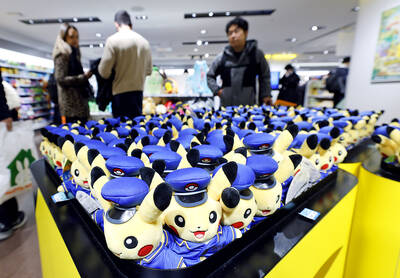
People stand in a Pokemon store in Tokyo on Thursday. One of the world highest-grossing franchises is celebrated its 30th anniversary yesterday.


 RSS
RSS