


US Federal Reserve officials appeared surprisingly wary of cutting interest rates when they met last month, with several even suggesting the central bank might need to raise rates if inflation remains stubbornly high.
While the minutes of the central bank’s Jan. 27-28 policy meeting, released on Wednesday, fell far short of suggesting most officials were contemplating the possibility of rate increases, they made clear the Fed is shifting further away from agreeing on another cut.
That could put it on a collision course with US President Donald Trump and complicates the task of Trump’s nominee for Fed chair, Kevin Warsh.
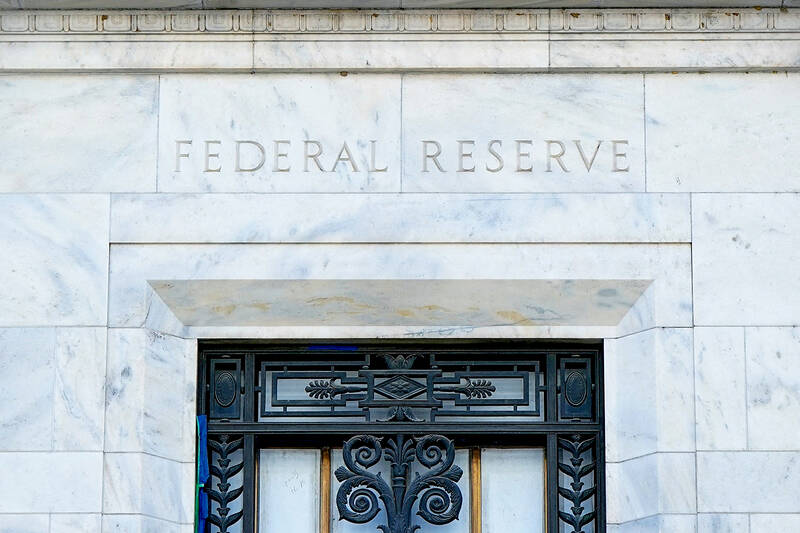
Photo: Reuters
Trump has repeatedly said he wants the next Fed chief to deliver lower interest rates, and on Jan. 30, two days after this policy meeting, he announced he would nominate Warsh, a former Fed governor, to take over when Jerome Powell’s tenure as chair ends in May.
“The minutes carry a distinctly more hawkish tilt,” EY-Parthenon chief economist Gregory Daco wrote in a note. “This sets up an interesting dynamic if and when Kevin Warsh is confirmed as Fed chair.”
White House spokesman Kush Desai said recent favorable price data provided proof that inflation is now “cool and stable” due to Trump’s policies aimed at spurring the economy’s supply side.
“It’s high time for the Federal Reserve to acknowledge this abundantly clear reality and cut rates to deliver further economic relief for American homebuyers and businesses,” he said.
The minutes showed most of the Federal Open Market Committee (FOMC) believed last year’s labor market weakness was fading by late last month.
“The vast majority of participants judged that downside risks to employment had moderated in recent months while the risk of more persistent inflation remained,” the minutes said.
That was before the release of a strong employment report for last month. Moreover, one group of policymakers at the meeting was embracing a view even more hostile to additional rate cuts.
“Several participants cautioned that easing policy further in the context of elevated inflation readings could be misinterpreted as implying diminished policymaker commitment to the 2 percent inflation objective,” the record showed.
Still, another group of “several officials” remained open to more rate cuts if inflation declined as they expected, though most said inflation progress could be slower than generally forecast.
The FOMC voted 10-2 at its meeting last month to hold the benchmark federal funds rate in a range of 3.5 percent to 3.75 percent.
Numbers published since that meeting have signaled accelerating growth, slowing inflation and a stabilizing labor market.
Since last month’s meeting, several Fed policymakers have maintained that an overall stable US economy provides them room to be patient in considering additional rate adjustments, while Trump and other administration officials continue to call for the Fed to lower rates immediately.
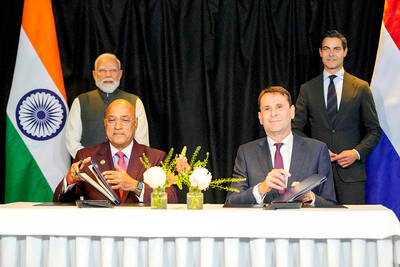
NEW MARKET: The partnership opens up India to the Dutch company, which already has a strong hold in the semiconductor market of South Korea, Taiwan and China ASML Holding NV entered into a partnership agreement with Tata Electronics Pvt Ltd aimed at ramping up India’s goal to develop domestic chip-manufacturing capabilities. The Dutch company’s technology would help power Tata Electronics’ planned 300 millimeter (mm) semiconductor foundry in Gujarat, according to a joint statement from the two companies on Saturday. The signing of a memorandum of understanding coincides with a visit by Indian Prime Minister Narendra Modi to the Netherlands, which is looking to deepen bilateral relations with New Delhi. ASML, whose top customers include Taiwan Semiconductor Manufacturing Co (台積電) and Samsung Electronics Co, makes lithography machines that can print

Tokyo Electron's Taiwan unit today said in a written response that it respects the judicial process, takes the court ruling seriously and would not appeal in the Taiwan Semiconductor Manufacturing Co (TSMC, 台積電) trade secrets case. Last month, a court fined the Taiwan unit of Japan's Tokyo Electron NT$150 million (US$4.74 million) in a case involving trade secrets related to TSMC's sensitive chip technology.
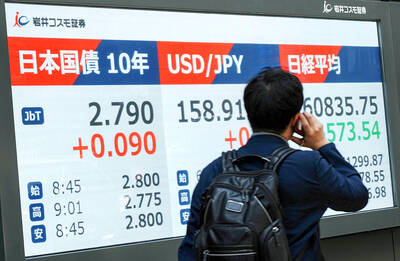
ROUGH RECORDS: Bonds in Japan, as well is in New Zealand, Australia and the US, are seeing the effects of a nervy market as stock exchanges across Asia edge down A deepening slump in Japanese government bonds added fuel to the selloff in global debt markets as rising oil prices stoked inflation fears and pushed yields to multi-decade highs. Japan’s 30-year yield yesterday surged as much as 20 basis points to the highest level since the tenor’s debut in 1999, before paring some of the move. Shorter-maturity Japanese debt was also under pressure, underscored by weak demand at a sale of five-year notes that offered a record-high coupon of 2 percent. Concerns over inflation and government spending rippling through markets including the US, Australia and New Zealand are being amplified in Japan,
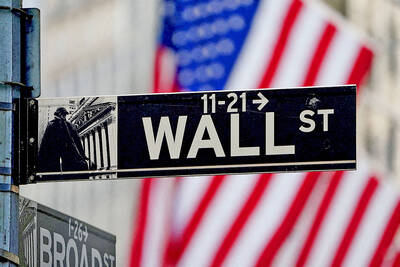
Wall Street is licking its chops over an unprecedented slate of massive initial public offerings (IPOs) set to arrive in the coming months, beginning with Elon Musk’s Space Exploration Technologies Corp (SpaceX) next month. That is expected to be followed by artificial intelligence (AI) rivals OpenAI and Anthropic PBC. The trio of mega listings, each eyeing valuations around US$1 trillion or more, constitutes a heady period of elevated risk and reward. SpaceX is targeting an IPO that would raise up to US$80 billion — about double the funds generated from all IPOs last year. OpenAI and Anthropic are eyeing IPOs raising US$60 billion. “We’re


 RSS
RSS