


Taiwan’s commercial property market is entering a transitional and increasingly competitive phase this year, as rising office availability, regulatory changes, and demand from artificial intelligence (AI) and semiconductor industries reshape leasing dynamics, consultancy Jones Lang LaSalle Taiwan Ltd (JLL Taiwan, 仲量聯行) said yesterday.
The market this year would be characterized by technology-driven upgrades, a gradual shift toward a more balanced office market and regulatory reforms that could unlock new sources of capital, JLL Taiwan managing director Kevin Hou (侯文信) told a news conference in Taipei.
“Good new offices are still being sought by many companies,” Hou said, highlighting continued corporate demand for high-quality, newly completed buildings despite broader market consolidation.
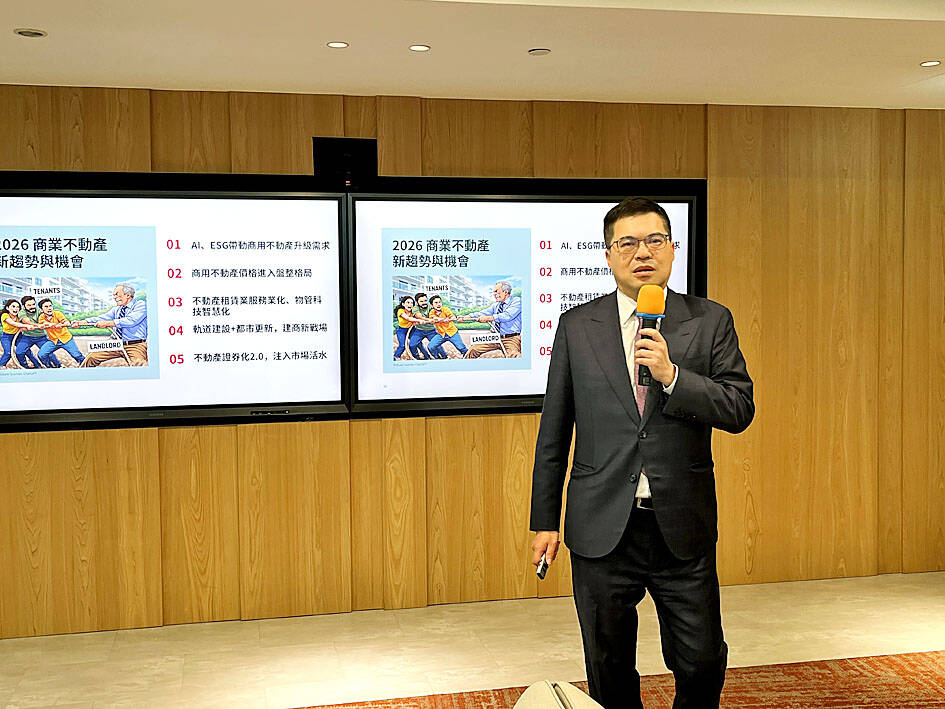
Photo: Hsu Yi-ping, Taipei Times
Demand from AI-related sectors, the semiconductor supply chain and growing environmental protection requirements are expected to drive upgrades in office space, he said.
On the supply side, Taipei’s city center is projected to add about 48,000 ping (158,678m2) of new Grade-A office space this year, Hou said, adding that, after excluding owner-occupied portions, about 24,000 ping would enter the leasing market.
By contrast, the city’s Nangang District (南港) would face a larger wave of new office availability and intensifying competition among landlords, giving tenants greater negotiating leverage, he said.
The company also pointed to a broader transformation in which urban renewal and transit-oriented development are emerging as key growth areas.
Rail infrastructure projects and metro-linked redevelopment initiatives have become a new battleground for developers, with government tenders and contract values reaching record highs last year, it said.
Revisions to Taiwan’s real-estate investment trust regulations are expected to pass the legislature in the second quarter, a development that could introduce fresh liquidity into the commercial property market, Hou said.
Grade-A office transactions in Taipei last year exceeded 50,000 ping for the second consecutive year, with deals in core business districts hitting their highest level in nearly seven years, JLL Taiwan office leasing advisory director Christina Yu (游淑芬) said.
However, rents showed clear signs of slowing as the market entered a consolidation phase, Yu said.
In the core districts, rents rose about 1.7 percent year-on-year, with average monthly rents reaching NT$3,258 per ping, the company said.
After six years of a landlord-driven market, rents have risen a cumulative 18 percent, and the market could now be shifting toward tenants, giving them greater choice and bargaining power, Yu said.
Taiwan’s office market is becoming more competitive, but demand for prime and high-specification space remains resilient, even as landlords face mounting pressure from new supply and evolving tenant expectations, JLL Taiwan said.
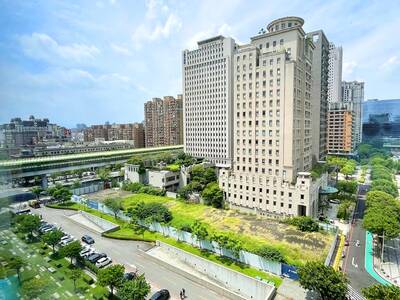
Taichung reported the steepest fall in completed home prices among the six special municipalities in the first quarter of this year, data compiled by Taiwan Realty Co (台灣房屋) showed yesterday. From January through last month, the average transaction price for completed homes in Taichung fell 8 percent from a year earlier to NT$299,000 (US$9,483) per ping (3.3m²), said Taiwan Realty, which compiled the data based on the government’s price registration platform. The decline could be attributed to many home buyers choosing relatively affordable used homes to live in themselves, instead of newly built homes in the city’s prime property market, Taiwan Realty
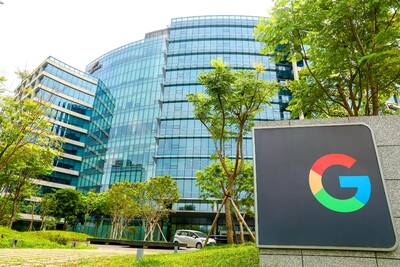
The government yesterday approved applications by Alphabet Inc’s Google to invest NT$27.08 billion (US$859.98 million) in Taiwan, the Ministry of Economic Affairs said in a statement. The Department of Investment Review approved two investments proposed by Google, with much of the funds to be used for data processing and electronic information supply services, as well as inventory procurement businesses in the semiconductor field, the ministry said. It marks the second consecutive year that Google has applied to increase its investment in Taiwan. Google plans to infuse NT$25.34 billion into Charter Investments Ltd (特許投資顧問) through its Singapore-based subsidiary Fructan Holdings Singapore Pte Ltd, and

JET JUICE: The war on Iran’s secondary effects have seen fuel prices skyrocket, knocking flight schedules down to earth in return as airlines struggle with costs Airline passengers should brace for more irritation in the next few months as carriers worldwide cancel flights and ground planes to cope with stratospheric increases in jet-fuel prices. Dutch flag carrier KLM is the latest company to cut its schedule, saying on Thursday that it would scrap 80 return flights at Amsterdam’s Schiphol Airport in the coming month. That puts it in the same league as United Airlines Holdings Inc, Deutsche Lufthansa AG and Cathay Pacific Airways Ltd, which have all pruned itineraries to mitigate costs. Global capacity for next month has been reduced by about 3 percentage points, with all

Micron Technology Inc is a driving force pushing the US Congress to pass legislation that would put new export restrictions on equipment its Chinese competitors use to make their chips, according to people familiar with the matter. A US House of Representatives panel yesterday was to vote on the “MATCH Act,” a bill designed to close gaps in restrictions on chipmaking equipment. It would also pressure foreign companies that sell equipment to Chinese chipmaking facilities to align with export curbs on US companies like Lam Research Corp and Applied Materials Inc. The bill targets facilities operated by China’s ChangXin Memory Technologies Inc


 RSS
RSS