


Shares in Taiwan closed at a new high yesterday, the first trading day of the new year, as contract chipmaker Taiwan Semiconductor Manufacturing Co (TSMC, 台積電) continued to break records amid an artificial intelligence (AI) boom, dealers said.
The TAIEX closed up 386.21 points, or 1.33 percent, at 29,349.81, with turnover totaling NT$648.844 billion (US$20.65 billion).
“Judging from a stronger Taiwan dollar against the US dollar, I think foreign institutional investors returned from the holidays and brought funds into the local market,” Concord Securities Co (康和證券) analyst Kerry Huang (黃志祺) said.

Photo: CNA
“Foreign investors just rebuilt their positions with TSMC as their top target, betting the company will give positive leads at an investor conference slated for Jan. 15,” Huang said.
TSMC, which accounts for more than 40 percent of the market’s total value, rose 2.26 percent to close at NT$1,585.00, contributing about 280 points to the TAIEX’s rise and sending the electronics index up 1.79 percent.
Foreign institutional investors also picked up other semiconductor heavyweights, including smartphone IC designer MediaTek Inc (聯發科), which gained 2.80 percent to close at NT$1,470.00, and IC packaging and testing services provider ASE Technology Holding Co (日月光投控), which added 2.99 percent to close at NT$258.00, Huang said.
Among other AI server makers, shares in Quanta Computer Inc (廣達) attracted bargain hunting, rising 1.84 percent to NT$232.00 at the close, while Hon Hai Precision Precision Industry Co (鴻海精密), second to TSMC in market value, closed up 0.65 percent at NT$232.00.
Buying continued to focus on memorychip suppliers as strong AI applications further squeezed supply and boosted product prices, Huang said, referring to Winbond Electronics Corp (華邦電) surging by the maximum daily increase of 10 percent to close at NT$90.80 and Nanya Technology Corp (南亞科技) gaining 7.25 percent to close at NT$207.00.
“With the electronics sector in the spotlight, nontech stocks largely moved in weakness with some exceptions in the cable and wire industry, which benefited from higher metal prices,” Huang said.
Ta Ya Electric Wire & Cable Co (大亞電線電纜) rose 1.45 percent to close at NT$38.50 and rival Walsin Lihwa Corp (華新麗華) close at NT$32.90, up 3.46 percent.
However, Formosa Plastics Corp (台灣塑膠) lost 1.41 percent to close at NT$38.48 on weakening oil prices and Nan Ya Plastics Corp (南亞塑膠) fell 5.32 percent to NT$57.00.
In the financial sector, E. Sun Financial Holding Co (玉山金控) rose 1.04 percent to close at NT$34.10, while Cathay Financial Holding Co (國泰金控) and Fubon Financial Holding Co (富邦金控) lost 0.79 percent and 0.52 percent to close at NT$75.20 and NT$95.60 respectively.
“The TAIEX is likely to challenge 30,000 points as foreign institutional buying continues until TSMC’s investor conference,” Huang said.
Foreign institutional investors bought a net NT$12.02 billion of shares on the main board yesterday, TWSE data showed.

Cairo’s new monorail slices across the city skyline, running above the familiar chaos of blaring horns and aging buses’ exhaust fumes that mark rush hour below. The US$4.5 billion monorail, opened this month, is among Egypt’s most prominent new transport projects, part of a debt-funded infrastructure drive criticized for sapping state finances while bringing limited benefits to most of the country’s 109 million people. “It feels like you’re in a different country,” said Ramy Sayed, a restaurant manager, aboard a driverless Innovia 300 train. “No noise, no traffic, we’re not used to this.” The eastern line runs 56km from the bustling middle-class
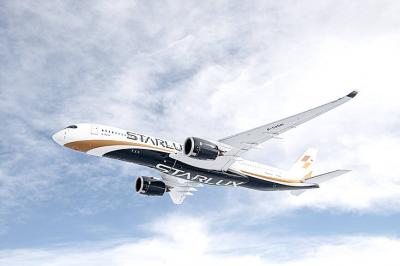
Starlux Airlines Co (星宇航空) today unveiled a long-haul network expansion plan at a shareholders’ meeting in Taipei, including direct flights to Barcelona, Spain, and Zurich, Switzerland, as well as a service connecting Taipei, Sydney and New Zealand. Starlux is to become the first Taiwanese carrier to offer non-stop services to the two European cities, while the inaugural oceanic route is expected to expand transit opportunities within the Australia-New Zealand market, Starlux said. Flight services to Chicago, Dallas, Washington and New York are under evaluation, the airline added. Prior to the shareholders’ meeting, the airline earlier this year announced that it would be
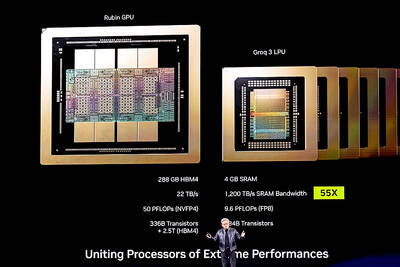
Taiwanese prosecutors suspect that three people successfully smuggled at least one shipment of Nvidia Corp artificial intelligence (AI) chips to China after first exporting them to Japan, people familiar with the matter said. The trio was detained last week by the Keelung District Prosecutors’ Office for allegedly falsifying documents related to exports of Super Micro Computer Inc servers containing advanced Nvidia chips, which the US has barred from sale to China without a license from Washington. The move marked Taiwan’s first public crackdown on AI chip diversion after years of pressure from the US to take a more active role in curtailing
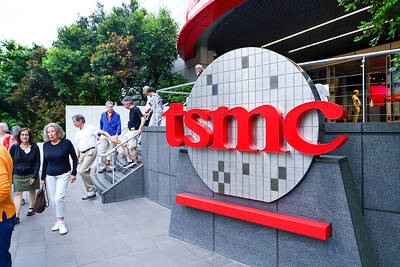
Taiwan Semiconductor Manufacturing Co (TSMC, 台積電) employee bonuses are likely to grow more than 30 percent this year, in line with the past few years as the company’s profits continue to set new records, an anonymous source cited TSMC chairman C.C. Wei (魏哲家) as saying yesterday. TSMC, the world’s largest contract chipmaker, is committed to taking care of its workers, the source said, citing Wei’s meeting with employees yesterday morning. Wei also expressed gratitude to employees for their contribution to the company’s improving bottom line, the source added. Since 2023, TSMC’s employee bonuses have grown at an annual rate of


 RSS
RSS