


Taiwan Sugar Corp (Taisugar, 台灣糖業), the National Atomic Research Institute (NARI) and Nice Enterprise Co (耐斯) signed a memorandum of understanding (MOU) on Tuesday to collaborate on a project aimed at recycling carbon generated in the sugar-making process.
Under the partnership, carbon-capture technologies and equipment developed by the NARI will be installed in the chimneys of the state-run sugar producer’s factories to convert carbon dioxide emissions into sodium bicarbonate.
The sodium bicarbonate will then be used by Nice, a Taiwan-based cosmetics producer, as an ingredient in cleaning products such as soap and laundry detergent, Taisugar said in a statement.
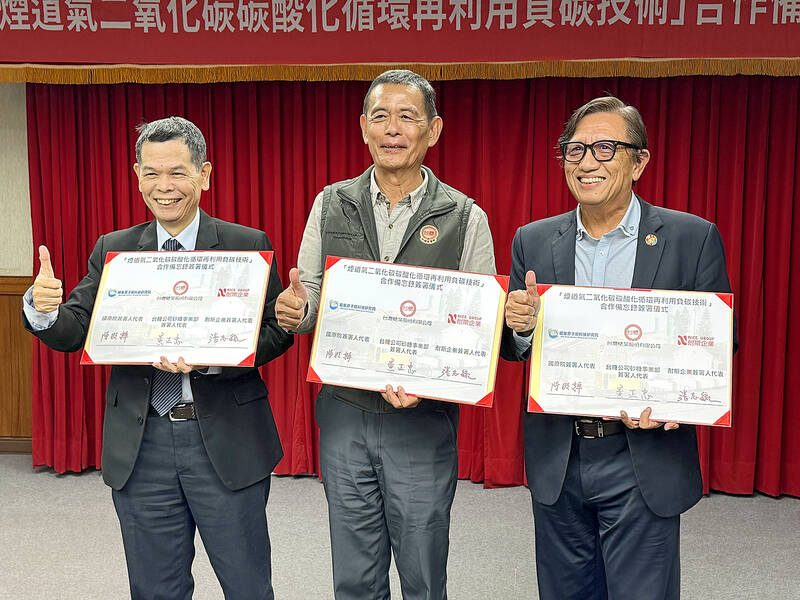
Photo: CNA
The partnership is not Taisugar’s first foray into circular economy strategies that use waste materials productively, with the company having long used recycled sugarcane bagasse — the fibrous residue that remains after crushing sugar cane — as fuel.
Huang Cheng-chung (黃正忠), head of Taisugar’s sugar business division, described the partnership as building a new circular system that will tie sugar cane fields to factory chimneys and sugar production to cleaning products.
Nice factory manager Chang Chih-yu (張志毓) concurred, saying the MOU will create a "fully green production site," while NARI vice president Chen Ming- huei (陳明輝) said it represented a significant step in converting scientific research into an industrial application.
Tuesday also saw Taisugar open its Huwei sugar refinery in Yunlin County to prepare for the 2025-2026 sugar production season.
At the opening ceremony, Vice Minister of Economic Affairs Lai Chien-hsin (賴建信) highlighted the Huwei refinery’s embrace of the circular economy, saying it not only used bagasse for fuel, but made feed and fertilizers from molasses.
From Tuesday to April 1 next year, the refinery is expected to harvest about 241,000 tonnes of sugar cane and produce around 21,000 tonnes of sugar, the company said.
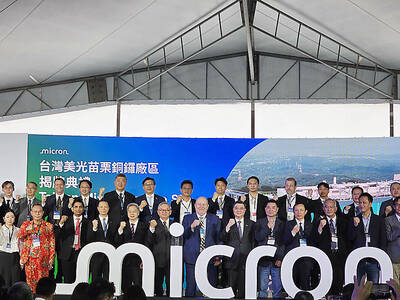
UNPRECEDENTED PACE: Micron Technology has announced plans to expand manufacturing capabilities with the acquisition of a new chip plant in Miaoli Micron Technology Inc unveiled a newly acquired chip plant in Miaoli County yesterday, as the company expands capacity to meet growing demand for advanced DRAM chips, including high-bandwidth memory chips amid the artificial intelligence boom. The plant in Miaoli County’s Tongluo Township (銅鑼), which Micron acquired from Powerchip Semiconductor Manufacturing Corp (力積電) for US$1.8 billion, is expected to make a sizeable capacity contribution to the company from fiscal 2028, the company said in a statement. It would be an extended production site of Micron’s large-scale manufacturing hub in Taichung, the company said. As the global semiconductor industry is racing to reach US$1 trillion

Singapore-based ride-hailing and delivery giant Grab Holdings Ltd has applied for regulatory approval to acquire the Taiwan operations of Germany-based Delivery Hero SE's Foodpanda in a deal valued at about US$600 million. Grab submitted the filing to the Fair Trade Commission on Friday last week, with the transaction subject to regulatory review and approval, the company said in a statement yesterday. Its independent governance structure would help foster a healthy and competitive market in Taiwan if the deal is approved, Grab said. Grab, which is listed on the NASDAQ, said in the filing that US-based Uber Technologies Inc holds about 13 percent of

Taiwan’s food delivery market could undergo a major shift if Singapore-based Grab Holdings Ltd completes its planned acquisition of Delivery Hero SE’s Foodpanda business in Taiwan, industry experts said. Grab on Monday last week announced it would acquire Foodpanda’s Taiwan operations for US$600 million. The deal is expected to be finalized in the second half of this year, with Grab aiming to complete user migration to its platform by the first half of next year. A duopoly between Uber Eats and Foodpanda dominates Taiwan’s delivery market, a structure that has remained intact since the Fair Trade Commission (FTC) blocked Uber Technologies Inc’s

Memory chip stocks extended their losses yesterday after Alphabet Inc’s Google publicized research that could allow more efficient use of the storage needed for artificial intelligence (AI) development. SK Hynix Inc and Samsung Electronics Co, South Korean leaders in the market, fell more than 6 percent and about 5 percent respectively in Seoul. In the US, Micron Technology Inc, Western Digital Corp and Sandisk Corp slid more than 2 percent in pre-market trading, after they all closed lower on Wednesday. Memory companies have been on a tear in recent months as the rapid development of AI infrastructure triggered a spike in chip


 RSS
RSS