


Taiwan should increase its geothermal development investment, as its stable output could complement the nation’s fast-growing solar and wind power capacity, an international consultant said last week.
COWI A/S Asia-Pacific business development director Vun Pui-lee (溫沛理) at an event hosted by the Trade Council of Denmark, Taipei said that geothermal systems offer consistent heat flow and round-the-clock generation.
“The output of geothermal power is like natural gas; the volume of hot water you have and its temperature are both stable and constant,” he said.
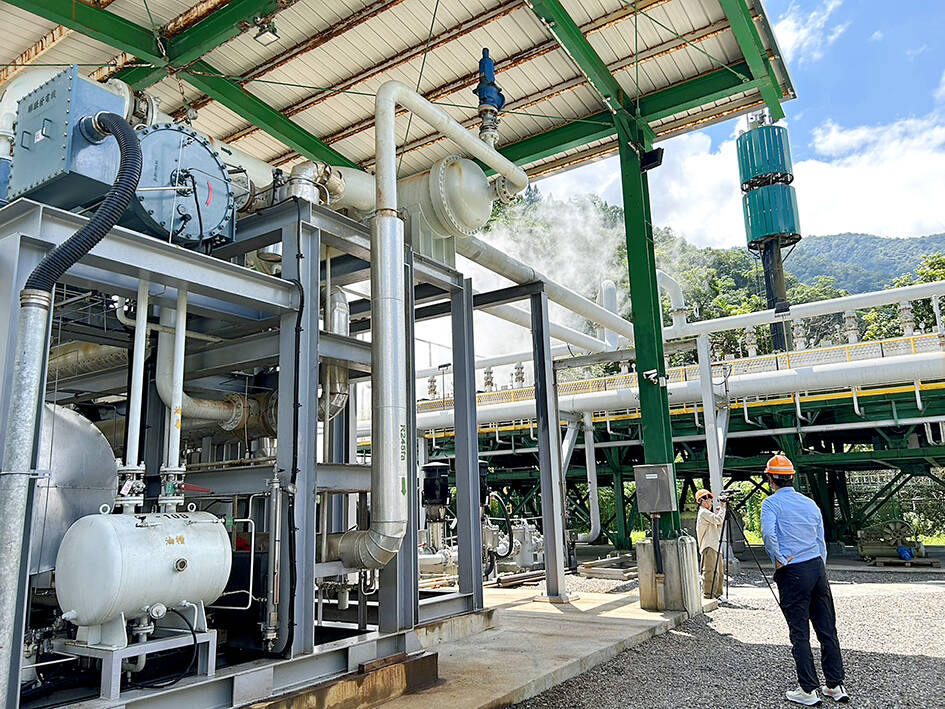
Photo: CNA
Such steadiness could enhance Taiwan’s energy resilience during geopolitical uncertainty, he added.
“A liquefied natural gas terminal might not be able to operate in the event of a blockade,” but geothermal energy does not require imports and is unaffected by weather, Vun said.
Taiwan Power Co (Taipower, 台電) vice president Wu Chin-chung (吳進忠), who also spoke at the event, reiterated that offshore wind and solar remain the pillars of Taiwan’s renewable transition due to land limitations.
Grid-connected renewable capacity rose from 1.92 gigawatts (GW) in 2016 to 19.31GW last year — an increase of more than 1,000 percent, he said, citing Energy Administration data.
However, solar output drops sharply between 4pm and 5pm, even as electricity demand remains high, Wu said.
The daily imbalance led Taipower to adjust its time-of-use pricing in 2023 to encourage more daytime consumption.
Geothermal energy avoids such intermittency issues and could serve as a stable, supplementary renewable source to help smooth fluctuations in the grid, Vun said.
Former minister of economic affairs J.W. Kuo (郭智輝) previously cited a government study estimating Taiwan’s shallow geothermal potential at about 1GW and its deep geothermal resources at up to 40GW, with a feasible development target of about 10GW.
Reaching even 1GW would be a major milestone, Vun said, pointing to Taipei’s Datun Mountain (大屯山) area as particularly promising.
Datun contains Taiwan’s only measured geothermal well exceeding 180°C, reaching 245°C, the Geothermal Exploration System said.
Geothermal plants generally have a smaller environmental footprint than large solar farms or offshore wind installations, Vun said.
Taiwan’s biggest obstacle is not technical capability, but regulatory restrictions, he said.
Regulations require that geothermal wells be drilled vertically, unlike international practice that allows directional drilling beyond a landowner’s subsurface boundary, he added.
“Taiwan’s rigid law forces developers such as CPC Corp, Taiwan (台灣中油) to miss the optimal path,” Vun said.
Research suggested geothermal energy is not scalable nationwide.
A study published last year in the journal Mathematics evaluating Taiwan’s geothermal sites found that complex geology and difficult site-selection conditions remain “the critical challenge” for its efficient development.
Similarly, a geothermal feasibility analysis conducted last year inside Yangmingshan National Park by National Central University researchers concluded that only a few specific subzones show conditions suitable for development.
An energies contingent-valuation study this year estimated that even under optimistic public-acceptance and pricing assumptions, economically viable geothermal capacity would amount to only about 100 megawatts (MW) to 300MW.
After several years flying high as Asia’s best Nvidia Corp proxy, Taiwan Semiconductor Manufacturing Co (TSMC, 台積電) is increasingly vying with other artificial intelligence (AI) stocks for investor attention. Stock traders are chasing a wider array of beneficiaries as mainstream usage of AI creates demand for hardware beyond the most-advanced chips TSMC makes for Nvidia. Subthemes from the deepening memory crunch to advances in robotics are also luring bids. At the same time, investment caps on single stocks are pushing funds to diversify, while retail investors long familiar with TSMC through its US depositary receipts are being offered a broader set of
UNDER MICROSCOPE: Taiwan detained three people who allegedly conspired to buy servers in Taiwan and export them using fraudulent documentation, prosecutors said Nvidia Corp chief executive officer Jensen Huang (黃仁勳) on Saturday urged Super Micro Computer Inc to tighten up on compliance after Taiwan detained three people this week for allegedly making fraudulent declarations about artificial intelligence (AI) servers made by its US partner. The development marked the nation’s first crackdown on semiconductor smuggling, which grew after the US slapped restrictions on exports of high-end chips such as Nvidia AI accelerators to China. Nvidia is “rigorous” in explaining regulations to all of its partners, Huang told reporters after arriving in Taipei. “Ultimately Super Micro has to run their own company,” he said in response to
TECH RELIANCE: Growth is increasingly reflecting an unequal K-shaped distribution, where technology sectors outperform and other industries struggle, an expert said Standard Chartered Bank has significantly raised its forecast for Taiwan’s economic growth to 9.5 percent this year, up from 7.6 percent previously, citing surging artificial intelligence (AI) demand driving exports, semiconductor production and investment. The upgrade reflects a sustained AI supercycle that continues to fuel demand for advanced chips and technology infrastructure, which form the backbone of Taiwan’s exports, the bank said in a report this week. “We raise our 2026 growth forecast to reflect a much stronger-than-expected first-quarter GDP figure,” Standard Chartered senior economist for greater China and Asia Tommy Wu (胡東安) said in the report. Driven largely by a 35.3 percent
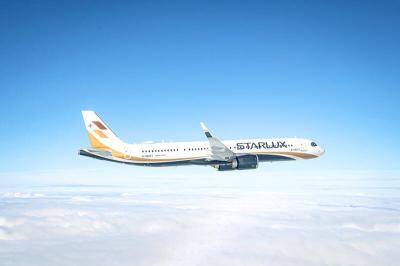
Two of Taiwan’s international carriers, Starlux Airlines Co (星宇航空) and EVA Airways Corp (長榮航空), have retained the five-star airline rating awarded by international airline review organization Skytrax. Starlux was awarded the distinction for a second consecutive year, while EVA Air received it for the 11th straight year, Skytrax said in statements released yesterday and on Thursday last week, respectively. The five-star rating is considered one of the airline industry's highest honors and is awarded following professional audits of airline product and frontline service standards, Skytrax said. The ratings are based on in-depth assessments using unified global quality standards rather than customer review scores


 RSS
RSS