


A large majority of vehicle manufacturers might disappear within two decades as humanoid robots become increasingly common in manufacturing, a Taiwanese company head said yesterday.
Peter Chen (陳其宏), chairman and CEO of Qisda Corp (佳世達), a technology manufacturer engaged in artificial intelligence (AI) of things applications, made the remark at a forum in Tainan.
Humanoid robots are expected to be used first in smart manufacturing, which relies on massive data, algorithms and computing power, he said.
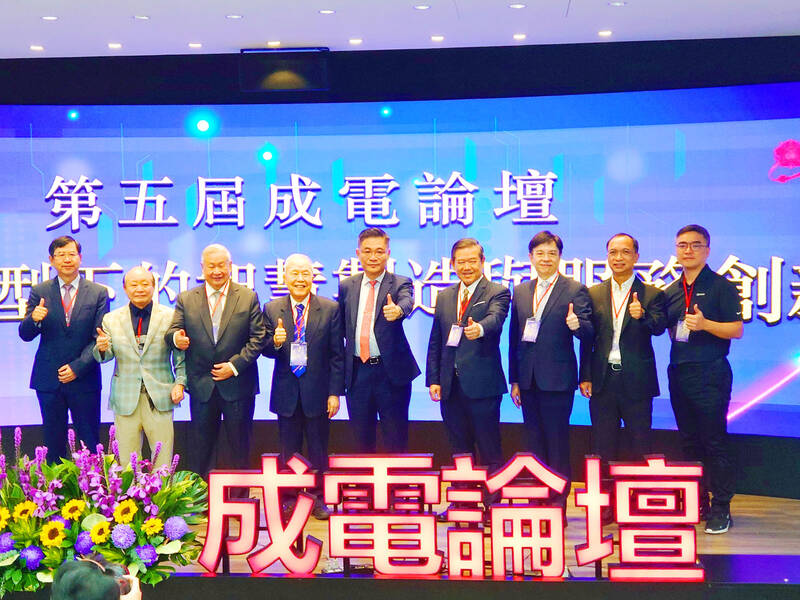
Photo: CNA
Smart manufacturing builds on conventional automation, which remains the dominant production model in most factories today, by embedding AI, sensors, big data and connectivity to make the entire production process data-driven, adaptive and self-optimizing.
Deploying humanoid robots in smart manufacturing can help solve issues employers have such as employee morale, overtime and labor unions, Chen said.
Qisda has moved its most advanced production lines to Vietnam as a way of extending its lead over competitors, Chen said.
However, Qisda’s decision to invest in Vietnam was not based solely on labor costs, since the cost of AI technologies rises by about 15 percent annually, he added.
He said that the vehicle industry would be among the sectors most affected by the growing use of humanoid robots, leading to the disappearance of most car brands within 10 to 20 years.
Chen said those automakers in danger could include ones such as Mercedes-Benz AG, whose production he described as “still driven by traditional concepts.”
At the forum, Chen showed footage of Tesla Inc’s largely human-free manufacturing process, saying it gives the US automaker an edge in production efficiency.
Late last month, Hon Hai Precision Industry Co (鴻海精密), the world’s largest electronics and AI server manufacturer, announced plans to deploy humanoid robots on its production lines in Texas.
Speaking at the forum were Mirle Automation Corp (盟立) chairman Sun Houng (孫弘) and Delta Electronics Inc (台達電) vice president for motion control business David Tsai (蔡清雄).
Sun said the transition from automation to smart manufacturing is an inevitable trend, while Tsai stressed that identifying a company’s challenges and needs is key to digital transformation.
Delta Electronics began its transformation in 2015 to address labor shortages in China and established a demonstration production line in 2018, Tsai said.
Through standardization, automation, digitalization and intelligentization, the company increased per-capita production-line efficiency by a factor of three to five, boosted overall capacity by 70 percent and reduced factory floor space by 35 percent, Tsai said.

The domestic unit of the Chinese-owned, Dutch-headquartered chipmaker Nexperia BV will soon be able to produce semiconductors locally within China, according to two company sources. Nexperia is at the center of a global tug-of-war over critical semiconductor technology, with a Dutch court in February ordering a probe into alleged mismanagement at the company. The geopolitical tussle has disrupted supply chains, with some carmakers reportedly forced to cut production due to chip shortages. Local production would allow Nexperia’s domestic arm, Nexperia Semiconductors (China) Ltd (安世半導體中國), to bypass restrictions in place since October on the supply of silicon wafers — etched with tiny components to

Singapore-based ride-hailing and delivery giant Grab Holdings Ltd has applied for regulatory approval to acquire the Taiwan operations of Germany-based Delivery Hero SE's Foodpanda in a deal valued at about US$600 million. Grab submitted the filing to the Fair Trade Commission on Friday last week, with the transaction subject to regulatory review and approval, the company said in a statement yesterday. Its independent governance structure would help foster a healthy and competitive market in Taiwan if the deal is approved, Grab said. Grab, which is listed on the NASDAQ, said in the filing that US-based Uber Technologies Inc holds about 13 percent of

Taiwan Semiconductor Manufacturing Co (TSMC, 台積電) yesterday received government approval to deploy its advanced 3-nanometer (3nm) process at its second fab currently under construction in Japan, the Ministry of Economic Affairs said in a news release. The ministry green-lit the plan for the facility in Kumamoto, which is scheduled to start installing equipment and come online in 2028 with a monthly production capacity of 15,000 12-inch wafers, the ministry said. The Department of Investment Review in June 2024 authorized a US$5.26 billion investment for the facility, slated to manufacture 6- to 12nm chips, significantly less advanced than 3nm process. At a meeting with

Taiwan’s food delivery market could undergo a major shift if Singapore-based Grab Holdings Ltd completes its planned acquisition of Delivery Hero SE’s Foodpanda business in Taiwan, industry experts said. Grab on Monday last week announced it would acquire Foodpanda’s Taiwan operations for US$600 million. The deal is expected to be finalized in the second half of this year, with Grab aiming to complete user migration to its platform by the first half of next year. A duopoly between Uber Eats and Foodpanda dominates Taiwan’s delivery market, a structure that has remained intact since the Fair Trade Commission (FTC) blocked Uber Technologies Inc’s


 RSS
RSS