


Silicon Motion Technology Corp (慧榮科技), the world’s largest supplier of NAND flash memory controllers, has hired former MediaTek Inc (聯發科) executive Jeffrey Ju (朱尚祖) as its senior vice president of platform and strategy, the company said yesterday.
In his new role, Ju would lead efforts to deepen executive-level platform engagement with top-tier customers in the PC, smartphone, automotive and server markets, Silicon Motion said in a statement.
He would also play a key role in strengthening the firm’s global research and development capabilities, it said.

Photo courtesy of Silicon Motion Technology Corp
Ju would also serve as a member of the Silicon Motion capital committee to contribute to strategic investments and acquisitions, as well as advise the company’s long-term business strategy, product portfolio expansion and artificial intelligence initiatives, it added.
Ju was once considered a front-runner for MediaTek chief executive officer. At MediaTek, he served as executive vice president and cochief operating officer, helping grow the firm’s mobile chipset business to US$4 billion a year and establish it as the world’s No. 2 mobile phone chip vendor, the statement said.
Ju was most recently cofounder and chief strategy officer at China’s ZEKU Technology (哲庫科技), where he built a global team of more than 3,000 engineers and delivered multiple advanced designs, including 6-nanometer and 4-nanometer tape-outs.
He previously served as a partner at Xiaomi Corp’s (小米) Xiaomi Private Equity Fund (小米產業投資).
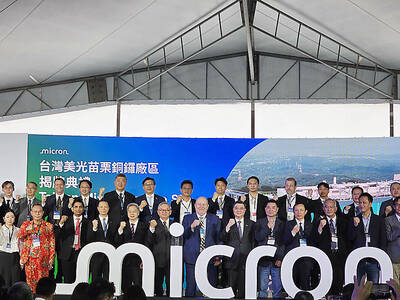
UNPRECEDENTED PACE: Micron Technology has announced plans to expand manufacturing capabilities with the acquisition of a new chip plant in Miaoli Micron Technology Inc unveiled a newly acquired chip plant in Miaoli County yesterday, as the company expands capacity to meet growing demand for advanced DRAM chips, including high-bandwidth memory chips amid the artificial intelligence boom. The plant in Miaoli County’s Tongluo Township (銅鑼), which Micron acquired from Powerchip Semiconductor Manufacturing Corp (力積電) for US$1.8 billion, is expected to make a sizeable capacity contribution to the company from fiscal 2028, the company said in a statement. It would be an extended production site of Micron’s large-scale manufacturing hub in Taichung, the company said. As the global semiconductor industry is racing to reach US$1 trillion

Singapore-based ride-hailing and delivery giant Grab Holdings Ltd has applied for regulatory approval to acquire the Taiwan operations of Germany-based Delivery Hero SE's Foodpanda in a deal valued at about US$600 million. Grab submitted the filing to the Fair Trade Commission on Friday last week, with the transaction subject to regulatory review and approval, the company said in a statement yesterday. Its independent governance structure would help foster a healthy and competitive market in Taiwan if the deal is approved, Grab said. Grab, which is listed on the NASDAQ, said in the filing that US-based Uber Technologies Inc holds about 13 percent of

Taiwan’s food delivery market could undergo a major shift if Singapore-based Grab Holdings Ltd completes its planned acquisition of Delivery Hero SE’s Foodpanda business in Taiwan, industry experts said. Grab on Monday last week announced it would acquire Foodpanda’s Taiwan operations for US$600 million. The deal is expected to be finalized in the second half of this year, with Grab aiming to complete user migration to its platform by the first half of next year. A duopoly between Uber Eats and Foodpanda dominates Taiwan’s delivery market, a structure that has remained intact since the Fair Trade Commission (FTC) blocked Uber Technologies Inc’s

Memory chip stocks extended their losses yesterday after Alphabet Inc’s Google publicized research that could allow more efficient use of the storage needed for artificial intelligence (AI) development. SK Hynix Inc and Samsung Electronics Co, South Korean leaders in the market, fell more than 6 percent and about 5 percent respectively in Seoul. In the US, Micron Technology Inc, Western Digital Corp and Sandisk Corp slid more than 2 percent in pre-market trading, after they all closed lower on Wednesday. Memory companies have been on a tear in recent months as the rapid development of AI infrastructure triggered a spike in chip


 RSS
RSS