


Taiwan’s technology protection rules prohibits Taiwan Semiconductor Manufacturing Co (TSMC, 台積電) from producing 2-nanometer chips abroad, so the company must keep its most cutting-edge technology at home, Minister of Economic Affairs J.W. Kuo (郭智輝) said yesterday.
Kuo made the remarks in response to concerns that TSMC might be forced to produce advanced 2-nanometer chips at its fabs in Arizona ahead of schedule after former US president Donald Trump was re-elected as the next US president on Tuesday.
“Since Taiwan has related regulations to protect its own technologies, TSMC cannot produce 2-nanometer chips overseas currently,” Kuo said at a meeting of the legislature’s Economics Committee in Taipei.
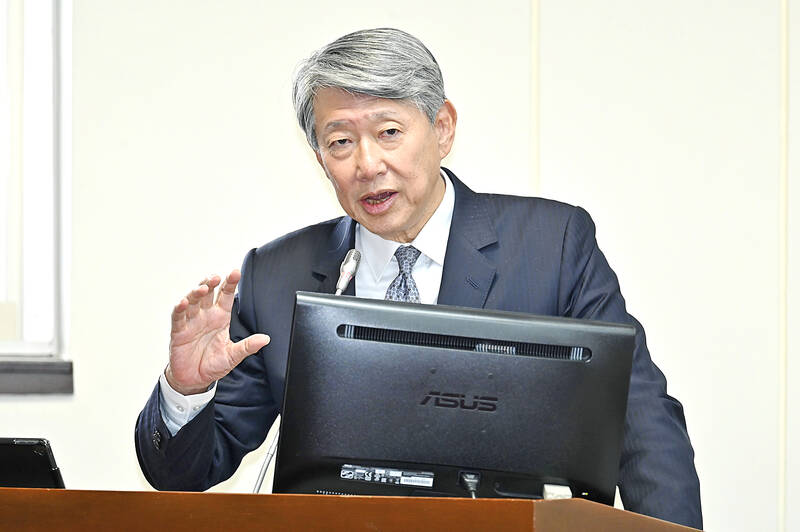
Photo: Tu Chien-jung, Taipei Times
“Although TSMC plans to make 2-nanometer chips [abroad] in the future, its core technology will stay in Taiwan,” Kuo added.
LAW
Taiwanese law limits domestic chipmakers to producing chips abroad that are at least one generation less advanced than their fabs at home. TSMC told investors in July its next-generation A-16 chip is to enter volume production in the second half of 2026, after ramping up production of 2-nanometer chips next year.
According to TSMC’s overseas manufacturing roadmap, the company plans to produce 2-nanometer or more advanced chips in the US by the end of this decade, when its second fab in Arizona — which would utilize its 3-nanometer and 2-nanometer process technologies — becomes operational in 2028.
The third fab in Arizona would produce chips using 2-nanometer or even more advanced process technology, the chipmaker said.
TSMC’s first Arizona fab is set to ramp up production of 4-nanometer chips next month.
BILATERAL TIES
Meanwhile, Taiwan Semiconductor Industry Association (TSIA) chairman Cliff Hou (侯永清) yesterday said that history has shown that the result of the US presidential election would not significantly affect the company’s decades-long partnership between Taiwan and the US.
Hou also serves as a senior vice president at TSMC.
“The bilateral relationship has not changed because of the political landscape changes in the US,” Hou said at a forum in Hsinchu.
“There could be some alterations in details regarding this partnership. We will look at it when everything is certain,” Hou added.
Asked about how the TSIA could help local semiconductor companies navigate the challenges of the potential 10 percent tariff hikes that Trump threatened during his election campaign, Hou said the association has not received any official notification yet.
However, Taiwan should pour more resources into advancing chip technology and expanding its supply chain expertise to maintain global leadership, he said.
“We should accelerate research and development to ensure our standing as an indispensable member of the global semiconductor supply chain,” Hou said. “We are also working with the government to see whether we can attract foreign partners to set up design and materials centers in Taiwan.”
The 27-year TSMC veteran added that Taiwan must also aim to develop more expertise in equipment and materials, areas that are dominated by foreign businesses.
Additional reporting by Bloomberg
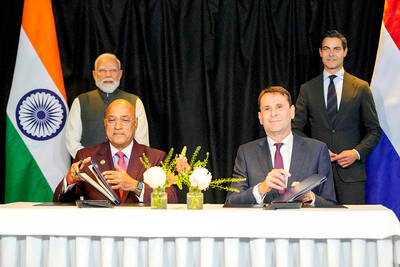
NEW MARKET: The partnership opens up India to the Dutch company, which already has a strong hold in the semiconductor market of South Korea, Taiwan and China ASML Holding NV entered into a partnership agreement with Tata Electronics Pvt Ltd aimed at ramping up India’s goal to develop domestic chip-manufacturing capabilities. The Dutch company’s technology would help power Tata Electronics’ planned 300 millimeter (mm) semiconductor foundry in Gujarat, according to a joint statement from the two companies on Saturday. The signing of a memorandum of understanding coincides with a visit by Indian Prime Minister Narendra Modi to the Netherlands, which is looking to deepen bilateral relations with New Delhi. ASML, whose top customers include Taiwan Semiconductor Manufacturing Co (台積電) and Samsung Electronics Co, makes lithography machines that can print
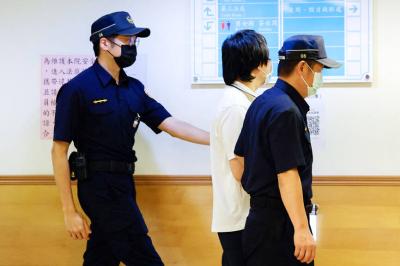
Tokyo Electron's Taiwan unit today said in a written response that it respects the judicial process, takes the court ruling seriously and would not appeal in the Taiwan Semiconductor Manufacturing Co (TSMC, 台積電) trade secrets case. Last month, a court fined the Taiwan unit of Japan's Tokyo Electron NT$150 million (US$4.74 million) in a case involving trade secrets related to TSMC's sensitive chip technology.
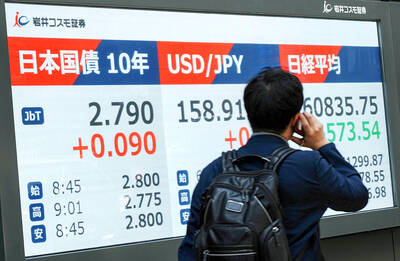
ROUGH RECORDS: Bonds in Japan, as well is in New Zealand, Australia and the US, are seeing the effects of a nervy market as stock exchanges across Asia edge down A deepening slump in Japanese government bonds added fuel to the selloff in global debt markets as rising oil prices stoked inflation fears and pushed yields to multi-decade highs. Japan’s 30-year yield yesterday surged as much as 20 basis points to the highest level since the tenor’s debut in 1999, before paring some of the move. Shorter-maturity Japanese debt was also under pressure, underscored by weak demand at a sale of five-year notes that offered a record-high coupon of 2 percent. Concerns over inflation and government spending rippling through markets including the US, Australia and New Zealand are being amplified in Japan,
Wall Street is licking its chops over an unprecedented slate of massive initial public offerings (IPOs) set to arrive in the coming months, beginning with Elon Musk’s Space Exploration Technologies Corp (SpaceX) next month. That is expected to be followed by artificial intelligence (AI) rivals OpenAI and Anthropic PBC. The trio of mega listings, each eyeing valuations around US$1 trillion or more, constitutes a heady period of elevated risk and reward. SpaceX is targeting an IPO that would raise up to US$80 billion — about double the funds generated from all IPOs last year. OpenAI and Anthropic are eyeing IPOs raising US$60 billion. “We’re


 RSS
RSS