


Interest rates on new loans at Taiwan’s five major state-run banks last month rose 23 basis points to an average of 2.051 percent as loan demand picked up, the central bank said yesterday.
The monetary policymaker analyzed data from Bank of Taiwan (臺灣銀行), Land Bank of Taiwan (土地銀行), Taiwan Cooperative Bank (合作金庫銀行), Hua Nan Commercial Bank (華南銀行) and First Commercial Bank (第一銀行).
The uptick was most evident for mortgage lending, which rose 8 basis points to 2.079 percent, driven by real demand and completion of new residential properties, although the central bank has kept interest rates unchanged since June, central bank research official Tsao Ti-jen (曹體仁) said.
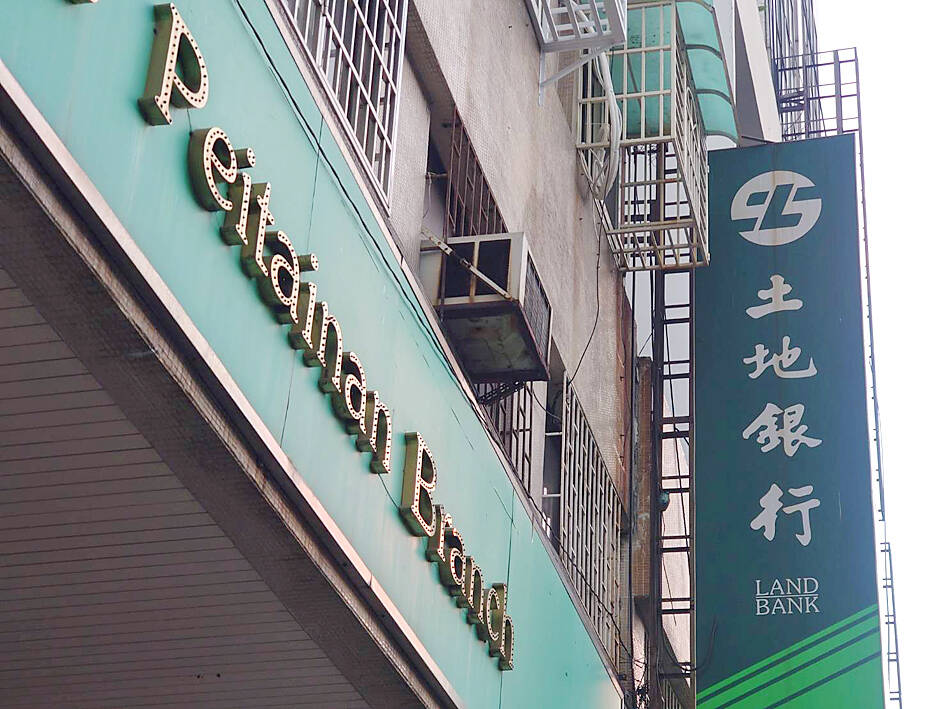
Photo: Wang Chieh, Taipei Times
The mortgage balance increased by NT$9.39 billion (US$299.73 million) to a record NT$98.96 billion, Tsao said, adding that loans backed by a government interest subsidy program accounted for 36.48 percent, or NT$36.1 billion.
The rise in mortgage volume was linked to seasonality, as it is common for developers in Taiwan to complete construction on presale residential projects and book profits ahead of the Lunar New Year holiday, he said.
Prospective home buyers also prefer to close deals toward the end of the year in keeping with tradition, he added.
Last year, mortgage operations at the five state-run banks expanded 8.4 percent from 2022, milder than the advances of 12.6 and 20 percent in the previous two years, Tsao said.
“I would not describe the pace of increases as a sign of overheating, but the central bank will continue to pay close attention to the housing market,” Tsao said, adding that interest subsidies are for purchases of first homes, suggesting that healthy real demand is upholding the house transaction data.
Interest rates on new working capital climbed to 2.015 percent, as companies sought cash to support the distribution of bonuses, he said.
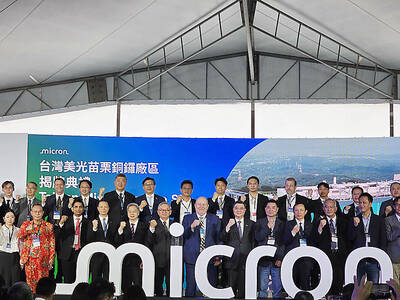
UNPRECEDENTED PACE: Micron Technology has announced plans to expand manufacturing capabilities with the acquisition of a new chip plant in Miaoli Micron Technology Inc unveiled a newly acquired chip plant in Miaoli County yesterday, as the company expands capacity to meet growing demand for advanced DRAM chips, including high-bandwidth memory chips amid the artificial intelligence boom. The plant in Miaoli County’s Tongluo Township (銅鑼), which Micron acquired from Powerchip Semiconductor Manufacturing Corp (力積電) for US$1.8 billion, is expected to make a sizeable capacity contribution to the company from fiscal 2028, the company said in a statement. It would be an extended production site of Micron’s large-scale manufacturing hub in Taichung, the company said. As the global semiconductor industry is racing to reach US$1 trillion

Singapore-based ride-hailing and delivery giant Grab Holdings Ltd has applied for regulatory approval to acquire the Taiwan operations of Germany-based Delivery Hero SE's Foodpanda in a deal valued at about US$600 million. Grab submitted the filing to the Fair Trade Commission on Friday last week, with the transaction subject to regulatory review and approval, the company said in a statement yesterday. Its independent governance structure would help foster a healthy and competitive market in Taiwan if the deal is approved, Grab said. Grab, which is listed on the NASDAQ, said in the filing that US-based Uber Technologies Inc holds about 13 percent of

Taiwan’s food delivery market could undergo a major shift if Singapore-based Grab Holdings Ltd completes its planned acquisition of Delivery Hero SE’s Foodpanda business in Taiwan, industry experts said. Grab on Monday last week announced it would acquire Foodpanda’s Taiwan operations for US$600 million. The deal is expected to be finalized in the second half of this year, with Grab aiming to complete user migration to its platform by the first half of next year. A duopoly between Uber Eats and Foodpanda dominates Taiwan’s delivery market, a structure that has remained intact since the Fair Trade Commission (FTC) blocked Uber Technologies Inc’s

Memory chip stocks extended their losses yesterday after Alphabet Inc’s Google publicized research that could allow more efficient use of the storage needed for artificial intelligence (AI) development. SK Hynix Inc and Samsung Electronics Co, South Korean leaders in the market, fell more than 6 percent and about 5 percent respectively in Seoul. In the US, Micron Technology Inc, Western Digital Corp and Sandisk Corp slid more than 2 percent in pre-market trading, after they all closed lower on Wednesday. Memory companies have been on a tear in recent months as the rapid development of AI infrastructure triggered a spike in chip


 RSS
RSS