


Toyota Motor Corp is poised to keep its title as the world’s best-selling vehicle manufacturer, beating Volkswagen AG (VW) for the fourth consecutive year after steady demand across North America and Europe helped sales and production reach new records last month.
Global sales — including that of subsidiaries Hino Motors Ltd and Daihatsu Motor Co — rose 12 percent from a year earlier to 986,262 units, the most ever for the month of November, the company said yesterday. The company’s worldwide production reached an all-time high at 1,067,446 units.
The world’s biggest vehicle maker has been making and selling an unprecedented number of cars throughout the year, further securing its dominance with hybrid cars as it pushes forward with ambitious plans to mass-produce electric vehicles (EVs) and catch up with Elon Musk’s Tesla Inc and China’s BYD Co (比亞迪).
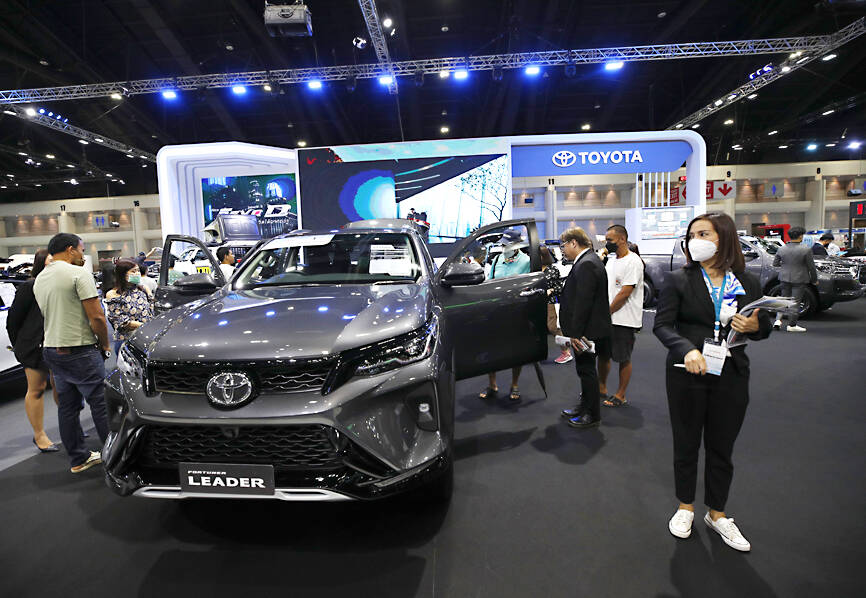
Photo: EPA-EFE
However, Toyota was last week dragged into a scandal after an investigation found that Daihatsu had manipulated collision safety data dating as far back as 1989.
It is not yet clear how much the latest scandal would cost, in terms of output, money and customer trust. Third-party investigators warned that numerous Toyota and Daihatsu brand vehicles need to undergo safety inspections again to become certified properly, and that several models could be ordered off the road.
Meanwhile, as BYD is set to overtake Tesla as the world’s best-selling EV maker, hybrids are becoming increasingly dominant in Japan. They are expected to overtake all other powertrains, including combustion and diesel engines, in registered passenger vehicle sales by the end of the year, according to Bloomberg Intelligence.
Toyota said its hybrid sales rose 52 percent year-on-year last month, while battery EV sales increased by 227 percent.
In a sector still dominated by more familiar names like Toyota, Volkswagen and General Motors Co, Chinese manufacturers including BYD and SAIC Motor Corp (上海汽車) are making serious inroads. After leapfrogging the US, South Korea and Germany over the past few years, China now rivals Japan for the global lead in passenger car exports. About 1.3 million of the 3.6 million vehicles shipped from China as of October this year were electric.
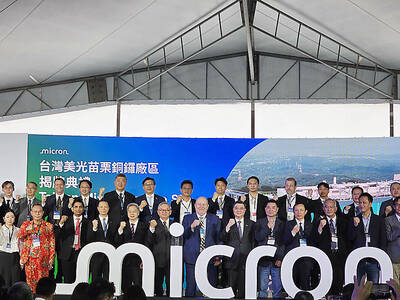
UNPRECEDENTED PACE: Micron Technology has announced plans to expand manufacturing capabilities with the acquisition of a new chip plant in Miaoli Micron Technology Inc unveiled a newly acquired chip plant in Miaoli County yesterday, as the company expands capacity to meet growing demand for advanced DRAM chips, including high-bandwidth memory chips amid the artificial intelligence boom. The plant in Miaoli County’s Tongluo Township (銅鑼), which Micron acquired from Powerchip Semiconductor Manufacturing Corp (力積電) for US$1.8 billion, is expected to make a sizeable capacity contribution to the company from fiscal 2028, the company said in a statement. It would be an extended production site of Micron’s large-scale manufacturing hub in Taichung, the company said. As the global semiconductor industry is racing to reach US$1 trillion

Singapore-based ride-hailing and delivery giant Grab Holdings Ltd has applied for regulatory approval to acquire the Taiwan operations of Germany-based Delivery Hero SE's Foodpanda in a deal valued at about US$600 million. Grab submitted the filing to the Fair Trade Commission on Friday last week, with the transaction subject to regulatory review and approval, the company said in a statement yesterday. Its independent governance structure would help foster a healthy and competitive market in Taiwan if the deal is approved, Grab said. Grab, which is listed on the NASDAQ, said in the filing that US-based Uber Technologies Inc holds about 13 percent of

Taiwan’s food delivery market could undergo a major shift if Singapore-based Grab Holdings Ltd completes its planned acquisition of Delivery Hero SE’s Foodpanda business in Taiwan, industry experts said. Grab on Monday last week announced it would acquire Foodpanda’s Taiwan operations for US$600 million. The deal is expected to be finalized in the second half of this year, with Grab aiming to complete user migration to its platform by the first half of next year. A duopoly between Uber Eats and Foodpanda dominates Taiwan’s delivery market, a structure that has remained intact since the Fair Trade Commission (FTC) blocked Uber Technologies Inc’s

Memory chip stocks extended their losses yesterday after Alphabet Inc’s Google publicized research that could allow more efficient use of the storage needed for artificial intelligence (AI) development. SK Hynix Inc and Samsung Electronics Co, South Korean leaders in the market, fell more than 6 percent and about 5 percent respectively in Seoul. In the US, Micron Technology Inc, Western Digital Corp and Sandisk Corp slid more than 2 percent in pre-market trading, after they all closed lower on Wednesday. Memory companies have been on a tear in recent months as the rapid development of AI infrastructure triggered a spike in chip


 RSS
RSS