


Export orders last month shrank 24.9 percent from a year earlier to US$44.18 billion, as demand in all major product categories from all major trading destinations declined by double-digit percentages, the Ministry of Economic Affairs said yesterday.
It was the 10th consecutive month of contraction in the critical economic bellwether, boding ill for customs-cleared exports in the next one to three months.
The situation looks set to worsen this month, as firms with negative views outnumbered those with a positive outlook, the ministry said, citing an internal survey.
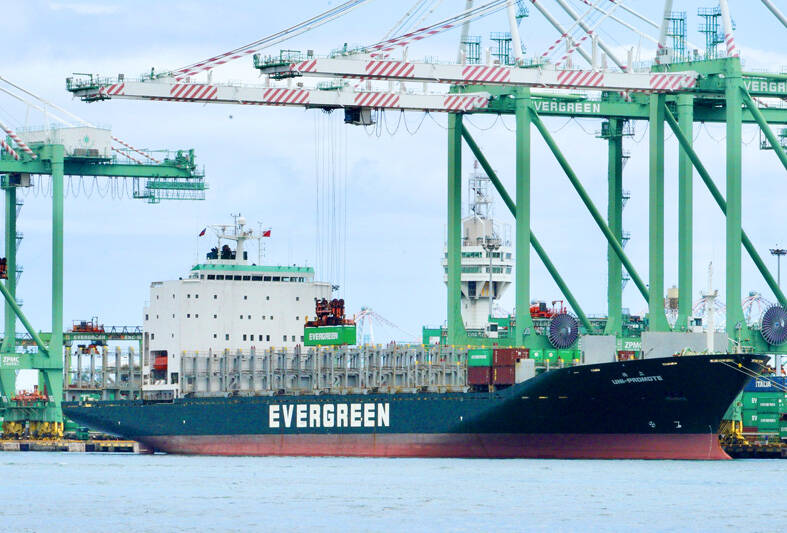
Photo: CNA
A majority, 57.5 percent, of the respondents are expecting business to remain flat, the ministry added.
Export orders from the eurozone registered the steepest retreat of 44.2 percent, followed by a 23.6 percent plunge in US orders, the ministry found. It attributed the downtrend to drastic monetary tightening in advanced economies, which has curtailed consumption of electronic gadgets.
Export orders from China and Hong Kong shed 19.7 percent year-on-year last month, as the economic recovery in the world’s second-largest economy turned out to be slower than expected, the ministry said.
Orders from Japan fell 17 percent last month, but dropped by a moderate 3.1 percent in ASEAN markets that have benefited from the global supply chain realignment as firms shift manufacturing facilities away from China, it said.
By product breakdown, export orders for information, communications and technology products tumbled 27.4 percent from a year earlier to US$12.3 billion last month, as end-market demand for notebook computers, smartphones, servers and graphics cards continued to take hard hits, the ministry said.
Export orders for electronics — including semiconductors, memory chips and printed circuit boards — slumped 22 percent to US$14.6 billion, as inventory adjustments turned out to be deeper and longer than expected, it said.
Taiwan Semiconductor Manufacturing Co (台積電), the sole iPhone chip supplier, yesterday confirmed that it expects inventory corrections to last into the fourth quarter, as its customers adopt a cautious approach to deal with slowing business.
The picture is bleaker for non-tech products, with the pace of inventory correction still exceeding 30 percent for chemical and plastics products, the ministry found.
In the second quarter, export orders decreased 20.4 percent from a year earlier, the ministry said, adding that the annual decline reached 20.8 percent in the first six months of the year.

UNPRECEDENTED PACE: Micron Technology has announced plans to expand manufacturing capabilities with the acquisition of a new chip plant in Miaoli Micron Technology Inc unveiled a newly acquired chip plant in Miaoli County yesterday, as the company expands capacity to meet growing demand for advanced DRAM chips, including high-bandwidth memory chips amid the artificial intelligence boom. The plant in Miaoli County’s Tongluo Township (銅鑼), which Micron acquired from Powerchip Semiconductor Manufacturing Corp (力積電) for US$1.8 billion, is expected to make a sizeable capacity contribution to the company from fiscal 2028, the company said in a statement. It would be an extended production site of Micron’s large-scale manufacturing hub in Taichung, the company said. As the global semiconductor industry is racing to reach US$1 trillion

Singapore-based ride-hailing and delivery giant Grab Holdings Ltd has applied for regulatory approval to acquire the Taiwan operations of Germany-based Delivery Hero SE's Foodpanda in a deal valued at about US$600 million. Grab submitted the filing to the Fair Trade Commission on Friday last week, with the transaction subject to regulatory review and approval, the company said in a statement yesterday. Its independent governance structure would help foster a healthy and competitive market in Taiwan if the deal is approved, Grab said. Grab, which is listed on the NASDAQ, said in the filing that US-based Uber Technologies Inc holds about 13 percent of

Taiwan’s food delivery market could undergo a major shift if Singapore-based Grab Holdings Ltd completes its planned acquisition of Delivery Hero SE’s Foodpanda business in Taiwan, industry experts said. Grab on Monday last week announced it would acquire Foodpanda’s Taiwan operations for US$600 million. The deal is expected to be finalized in the second half of this year, with Grab aiming to complete user migration to its platform by the first half of next year. A duopoly between Uber Eats and Foodpanda dominates Taiwan’s delivery market, a structure that has remained intact since the Fair Trade Commission (FTC) blocked Uber Technologies Inc’s

Memory chip stocks extended their losses yesterday after Alphabet Inc’s Google publicized research that could allow more efficient use of the storage needed for artificial intelligence (AI) development. SK Hynix Inc and Samsung Electronics Co, South Korean leaders in the market, fell more than 6 percent and about 5 percent respectively in Seoul. In the US, Micron Technology Inc, Western Digital Corp and Sandisk Corp slid more than 2 percent in pre-market trading, after they all closed lower on Wednesday. Memory companies have been on a tear in recent months as the rapid development of AI infrastructure triggered a spike in chip


 RSS
RSS