


The leader of a US congressional committee on China on Monday said he was concerned about electric automaker Tesla Inc’s dependency on China, a day after the company revealed plans to open a Megapack battery factory in Shanghai.
Tesla on Sunday announced the factory in a Twitter post, and Chinese state media said it would initially produce 10,000 Megapack units a year, equal to about 40 gigawatt hours of energy storage, and complement a huge existing Shanghai plant making electric vehicles.
US Representative Mike Gallagher, chairman of the US House Select Committee on Strategic Competition Between the US and the Chinese Communist Party, said he would like to know how Tesla CEO Elon Musk balances US government support for the company and its operations in China.
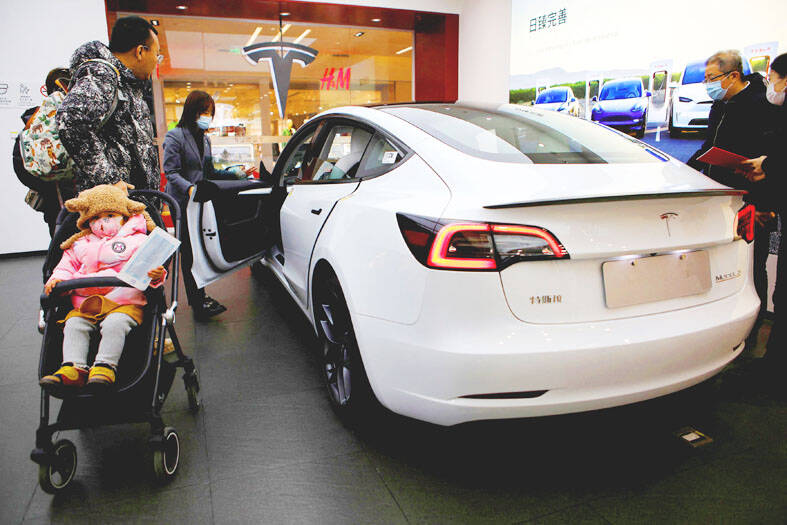
Photo: Reuters
“I’m concerned about this,” Gallagher said when asked about the battery factory.
“Tesla seems entirely dependent, A, on the largesse of the federal government via tax breaks, and B, upon access to the Chinese market,” Gallagher said.
“The sort of deals they’ve struck there seem very concerning. I’d just be curious to know how Elon Musk balances both of those,” he said, adding that Musk’s space flight venture, Space Exploration Technologies Corp, was by contrast a “massive success story.”
Tesla did not immediately respond to a request for comment on Gallagher’s remarks.
Musk on Sunday responded to criticism on Twitter, writing in a post that “Tesla is increasing production rapidly in Texas, California & Nevada.”
The company’s Shanghai factory accounted for more than half of the automaker’s global production last year. Tesla generated US$18.15 billion in revenue from China last year, accounting for more than one-fifth of its total revenue.
Tesla’s plans to open the Megapack factory come amid growing tensions between China and the US and a push by Beijing to woo foreign firms back after the country’s extended COVID-19 lockdowns battered its economy.
Gallagher last week met in California with technology and entertainment companies — including Apple Inc, Alphabet Inc’s Google and Walt Disney Co — about their business dealings in China.
His select committee, which US House of Representatives Speaker Kevin McCarthy created in January, has sought to convince Americans of the need to forcefully compete with China and to “selectively decouple” the US and Chinese economies in certain strategic industries.
Gallagher said he hoped to engage with Tesla and other companies going forward, but suggested he could require corporate executives to testify if his investigation into their ties to China were stymied.
“If we reach roadblocks and we get to a point where lawyers are getting involved with answers, that’s when you start to think about subpoenas,” he said.
Three sources at large US companies, from technology to retail, said that they are anxious about the prospect of their executives being called to testify about business operations in China and face questions such as whether their companies use supplies produced in China with forced labor.
Gallagher said he was aware executives from a range of businesses might be concerned about testifying.
“It could be a major asset manager on Wall Street. It could be a movie star or a high-powered producer. It could be the CEO of a big tech company. If they want to do business in China, there are certain questions nobody wants to be asked,” he said.
Gallagher declined to discuss the topics of the committee’s upcoming hearings, but said he was on a “tight timeline.”
So far the committee has held two hearings, one framing “existential” US-China competition, and the other on Chinese government abuses toward Uighurs in Xinjiang.
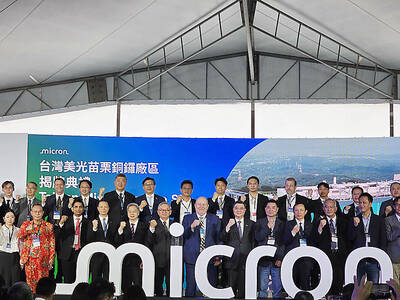
UNPRECEDENTED PACE: Micron Technology has announced plans to expand manufacturing capabilities with the acquisition of a new chip plant in Miaoli Micron Technology Inc unveiled a newly acquired chip plant in Miaoli County yesterday, as the company expands capacity to meet growing demand for advanced DRAM chips, including high-bandwidth memory chips amid the artificial intelligence boom. The plant in Miaoli County’s Tongluo Township (銅鑼), which Micron acquired from Powerchip Semiconductor Manufacturing Corp (力積電) for US$1.8 billion, is expected to make a sizeable capacity contribution to the company from fiscal 2028, the company said in a statement. It would be an extended production site of Micron’s large-scale manufacturing hub in Taichung, the company said. As the global semiconductor industry is racing to reach US$1 trillion

Singapore-based ride-hailing and delivery giant Grab Holdings Ltd has applied for regulatory approval to acquire the Taiwan operations of Germany-based Delivery Hero SE's Foodpanda in a deal valued at about US$600 million. Grab submitted the filing to the Fair Trade Commission on Friday last week, with the transaction subject to regulatory review and approval, the company said in a statement yesterday. Its independent governance structure would help foster a healthy and competitive market in Taiwan if the deal is approved, Grab said. Grab, which is listed on the NASDAQ, said in the filing that US-based Uber Technologies Inc holds about 13 percent of

Taiwan’s food delivery market could undergo a major shift if Singapore-based Grab Holdings Ltd completes its planned acquisition of Delivery Hero SE’s Foodpanda business in Taiwan, industry experts said. Grab on Monday last week announced it would acquire Foodpanda’s Taiwan operations for US$600 million. The deal is expected to be finalized in the second half of this year, with Grab aiming to complete user migration to its platform by the first half of next year. A duopoly between Uber Eats and Foodpanda dominates Taiwan’s delivery market, a structure that has remained intact since the Fair Trade Commission (FTC) blocked Uber Technologies Inc’s

Memory chip stocks extended their losses yesterday after Alphabet Inc’s Google publicized research that could allow more efficient use of the storage needed for artificial intelligence (AI) development. SK Hynix Inc and Samsung Electronics Co, South Korean leaders in the market, fell more than 6 percent and about 5 percent respectively in Seoul. In the US, Micron Technology Inc, Western Digital Corp and Sandisk Corp slid more than 2 percent in pre-market trading, after they all closed lower on Wednesday. Memory companies have been on a tear in recent months as the rapid development of AI infrastructure triggered a spike in chip


 RSS
RSS