


Flat-panel maker Innolux Corp (群創) yesterday said it has seen earlier-than-expected restocking demand from customers in preparation for the Black Friday shopping season, an early indicator that the industry is poised to recover after prices likely bottomed out this quarter.
“The inventory levels on the channel side, or on the customer side, are all very low. That is why rush orders keep coming. That is why we even see customers pre-ordering for Black Friday,” Innolux chairman Jim Hung (洪進揚) told investors at a teleconference.
Customers used to conclude supply contract negotiations in April, but they are willing to strike deals this month, as there is scant room for further downside in terms of panel prices, Innolux said.

Photo: Chen Mei-ying, Taipei Times
Hung said he expects a single-digit percentage improvement in factory utilization this quarter.
Factory utilization fell to about 75 percent in the fourth quarter of last year, down slightly from the previous quarter, he said.
As inventory digestion approaches a healthy level, Innolux expects panel prices to rebound for major applications, from TV panels to those used in notebook computers and monitors, company president James Yang (楊柱祥) said.
Yang said TV panels enjoyed a “juicy rebound” in the fourth quarter of last year, and panels for computers and monitors would follow suit this quarter or next quarter.
“We hold a cautiously optimistic view about the second quarter, which should be the point of rebound,” Yang said.
Innolux also said it has signed an agreement with India’s Vedanta Group to transfer its flat-panel manufacturing technology, to tap into India’s TV market and answer customers’ calls for capacity diversification.
Some key customers have asked the company to allocate capacity outside of Taiwan and China, due to concerns over geopolitical tensions, Innolux said.
Based on the agreement, Innolux would help Vedanta build a flat-panel production line in India and help license its intellectual property, in line with New Delhi’s “Make in India” policy.
Innolux did not provide details about its strategic partnership with Vedanta, saying cooperation would largely depend on government approval.
Market researcher Omidia said the planned fab, which would be the first flat-panel factory in India, would be similar to Innolux’s generation 8.6 fab.
Vedanta engineers are undergoing on-site training in Taiwan, the researcher said.
Construction is expected to begin next year and the factory is scheduled to start production in 2026, it added.
Innolux would likely receive a one-time technical transfer payment and collect ongoing royalty payments per display when mass production begins, the researcher said.
Innolux said quarterly losses last quarter narrowed slightly to NT$12.39 billion (US$404.5 million), compared with NT$12.75 billion in the third quarter of last year.
The company attributed the improvement to robust cost management efforts, which helped boost gross margin to minus-15 percent from minus-18.7 percent in the prior quarter. Operating margin also improved to minus-26.7 percent from minus 32-percent.
Last year, Innolux lost NT$27.99 billion, or a loss per share of NT$2.76, its poorest performance in about a decade.

NEW MARKET: The partnership opens up India to the Dutch company, which already has a strong hold in the semiconductor market of South Korea, Taiwan and China ASML Holding NV entered into a partnership agreement with Tata Electronics Pvt Ltd aimed at ramping up India’s goal to develop domestic chip-manufacturing capabilities. The Dutch company’s technology would help power Tata Electronics’ planned 300 millimeter (mm) semiconductor foundry in Gujarat, according to a joint statement from the two companies on Saturday. The signing of a memorandum of understanding coincides with a visit by Indian Prime Minister Narendra Modi to the Netherlands, which is looking to deepen bilateral relations with New Delhi. ASML, whose top customers include Taiwan Semiconductor Manufacturing Co (台積電) and Samsung Electronics Co, makes lithography machines that can print
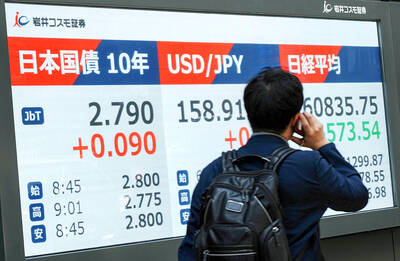
ROUGH RECORDS: Bonds in Japan, as well is in New Zealand, Australia and the US, are seeing the effects of a nervy market as stock exchanges across Asia edge down A deepening slump in Japanese government bonds added fuel to the selloff in global debt markets as rising oil prices stoked inflation fears and pushed yields to multi-decade highs. Japan’s 30-year yield yesterday surged as much as 20 basis points to the highest level since the tenor’s debut in 1999, before paring some of the move. Shorter-maturity Japanese debt was also under pressure, underscored by weak demand at a sale of five-year notes that offered a record-high coupon of 2 percent. Concerns over inflation and government spending rippling through markets including the US, Australia and New Zealand are being amplified in Japan,

The US has cleared about 10 Chinese firms to buy Nvidia Corp’s second-most powerful artificial intelligence (AI) chip, the H200, but not a single delivery has been made so far, three people familiar with the matter said, leaving a major technology deal in limbo as chief executive officer Jensen Huang (黃仁勳) seeks a breakthrough in China this week. Huang, who was not initially listed in a White House delegation to Beijing, joined the trip after an invitation from US President Donald Trump, a source said. Trump picked him up in Alaska en route to a summit with Chinese President Xi Jinping

Wall Street is licking its chops over an unprecedented slate of massive initial public offerings (IPOs) set to arrive in the coming months, beginning with Elon Musk’s Space Exploration Technologies Corp (SpaceX) next month. That is expected to be followed by artificial intelligence (AI) rivals OpenAI and Anthropic PBC. The trio of mega listings, each eyeing valuations around US$1 trillion or more, constitutes a heady period of elevated risk and reward. SpaceX is targeting an IPO that would raise up to US$80 billion — about double the funds generated from all IPOs last year. OpenAI and Anthropic are eyeing IPOs raising US$60 billion. “We’re


 RSS
RSS