


Air France and Airbus SE faced the start of a nine-week manslaughter trial yesterday, 13 years after an A330 jet plunged into the Atlantic Ocean killing all 228 people on board.
Flight 447 vanished in pitch darkness during an equatorial storm en route from Rio de Janeiro to Paris on June 1, 2009.
After a two-year search for black boxes using remote submarines, investigators determined that the pilots had mishandled the loss of data from iced-up sensors and pushed the 205-tonne jet into a freefall, without responding to repeated “stall” alerts.
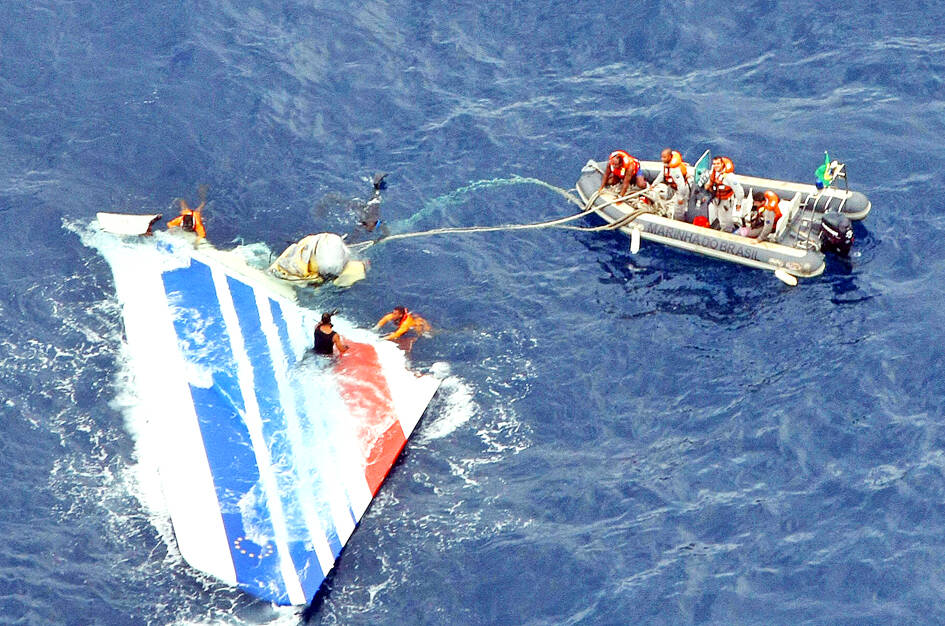
Photo: Brazilian Navy via AFP
However, the French Bureau of Enquiry and Analysis for Civil Aviation Safety also revealed earlier discussions between Air France and Airbus about the reliability of the probes, and said the airline had begun swapping to an improved version just six days before its worst ever disaster.
Experts said that the relative roles of pilot or sensor error are to be key factors in the historic trial.
It is the first time French companies face trial for “involuntary manslaughter” following an air crash. Victims’ families have said that individual managers should also be on trial.
The maximum fine for either company, if convicted, is just 225,000 euros (US$218,263). Undisclosed larger sums have also been made in compensation and out-of-court civil settlements.
Relatives of those who died, who were mainly French, Brazilian or German, have called for “impartial justice” after campaigning to overturn an earlier decision to shelve a trial.
The trial is expected to expose differences between Air France and Airbus over causes of the crash, with the planemaker blaming pilot error and the airline pointing to confusing displays and alarms.
The tragedy sparked a rethink about airline training and technology, and is seen as one of a handful of accidents that changed aviation, including improvements in handling lost control.
Central to the trial is the mystery of why the crew of three, with more than 20,000 hours of flying experience between them, failed to understand that the A330 had lost lift or “stalled.”
That required the basic maneuver of pushing the nose down instead of yanking it up as they did during much of the fatal four-minute plunge, creating even more error messages that fed off each other as the plane hurtled towards the Atlantic.
The French safety bureau’s report said the pilots responded inappropriately to the icing problem, but also did not have the training needed to fly manually at high altitudes after the autopilot dropped out.
It also singled out erratic readings of a cockpit display called the flight director, which has since been redesigned to switch itself off in such events to avoid distraction.
The trial is scheduled to run until Dec. 8 at the Paris Criminal Court.

Elon Musk’s lieutenants have reached out to chip industry suppliers, including Applied Materials Inc, Tokyo Electron Ltd and Lam Research Corp, for his envisioned Terafab, early steps in an audacious and likely arduous attempt to break into the production of cutting-edge chips. Staff working for the joint venture between Tesla Inc and Space Exploration Technologies Corp (SpaceX) have sought price quotes and delivery times for an array of chipmaking gear, people familiar with the matter said. In past weeks, they’ve contacted makers of photomasks, substrates, etchers, depositors, cleaning devices, testers and other tools, according to the people, who asked not to

Taiwan is attracting a growing number of foreign jobseekers as companies increasingly recruit overseas talent to ease labor shortages and expand global reach, recruitment platform 104 Job Bank (104人力銀行) said yesterday. More than 40,000 foreign nationals searched for jobs in Taiwan through the platform last year, a 28 percent increase from a year earlier, the company said. Malaysians accounted for the largest share of overseas jobseekers at 12.2 percent, followed by Indonesians at 11.9 percent and Vietnamese at 10.8 percent. Indonesian applicants surged more than 50 percent year-on-year, while Vietnamese jobseekers rose by more than 30 percent. Applicants from the
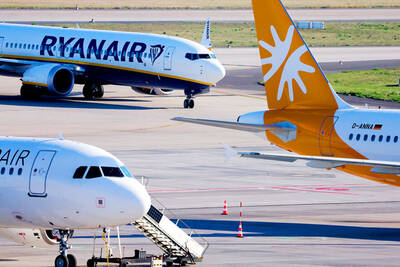
JET JUICE: The war on Iran’s secondary effects have seen fuel prices skyrocket, knocking flight schedules down to earth in return as airlines struggle with costs Airline passengers should brace for more irritation in the next few months as carriers worldwide cancel flights and ground planes to cope with stratospheric increases in jet-fuel prices. Dutch flag carrier KLM is the latest company to cut its schedule, saying on Thursday that it would scrap 80 return flights at Amsterdam’s Schiphol Airport in the coming month. That puts it in the same league as United Airlines Holdings Inc, Deutsche Lufthansa AG and Cathay Pacific Airways Ltd, which have all pruned itineraries to mitigate costs. Global capacity for next month has been reduced by about 3 percentage points, with all
NO SHORTCUTS: Asked about Elon Musk’s Terafab initiative, TSMC CEO C.C. Wei said it takes two to three years to build a fab and another one to two to ramp it up Taiwan Semiconductor Manufacturing Co (TSMC, 台積電) yesterday raised its revenue growth forecast for this year to above 30 percent, up from the 25 percent it estimated three months earlier, citing extremely robust artificial intelligence (AI)-related chip demand. “Our customers and customers’ customers, who are mainly cloud service providers, continue to send us very positive signals and outlook,” TSMC chairman and CEO C.C. Wei (魏哲家) said at an earnings conference. The company also hiked its capital expenditure for this year toward the higher end of its forecast, or US$56 billion, as it aims to step up advanced chip capacity expansions, such as


 RSS
RSS