


GERMANY
Trade deficit reported
The country reported its first monthly trade deficit in three decades after exports unexpectedly fell in May. The shortfall of 1 billion euros (US$1.04 billion) was the first since 1991. Cross-border sales declined 0.5 percent, compared with an economist forecast of an increase of 0.7 percent. At the same time imports rose 2.7 percent, much more than anticipated. Russia’s invasion of Ukraine and China’s COVID-19 lockdowns are wreaking havoc with international supply chains, with substantial fallout for Germany’s export-oriented economy.
SOUTH KOREA
Officials to boost efforts
Bank of Korea Governor Rhee Chang-yong and Minister of Finance Choo Kyung-ho met yesterday and agreed to ramp up their cooperation to deal with rising risks to the economy. Rhee and Choo agreed to “pre-emptively” act to prevent macroeconomic risks with rates rising at home and abroad, the ministry said in a statement. They also expected a “complex economic crisis situation” to last for a considerable period, it said. Choo has warned inflation could surpass 6 percent this summer. Higher-than-expected gains in consumer prices have prompted the finance ministry and the bank to revise their earlier growth forecasts to below 3 percent this year.
TURKEY
Inflation nears 79 percent
Inflation last month soared to an annual rate of 78.6 percent, the highest in 24 years, official data showed yesterday, as President Recep Tayyip Erdogan’s unconventional economic policies continued to take their toll. Inflation had stood at 73.5 percent in May and at 15 percent at the start of last year. The data showed that headline inflation was driven by a 123.4 percent jump in the cost of transportation and a 94 percent increase in non-alcoholic drinks. The price of household goods surged by 81.1 percent, the statistics agency calculated. Minister of Economy Nureddin Nebati on Friday “promised” that consumer prices will start dropping in December.
UTILITIES
UK Power deal collapses
A £15 billion (US$18.2 billion) takeover approach led by KKR & Co for the UK’s largest electricity distribution business collapsed, the Financial Times reported. CK Infrastructure Holdings Ltd (長江基建), which jointly owns UK Power Networks Holdings Ltd, tried to increase the sale price before an agreement was due to be signed last month, the newspaper said, citing two people close to the deal who it did not identify. The bidder group, which also includes Macquarie Group Ltd, APG, China Investment Corp (中國投資), Ontario Teachers’ Pension Plan Board and PSP Investments, had been in advanced talks over an agreement, people familiar with the issue told Bloomberg News in March.
TELECOMS
Thai firm eyes expansion
Advanced Info Service PCL, Thailand’s biggest mobile phone operator, plans to expand its network by acquiring Triple T Broadband PCL and an infrastructure fund for a total of 32.4 billion baht (US$908 million). The Bangkok-based company is to buy Internet provider Triple T from Jasmine International PCL for 19.5 billion baht, chief financial officer Tee Seeumpornroj said in an exchange filing. It would also acquire 1.52 billion units, or a 19 percent stake, in Jasmine Broadband Internet Infrastructure Fund for 12.9 billion baht. At 8.5 baht a unit, that is a 7.6 percent discount to the fund’s latest unit price of 9.2 baht.
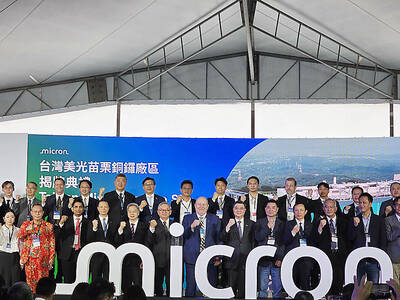
UNPRECEDENTED PACE: Micron Technology has announced plans to expand manufacturing capabilities with the acquisition of a new chip plant in Miaoli Micron Technology Inc unveiled a newly acquired chip plant in Miaoli County yesterday, as the company expands capacity to meet growing demand for advanced DRAM chips, including high-bandwidth memory chips amid the artificial intelligence boom. The plant in Miaoli County’s Tongluo Township (銅鑼), which Micron acquired from Powerchip Semiconductor Manufacturing Corp (力積電) for US$1.8 billion, is expected to make a sizeable capacity contribution to the company from fiscal 2028, the company said in a statement. It would be an extended production site of Micron’s large-scale manufacturing hub in Taichung, the company said. As the global semiconductor industry is racing to reach US$1 trillion
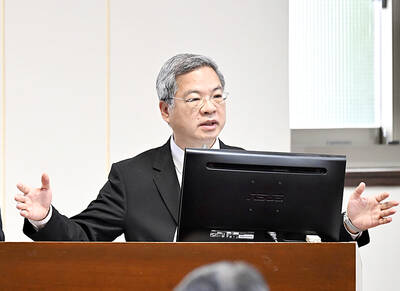
ABOVE LEGAL REQUIREMENT: The Ministry of Economic Affairs is prepared if LNG supply is disrupted, with more than the legal requirement of 11 days of inventory Taiwan has largely secured liquefied natural gas (LNG) supplies through May and arranged about half of June’s supply, Minister of Economic Affairs Kung Ming-hsin (龔明鑫) said yesterday. Since the Middle East conflict began on Feb. 28, Taiwan’s LNG inventories have remained more than 12 days, exceeding the legal requirement of 11 days, indicating no major supply concerns for domestic gas and electricity, Kung said at a meeting of the legislature’s Economics Committee in Taipei. The ministry aims to increase the figure to 14 days by the end of next year, he said. While one or two LNG or crude oil shipments for May

Taiwan’s food delivery market could undergo a major shift if Singapore-based Grab Holdings Ltd completes its planned acquisition of Delivery Hero SE’s Foodpanda business in Taiwan, industry experts said. Grab on Monday last week announced it would acquire Foodpanda’s Taiwan operations for US$600 million. The deal is expected to be finalized in the second half of this year, with Grab aiming to complete user migration to its platform by the first half of next year. A duopoly between Uber Eats and Foodpanda dominates Taiwan’s delivery market, a structure that has remained intact since the Fair Trade Commission (FTC) blocked Uber Technologies Inc’s

Memory chip stocks extended their losses yesterday after Alphabet Inc’s Google publicized research that could allow more efficient use of the storage needed for artificial intelligence (AI) development. SK Hynix Inc and Samsung Electronics Co, South Korean leaders in the market, fell more than 6 percent and about 5 percent respectively in Seoul. In the US, Micron Technology Inc, Western Digital Corp and Sandisk Corp slid more than 2 percent in pre-market trading, after they all closed lower on Wednesday. Memory companies have been on a tear in recent months as the rapid development of AI infrastructure triggered a spike in chip


 RSS
RSS