


Former Taipei mayor Ko Wen-je (柯文哲) was yesterday sentenced to 17 years in prison and had his civil rights suspended for six years over corruption, embezzlement and other charges.
Taipei prosecutors in December last year asked the Taipei District Court for a combined 28-year, six-month sentence for the four cases against Ko, who founded the Taiwan People’s Party (TPP).
The cases were linked to the Core Pacific City (京華城購物中心) redevelopment project and the mismanagement of political donations.
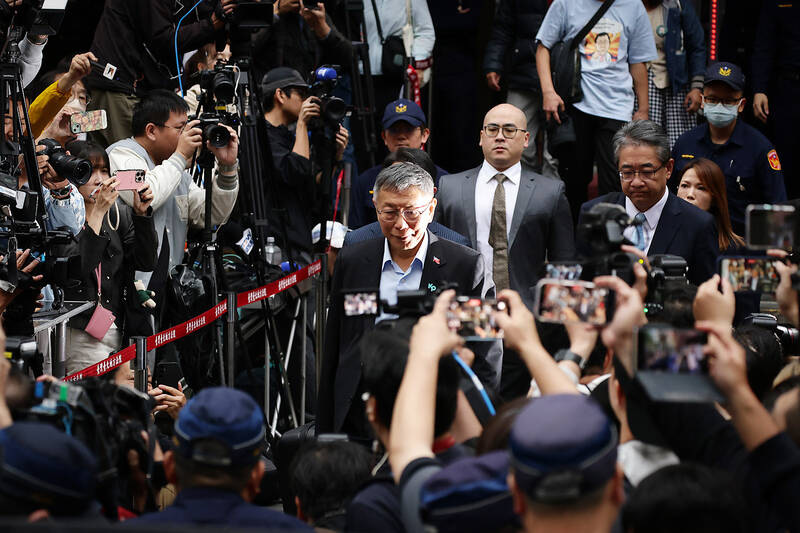
Photo: Ritchie B. Tongo, EPA
Other defendants convicted on separate charges included Chinese Nationalist Party (KMT) Taipei City Councilor Angela Ying (應曉薇), who was handed a 15-year, six-month sentence; Core Pacific Group (威京集團) chairman Sheen Ching-jing (沈慶京), who was given 10 years.
Also receiving jail terms were Huang Ching-mao (黃景茂), former head of the Taipei Department of Urban Development (six years, six months); Lee Wen-tsung (李文宗), office manager in charge of Ko’s presidential campaign finances (four years, six months); Shao Hsiu-pei (邵琇珮), former Taipei Urban Planning Commission executive secretary (one year, three months, suspended); and Tuanmu Cheng (端木正), an accountant (one year).
Pong Cheng-sheng (彭振聲), who was Taipei deputy mayor while Ko was in office, was convicted on charges of illegal profiteering for his role in the Core Pacific case and handed a two-year suspended sentence.
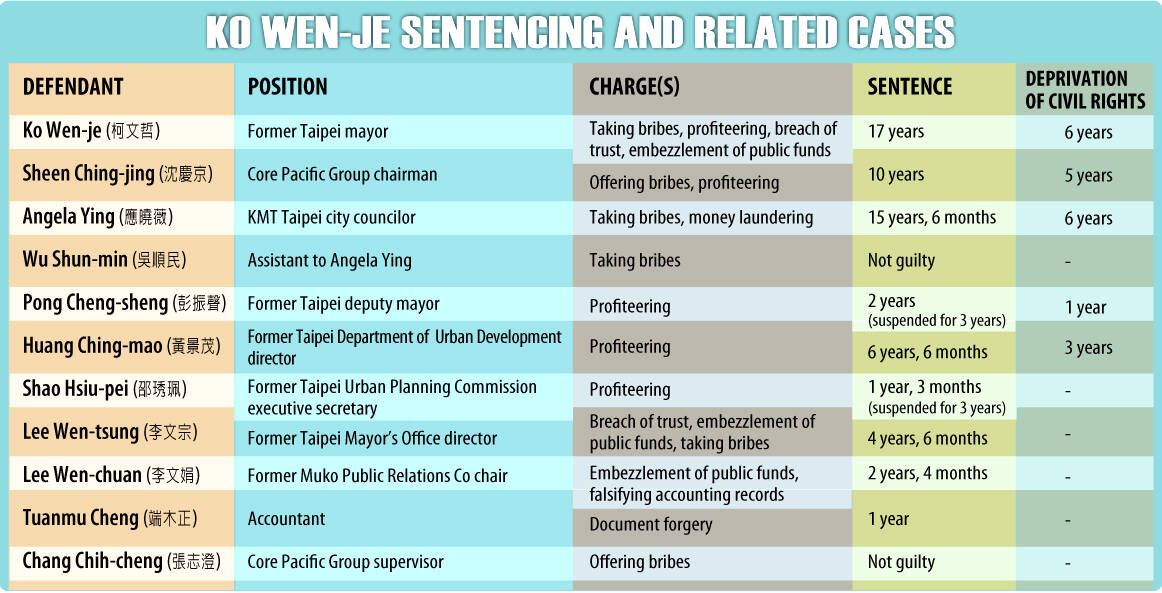
The district court ruling can be appealed, with Ko’s lawyers saying that they planned to do so.
The trial also covered charges related to Ko’s dealings when he was Taipei mayor from 2018 to 2022, and during his presidential campaign in January 2024.
The other charges included breaches of the Anti-Corruption Act (貪污治罪條例): embezzlement of political donations, illicit funds transfers to pay campaign expenses, false declarations of assets relating to political donations and taking bribes.
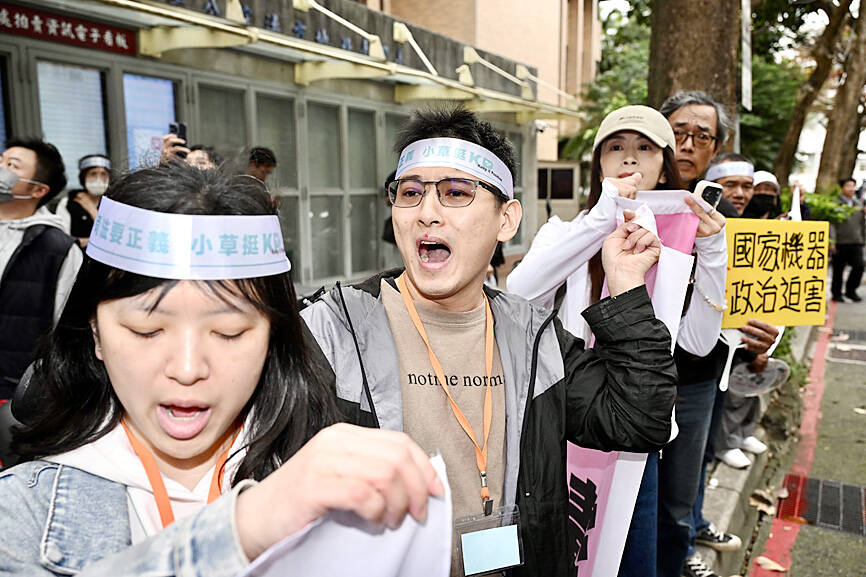
Photo: Lo Pei-de, Taipei Times
The court said that it found sufficient evidence from seized records, office documents, and testimony from defendants and witnesses to convict Ko on the corruption charges, which carried a 13-year sentence; two years for illegal profiteering; three-and-a-half years for embezzlement; and two-and-a-half years for breach of trust.
The evidence showed that Ko had received bribes originating from Sheen and his executives that had a direct bearing on the decision to increase the floor area ratio of the Core Pacific City project to up to 840 percent, the court said.
The change gave permission for more floor space in the project, boosting potential returns, with the decisions approved by the Taipei City Government during Ko’s tenure, it said.
Ko has been ruled out of contesting the 2028 presidential election in accordance with the Presidential and Vice Presidential Election and Recall Act (總統副總統選舉罷免法), which stipulates that people convicted and sentenced to 10 years or more are ineligible to run for office.
Ying was convicted of accepting bribes in breach of public office duty and money laundering. In addition to her jail sentence, she was deprived of her civil rights for six years and fined NT$10 million (US$313,430).
Sheen was found guilty of illegal profiteering and bribing public officials. He was deprived of his civil rights for five years and fined NT$20 million.
Ko’s lawyers asked the court to reduce the NT$70 million bail he posted last year and lift the requirement that he wear an electronic monitor, but the bail judge denied the requests.
The bail court also denied requests from Sheen and Ying to have additional bail amounts of NT$30 million lifted.
It said that as they had received heavy sentences, the reasons for their high bonds — including the likelihood of flight and tampering with evidence — remained in effect.
A crowd of about 200 TPP supporters gathered outside the Taipei District Court on Boai Road, as party executives told reporters they had mobilized people from across Taiwan, to give support to Ko, who was mandated to attend in person to hear the court’s ruling.
“Ko Wen-je is innocent,” they shouted after the ruling was announced.
Others outside the court shouted that Ko is a “major offender” and must serve prison time.
Police put up metal barricades to separate the two sides.
National Taiwan University (NTU) yesterday said it disqualified a person from an entrance examination for using AI smart glasses to cheat, along with two others for making untruthful statements in their curriculum vitae. The three applicants were given null scores, Taiwan’s highest-ranked university said, calling on prospective students to be honest in the admissions process. NTU registrar Lee Hung-sen (李宏森) said that the cheating applicant wore a hat and thick-rimmed glasses to the second written exam for medical school, claiming that they felt cold. Suspicions were aroused when the applicant stared oddly at the test for long stretches while steadily bringing the paper

66 FIGHTER JETS: The aircraft is likely undergoing preparations for its transfer to Taiwan — a significant step forward in the nation’s modernization program, a lawmaker said The first of Taiwan’s order of F-16V Block 70 aircraft has been sighted in Texas ahead of delivery, Democratic Progressive Party (DPP) Legislator Wang Ting-yu (王定宇) said. Taiwan’s first F-16V Block 70 two-seat aircraft, tail number 6831, was seen flying from Lockheed Martin’s production facility in Greenville, South Carolina, to Naval Air Station Joint Reserve Base Fort Worth in Texas, Wang wrote on Facebook yesterday. The plane is likely undergoing preparations for its transfer to Taiwan, marking a significant step forward in the Republic of China Air Force’s modernization program, Wang said, citing military analysts. The F-16V Block 70 is a new-build version
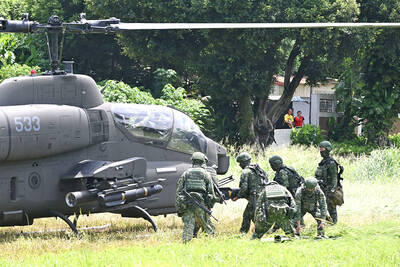
MILITARY ISSUES: A partisan divide between the Cabinet and the legislature ‘raised questions about Taiwan’s ability to adequately fund its defense,’ the report said Taiwan’s defense budget, military personnel numbers and resilience are challenges to its ability to meet national defense goals, the US Naval Institute said in a report published on Tuesday. In response to the perception of a growing military threat posed by China, Taiwan has embarked on an effort to enhance the capabilities needed to deter an attempt by Beijing to annex the nation by force, the institute said in the US Congressional Research Service report, titled Taiwan: Defense and Military Issues, which was filed on Thursday last week. Taiwan’s defense budget increased by about 7.5 percent from 2024 to last year, it
NOT JUST NUMBERS: What matters to intelligence work is crucial, reliable information, so even a few credible leads can be highly valuable to national security, a legislator said The National Security Bureau (NSB) yesterday said it has finished the establishment of an information-reporting channel for Chinese nationals, the aim of which is to broaden intelligence gathering on China’s political, military, economic and social developments. Chinese nationals can submit information on the Web page, https://report.nsb.gov.tw, the NSB said in a statement. The move aims to expand the bureau’s diverse intelligence sources and is pursuant to the National Intelligence Services Act (國家情報工作法), it said, adding that it referenced practices adopted by intelligence agencies in the US, the UK and Israel. An increasing number of people are approaching Taiwanese agencies to provide information, as


 RSS
RSS