


The Financial Supervisory Commission (FSC) yesterday fined Cathay United Bank (國泰世華銀行) NT$2 million (US$68,622) and banned the lender from setting up new automatic teller machines (ATMs) as the bank’s ATM service malfunctioned several times recently, significantly affecting clients, the commission said.
The commission also raised the risk factor for Cathay United Bank in light of the recent incidents.
The bank must increase its capital by at least NT$750 million to keep its BIS capital adequacy ratio unchanged at 16.25 percent, Banking Bureau Chief Secretary Phil Tong (童政彰) told a news conference.
The bank could issue new shares or bonds to perform the cash injection, Tong added.
The bank, which operates 5,070 ATMs and ranks second among local banks in terms of the number of ATMs, had applied to the commission to set up 246 new machines this year, but the expansion would be suspended until the bank improves its ATM system, Tong said.
Only some ATMs proposed to be installed in remote areas would be allowed to be set up, he added.
Cathay United Bank’s ATMs have malfunctioned four times over the past six months, affecting 32,452 clients in the first two incidents in October last year, 2,015 in February and 732 people last month, the commission said.
The malfunctions occurred while the bank was updating its database, causing clients not to be able to transfer, withdraw or deposit money, Tong said.
Although the bank said that it had hired a contractor to update its database and was negotiating compensation with the company, it demonstrated poor internal control when dealing with the malfunctions, Tong said.
The bank did not properly evaluate whether a stress test was intense enough, nor did it set up an emergency plan for its call center, Tong said, adding that the bank did not notify the regulator quickly enough.
Among the fines levied on financial institutions for malfunctions in their information systems, Cathay United Bank’s fine was the second-highest after the NT$5 million fine on Citibank Taiwan Ltd (花旗台灣) in 2019, commission data showed.
However, Cathay United Bank was the first bank that was required to increase capital due to a malfunction, the commission said.
Previously, E.Sun Commercial Bank (玉山銀行) was asked to inject cash after its personnel stole money from clients, it said.
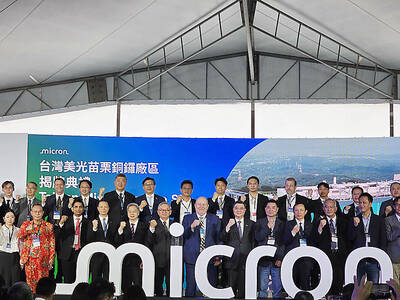
UNPRECEDENTED PACE: Micron Technology has announced plans to expand manufacturing capabilities with the acquisition of a new chip plant in Miaoli Micron Technology Inc unveiled a newly acquired chip plant in Miaoli County yesterday, as the company expands capacity to meet growing demand for advanced DRAM chips, including high-bandwidth memory chips amid the artificial intelligence boom. The plant in Miaoli County’s Tongluo Township (銅鑼), which Micron acquired from Powerchip Semiconductor Manufacturing Corp (力積電) for US$1.8 billion, is expected to make a sizeable capacity contribution to the company from fiscal 2028, the company said in a statement. It would be an extended production site of Micron’s large-scale manufacturing hub in Taichung, the company said. As the global semiconductor industry is racing to reach US$1 trillion

Singapore-based ride-hailing and delivery giant Grab Holdings Ltd has applied for regulatory approval to acquire the Taiwan operations of Germany-based Delivery Hero SE's Foodpanda in a deal valued at about US$600 million. Grab submitted the filing to the Fair Trade Commission on Friday last week, with the transaction subject to regulatory review and approval, the company said in a statement yesterday. Its independent governance structure would help foster a healthy and competitive market in Taiwan if the deal is approved, Grab said. Grab, which is listed on the NASDAQ, said in the filing that US-based Uber Technologies Inc holds about 13 percent of

Taiwan’s food delivery market could undergo a major shift if Singapore-based Grab Holdings Ltd completes its planned acquisition of Delivery Hero SE’s Foodpanda business in Taiwan, industry experts said. Grab on Monday last week announced it would acquire Foodpanda’s Taiwan operations for US$600 million. The deal is expected to be finalized in the second half of this year, with Grab aiming to complete user migration to its platform by the first half of next year. A duopoly between Uber Eats and Foodpanda dominates Taiwan’s delivery market, a structure that has remained intact since the Fair Trade Commission (FTC) blocked Uber Technologies Inc’s

Memory chip stocks extended their losses yesterday after Alphabet Inc’s Google publicized research that could allow more efficient use of the storage needed for artificial intelligence (AI) development. SK Hynix Inc and Samsung Electronics Co, South Korean leaders in the market, fell more than 6 percent and about 5 percent respectively in Seoul. In the US, Micron Technology Inc, Western Digital Corp and Sandisk Corp slid more than 2 percent in pre-market trading, after they all closed lower on Wednesday. Memory companies have been on a tear in recent months as the rapid development of AI infrastructure triggered a spike in chip


 RSS
RSS