


Trade relations between Washington and Beijing are at a “difficult” stage, but US President Joe Biden’s administration is committed to protecting the US economy from negative impacts of China’s policies, the top US trade official said on Monday.
US Trade Representative Katherine Tai (戴琪) said her team will “engage robustly” with China in ongoing talks over Beijing’s commitments to buy US goods under a deal signed under former US president Donald Trump.
“We’re in a very difficult stage of this trade relationship,” Tai said, adding that “the conversations are not easy.”
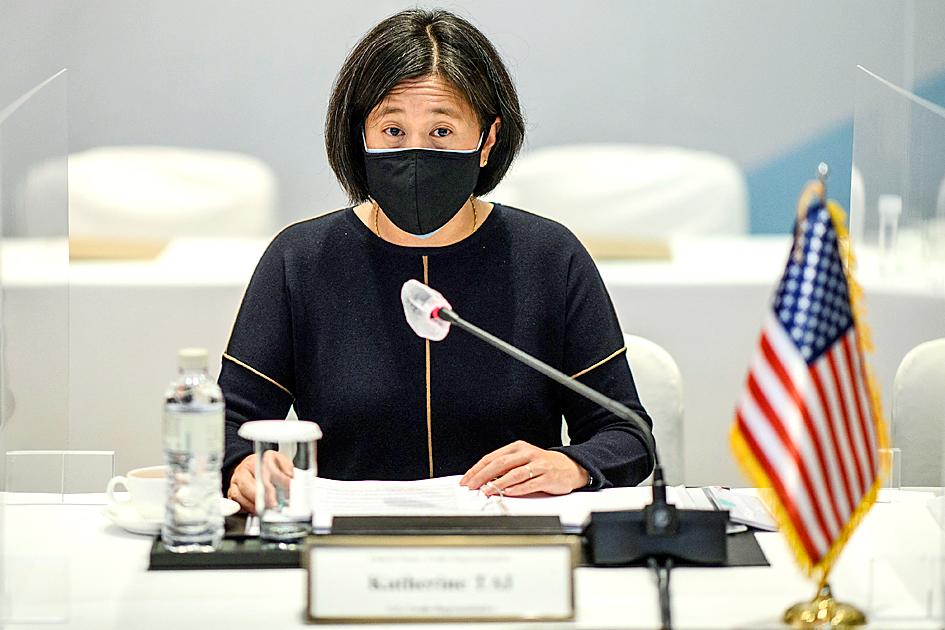
Photo: AFP
The two countries signed a so-called “phase one” agreement in January 2020, in which Beijing pledged to increase its purchases of US products and services by at least US$200 billion over 2020 and last year.
However, amid the COVID-19 pandemic, Beijing has fallen fall short of those targets.
Calling the relationship “one of the defining issues we work on,” Tai said she has started the “step one” discussions with China on the trade deal, but they have not yielded results yet.
The administration’s broader aim is to “defend the American economy, our workers and our businesses from the negative impacts” of China’s nonmarket policies, she said in a fireside chat with the National Asian Pacific American Bar Association.
Biden recently said he is not yet ready to remove the tariffs his predecessor imposed in 2018 on Chinese products worth US$370 billion, citing “unfair” trade practices.
REFORM WHO
In her comments on Monday, Tai also said that she is “heartened” by the prospects of reforming the WTO.
She pointed to a “universal commitment ... that the WTO as an institution is important, and deserves our attention.”
The Trump administration paralyzed the WTO’s dispute resolution body, but Tai pledged the US would take a leadership role in the reform effort.
“We might have different visions about what we would like the WTO to be specifically, but let’s engage in that process,” she said.
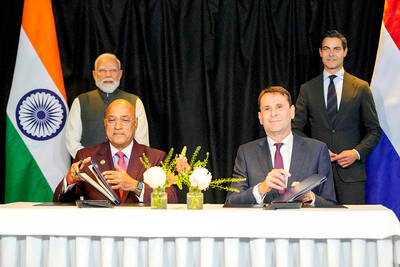
NEW MARKET: The partnership opens up India to the Dutch company, which already has a strong hold in the semiconductor market of South Korea, Taiwan and China ASML Holding NV entered into a partnership agreement with Tata Electronics Pvt Ltd aimed at ramping up India’s goal to develop domestic chip-manufacturing capabilities. The Dutch company’s technology would help power Tata Electronics’ planned 300 millimeter (mm) semiconductor foundry in Gujarat, according to a joint statement from the two companies on Saturday. The signing of a memorandum of understanding coincides with a visit by Indian Prime Minister Narendra Modi to the Netherlands, which is looking to deepen bilateral relations with New Delhi. ASML, whose top customers include Taiwan Semiconductor Manufacturing Co (台積電) and Samsung Electronics Co, makes lithography machines that can print
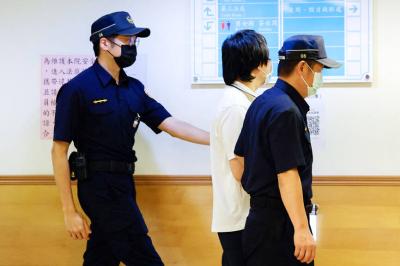
Tokyo Electron's Taiwan unit today said in a written response that it respects the judicial process, takes the court ruling seriously and would not appeal in the Taiwan Semiconductor Manufacturing Co (TSMC, 台積電) trade secrets case. Last month, a court fined the Taiwan unit of Japan's Tokyo Electron NT$150 million (US$4.74 million) in a case involving trade secrets related to TSMC's sensitive chip technology.
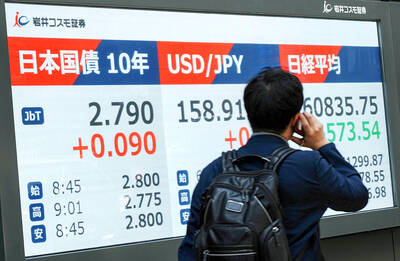
ROUGH RECORDS: Bonds in Japan, as well is in New Zealand, Australia and the US, are seeing the effects of a nervy market as stock exchanges across Asia edge down A deepening slump in Japanese government bonds added fuel to the selloff in global debt markets as rising oil prices stoked inflation fears and pushed yields to multi-decade highs. Japan’s 30-year yield yesterday surged as much as 20 basis points to the highest level since the tenor’s debut in 1999, before paring some of the move. Shorter-maturity Japanese debt was also under pressure, underscored by weak demand at a sale of five-year notes that offered a record-high coupon of 2 percent. Concerns over inflation and government spending rippling through markets including the US, Australia and New Zealand are being amplified in Japan,
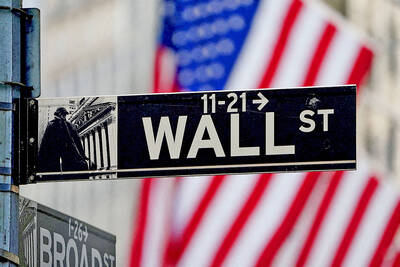
Wall Street is licking its chops over an unprecedented slate of massive initial public offerings (IPOs) set to arrive in the coming months, beginning with Elon Musk’s Space Exploration Technologies Corp (SpaceX) next month. That is expected to be followed by artificial intelligence (AI) rivals OpenAI and Anthropic PBC. The trio of mega listings, each eyeing valuations around US$1 trillion or more, constitutes a heady period of elevated risk and reward. SpaceX is targeting an IPO that would raise up to US$80 billion — about double the funds generated from all IPOs last year. OpenAI and Anthropic are eyeing IPOs raising US$60 billion. “We’re


 RSS
RSS