


You can save your prized Aston Martin DB6, Porsche 911 or Mustang from the museum of combustion engine history. Or your Fiat 500 and Renault Clio, for that matter. That is the message from a growing cohort of European and US start-ups seeking to carve out roles in the auto transition by converting the roaring dinosaurs of the fossil-fuel age into clean electric vehicles (EVs).
At the high end, companies like Britain’s Lunaz Group sell a “remanufactured” Aston Martin DB6 for £1 million (US$1.32 million), or Dutch firm Voitures Extravert, which sells a re-engineered 1960s Porsche 911 for 300,000 euros (US$339,435).
At the lower end, start-ups like France’s Transition-One have developed no-frills kits designed to electrify mass-market models such as the Fiat 500 and Renault Clio in a few hours for about 8,000 euros.
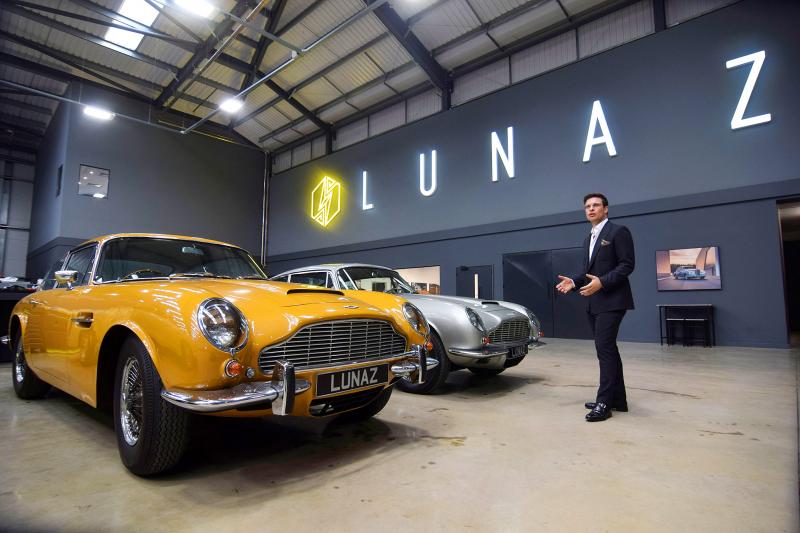
Photo: Reuters
They are betting they can provide drivers with a cheaper and greener road to zero emissions than scrapping their car and buying a new one.
EV conversion is a cottage industry that has emerged over the past five years, and been turbo-charged by advances in battery technology and electric motors in the past two. The market is largely untested, and several industry players described an exciting, if precarious, scene.
“It’s pretty revolutionary at the moment,” said Mark Roberts, a 30-year McLaren Automotive veteran who is now chief creative officer at British start-up Charge Cars. “Almost every month there are new companies popping up, and you don’t know who’ll fade away after a year or so or who’ll be there for the duration.”
Next year, Charge Cars plans to launch production of 499 electric versions of 1960s Mustangs, built from the ground up using car bodies produced under license from Ford and starting at 300,000 pounds apiece.
The company, which initially set out to convert classic cars, has spent five years developing an electric replica model instead.
“Traditional manufacturers like Porsche can afford to screw up,” Charge Cars chief executive Vadim Shageleev said. “We’re a start-up, so we can’t.”
Established start-ups like his have attracted attention from traditional auto suppliers and manufacturers seeking technical input as they transition to electric — Michelin, for instance, has partnered with Charge Cars to test new technologies.
However, there might be little room for error as a host of new EV conversion start-ups strive for scale to help them weather the increasing regulatory standards and costs that have begun to be introduced in countries such as France.
“New regulations will wipe out a lot of smaller players, because they won’t be in position to meet the standards,” said Chris Hazell, founder of Britain’s Zero EV, another start-up working on mass-producing conversion kits for Porsche 964s and other classic models.
His company plans to expand to the US next year.
There are various proposed routes to scale.
Lunaz, for example, sees classic cars such as the Aston Martin DB6 as a good start.
The three-year-old company and its competitors aim to capitalize on the world’s large population of classic vehicles, with an estimated 5 million in the US alone.
Lunaz typically buys a classic car on the open market or takes a customer’s existing vehicle, strips it down to the bare metal, rebuilds it, gives it a fresh paint job, new interior and an electric drive system and software with a range of about 400km.
Yet Lunaz sees its future in commercial vehicles, and is building a new factory at Silverstone in central England, home to the British Grand Prix, to convert more than 1,000 diesel garbage trucks a year into upgraded electric models.
“Classic cars were the lightning rod to get us to market, but if you want to have a real impact, you’ve got to have scale,” Lunaz founder David Lorenz said.
Lorenz said the company was scoping out sites for a US plant and one in continental Europe, and was considering going public within a few years.
In France, by comparison, the race is heating up among mass-market converters who spy an opportunity in the country’s anti-road pollution plans, which outpace much of Europe.
All diesels older than 2011 are to be banned in large cities from the start of 2025, affecting millions of vehicle owners. Paris wants to go faster and implement the ban from 2024.
New vehicle retrofitting laws introduced in the country last year — which start-ups say require government testing of about 100,000 euros per generic model to be converted — have intensified the need for scale.
Orleans-based converter Transition-One plans to start selling conversion kits for six models including the popular Fiat 500 and Renault Clio for those diesel owners who cannot afford a new EV.
The kits consist of battery, electric motor, power electronics and new instrument cluster, and typically have a range of about 140km.
The cost to customers could be close to 5,000 euros including government subsidies, Transition-One chief executive Aymeric Libeau said.
He said he aims to produce kits “at scale” next year, having waited for the retrofitting laws to materialize, with the gear to be installed by independent mechanics certified by Transition-One.
Arnaud Pigounides, chief executive of Paris-based REV Mobilities, estimates converting a car to electric cuts emissions 60 percent versus scrapping an old vehicle and producing a new one, in a country that is home to about 40 million passenger vehicles.
Pigounides said that his company, which offers to convert a range of cars and commercial vans for about half the price of a new vehicle, has orders to convert 370 cars and 1,500 vans.
“The big question is: Do we throw all those cars away or do we convert them?” he asked.
Chris Pateman-Jones, chief executive of British vehicle charging company Connected Kerb, said only “mass market” options in the EV conversion industry could make a real difference to the environment, rather than classic cars.
“The cost of producing a new car is huge, so if you can reuse what’s there it’s a fantastic idea, but the challenge is doing it at sufficient scale to actually have a meaningful impact,” he said.
For four-year-old start-up Electrogenic Ltd, based down the road from Lunaz, the plan to reach significant size is to tap into rural Britain’s four-wheel drive market, specifically the Land Rover Defenders popular among farmers.
Electrogenic cofounder Steve Drummond said the company is developing a kit for old Land Rover Defenders for £20,000 that local mechanics can install.
The UK’s 36,000 farms need four-wheel drive Evs, but there are no equivalent new models on the market, he added.
Meanwhile, across the world in California, Zero Labs is aware of the limits of its business performing electric “restomods” to rebuild classic Ford Broncos and Land Rovers.
The company’s vehicles start at US$350,000, but it can only convert about 50 a year, so it is developing electric platforms that licensed auto shops can use to convert classic cars.
“We asked ourselves how do we do 10,000 a year?” Zero Labs chief executive Adam Roe said. “Our platforms are going to be our scale product.”
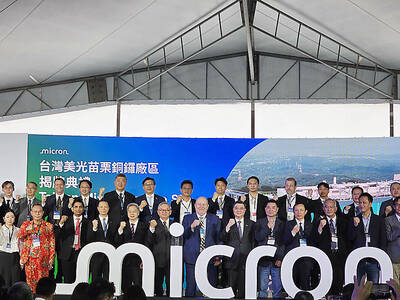
UNPRECEDENTED PACE: Micron Technology has announced plans to expand manufacturing capabilities with the acquisition of a new chip plant in Miaoli Micron Technology Inc unveiled a newly acquired chip plant in Miaoli County yesterday, as the company expands capacity to meet growing demand for advanced DRAM chips, including high-bandwidth memory chips amid the artificial intelligence boom. The plant in Miaoli County’s Tongluo Township (銅鑼), which Micron acquired from Powerchip Semiconductor Manufacturing Corp (力積電) for US$1.8 billion, is expected to make a sizeable capacity contribution to the company from fiscal 2028, the company said in a statement. It would be an extended production site of Micron’s large-scale manufacturing hub in Taichung, the company said. As the global semiconductor industry is racing to reach US$1 trillion

Singapore-based ride-hailing and delivery giant Grab Holdings Ltd has applied for regulatory approval to acquire the Taiwan operations of Germany-based Delivery Hero SE's Foodpanda in a deal valued at about US$600 million. Grab submitted the filing to the Fair Trade Commission on Friday last week, with the transaction subject to regulatory review and approval, the company said in a statement yesterday. Its independent governance structure would help foster a healthy and competitive market in Taiwan if the deal is approved, Grab said. Grab, which is listed on the NASDAQ, said in the filing that US-based Uber Technologies Inc holds about 13 percent of

Taiwan’s food delivery market could undergo a major shift if Singapore-based Grab Holdings Ltd completes its planned acquisition of Delivery Hero SE’s Foodpanda business in Taiwan, industry experts said. Grab on Monday last week announced it would acquire Foodpanda’s Taiwan operations for US$600 million. The deal is expected to be finalized in the second half of this year, with Grab aiming to complete user migration to its platform by the first half of next year. A duopoly between Uber Eats and Foodpanda dominates Taiwan’s delivery market, a structure that has remained intact since the Fair Trade Commission (FTC) blocked Uber Technologies Inc’s

Memory chip stocks extended their losses yesterday after Alphabet Inc’s Google publicized research that could allow more efficient use of the storage needed for artificial intelligence (AI) development. SK Hynix Inc and Samsung Electronics Co, South Korean leaders in the market, fell more than 6 percent and about 5 percent respectively in Seoul. In the US, Micron Technology Inc, Western Digital Corp and Sandisk Corp slid more than 2 percent in pre-market trading, after they all closed lower on Wednesday. Memory companies have been on a tear in recent months as the rapid development of AI infrastructure triggered a spike in chip


 RSS
RSS