


Winemakers in northern Greece are diving into the unknown by plunging hundreds of bottles of their wine into the depths of a local river.
Far from the sea or any lakes, producers in the town of Naoussa are to age some of their wine in the cool running waters of the Arapitsa River.
As a band ceremoniously played traditional Greek songs, a crane lowered a large metal crate holding about 500 bottles of wine from off the riverbank.
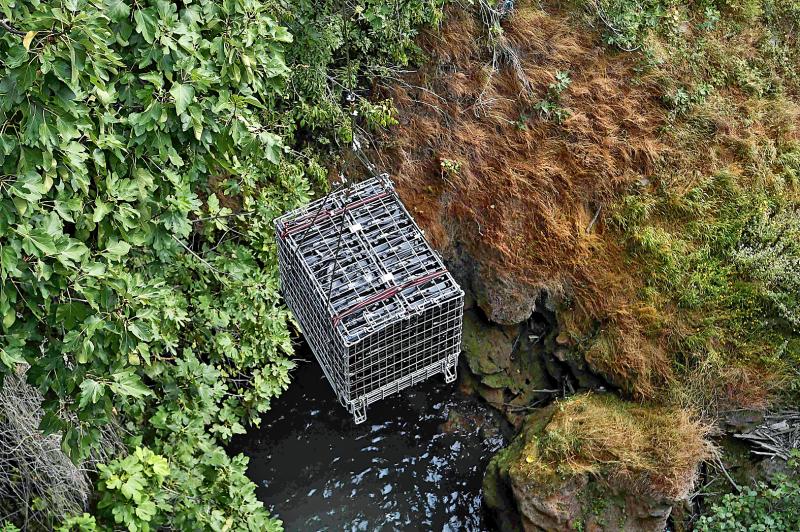
Photo: AFP
About 22 makers of Xinomavro, a wine made from a dark-skinned grape variety, proudly watched, hoping the water cellar will broaden the varieties of the products.
“The bottles are placed at 12m depth, and we aim to keep them there for at least 12 years,” said George Fountoulis, president of the Vaeni Naoussa wine cooperative which represents half of the region’s wine production.
Tests are to be done on an annual basis to check how the process evolves, he added.
It is part of a trend in the past few years by winemakers to test the benefits of a deep soak — including in the ocean — on the wine aging process.
Some scientists say that one year underwater is equivalent to three years in a cellar. Naoussa’s vineyards are on the slopes of Mount Vermio and mostly produce Xinomavro, which roughly translates as acid black or sour black.
About 5,000 tonnes of Xinomavro wine are produced there annually. The wine is also exported to more than 45 countries.
“Naoussa is the city of wine, the Burgundy of Greece as we call it here,” Naoussa Mayor Nikolas Karanikolas said. “This is an experiment and we will wait to see how the identity of the wine will evolve in these conditions. Our winemakers are well organized, extrovert and always innovative.”
Oenologists do not know what the outcome will be, but are excited by the whole process.
“We know that oxygen is insoluble in water, the average temperature of which we estimate will be 16°C,” oenologist George Diamantakos said. “The hygienic condition of the water is excellent, and we want to see how the sun and the natural environment of the river will affect the wine.”
The Naoussa area mainly has small family wineries with limited production. In the past, nearly every house had its own vineyard.
“We call Xinomavro ‘the Barolo of the poor,’ but we are very proud of our products,” said Petros Karydas, referring to Italy’s sought-after wine.
Karydas runs a small vineyard that produces about 12,000 bottles of wine a year, some of which are exported to the UK and the US.
However, other challenges posed by the effects of a warming climate are more of a concern for wine industry professional Nana Chrysochoou than the results of the experiment.
The winery set up by her father produces the only white wine placed in the water cellar and is from a local grape variety that he revived in his vineyards.
“Year after year, we see climate change having an even greater negative impact on vineyards,” she said. “Especially this year, our plants went into a big shock due to the prolonged heatwave and drought. I do not know if the crop will last in 20 years’ time, if the same climatic conditions continue.”

Cairo’s new monorail slices across the city skyline, running above the familiar chaos of blaring horns and aging buses’ exhaust fumes that mark rush hour below. The US$4.5 billion monorail, opened this month, is among Egypt’s most prominent new transport projects, part of a debt-funded infrastructure drive criticized for sapping state finances while bringing limited benefits to most of the country’s 109 million people. “It feels like you’re in a different country,” said Ramy Sayed, a restaurant manager, aboard a driverless Innovia 300 train. “No noise, no traffic, we’re not used to this.” The eastern line runs 56km from the bustling middle-class

Taiwanese firms have increased investment in the Philippines in recent years as Manila’s ties with Washington deepen and global supply chains continue to shift away from China, an expert at the Chung-Hua Institution for Economic Research (CIER, 中華經濟研究院) said yesterday. The Philippines had not been among Taiwanese investors’ top choices in Southeast Asia, CIER Taiwan ASEAN Studies Center director Kristy Hsu (徐遵慈) said at a seminar in Taipei. However, Taiwan’s investment in the country has grown significantly since the COVID-19 pandemic, reaching US $257 million last year, a high in recent years, she said. Although Taiwan’s total investment in the Philippines still lags

Intel Corp regards Taiwan Semiconductor Manufacturing Co (TSMC, 台積電) as a longstanding partner, as the US chipmaker would continue outsourcing production of advanced chips to TSMC, Intel chief executive officer Lip-Bu Tan (陳立武) said yesterday. “I don’t look at people as competitors. I look at the collaboration... Nvidia is also, you know, a good friend,” Tan told a news conference following his keynote speech at the Computex trade show in Taipei. “It’s a very trusted partnership for us... We are a big, top customer for them, and we’re going to continue doing that,” he said, referring to TSMC, the world’s largest foundry

Artificial intelligence (AI) agents would supplant smartphones as the center of people’s digital lives, fundamentally reshaping personal devices and driving a major computing upgrade cycle, Qualcomm Inc CEO Cristiano Amon said yesterday. In his keynote speech for this year’s Computex trade show in Taipei, Amon said that the rise of "agentic AI" — AI systems capable of reasoning, planning and carrying out tasks autonomously — would transform how people interact with technology across phones, PCs, vehicles and wearable devices. Describing the technology as the next major evolution in computing, Amon said that "2026 is the year of agents.” For decades, smartphones have sat


 RSS
RSS