


Ant Group Co’s (螞蟻集團) profit fell to US$2.1 billion in the March quarter after Chinese regulators thwarted its record initial public offering and told it to overhaul its sprawling operation.
Billionaire Jack Ma’s (馬雲) fintech giant contributed nearly 4.5 billion yuan (US$696 million) to Alibaba Group Holding Ltd’s (阿里巴巴) earnings, a company filing showed yesterday.
Based on Alibaba’s one-third stake in Ant, that translates to 13.6 billion yuan in profit, down 37 percent from the previous three months. Ant’s earnings lag one quarter behind Alibaba’s.
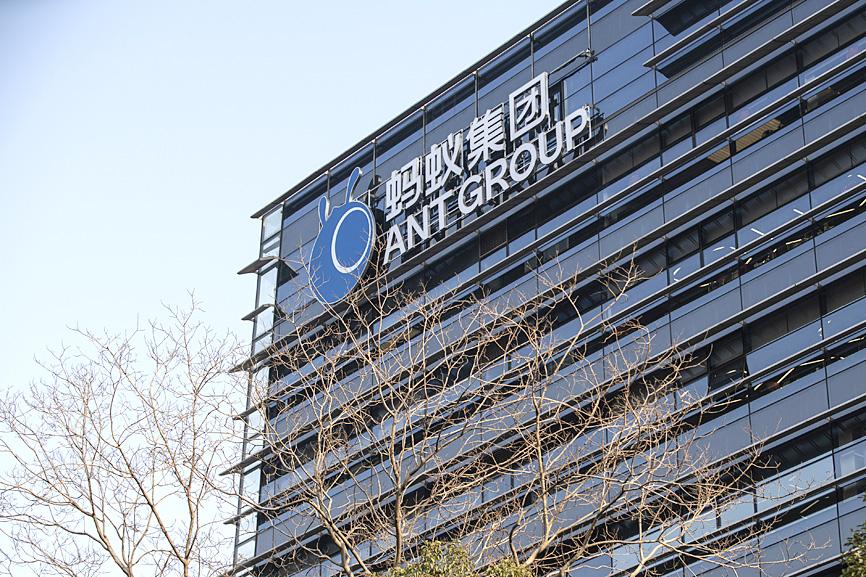
Photo: Bloomberg
Ant declined to comment.
The fall in profit underscores the challenges facing Ant following a widespread crackdown on China’s most powerful technology companies. In response, the nation’s largest fintech agreed to turn itself into a holding company that would be regulated more like a bank. Regulators have also issued a battery of proposals that threaten to curb Ant’s dominance in online payments and scale back its expansion into consumer lending and wealth management.
China has widened its net of crackdowns, expanding tightening to everything from ride-hailing and educational technology to food delivery and monopolistic practices in music streaming. The policies shook global investors, sparking a US$1 trillion selloff.
Regulators approved Ant’s consumer finance unit about two months ago as part of its overhaul, limiting the company’s ability to lend on its own and in partnership with banks. The operation folds in its two most well-known consumer lending businesses, Huabei and Jiebei. The unit will need to provide 30 percent of funding for all co-loans, based on rules released earlier this year. At 10 times leverage of its registered capital, that means its total amount of joint loans would be capped at 266 billion yuan.
Alibaba yesterday reported that revenue for the three months ended June climbed from a year earlier to 205.7 billion yuan, compared with analysts’ average estimates of 209.4 billion yuan. Net income was 45.1 billion yuan, rebounding from a loss in the previous quarter following the firm’s record antitrust penalty.
Separately, China yesterday launched a probe into possible price manipulation, putting a brake on share surges buoyed by a global semiconductor shortage that was approaching the 12-month mark. The market regulator said it was looking into some auto-chip sellers over allegations of price misconduct.
The State Administration for Market Regulation vowed to continue watching chip prices and punish any companies found to be hoarding chips, manipulating prices or raising prices through collusion.
It did not name any firms.
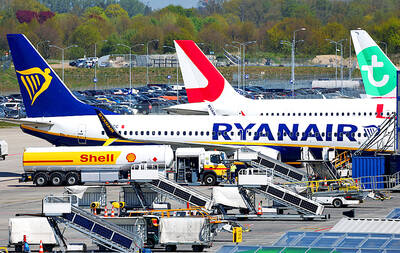
Ryanair, Transavia, Volotea and other low-cost airlines are feeling the financial pain from high jet fuel prices as a result of the Middle East war and are cutting flights. The closure of the Strait of Hormuz has taken a huge chunk of oil supplies off the market, sending the price of jet fuel soaring and triggering fears of shortages that could force airlines to cancel flights. Airlines are not waiting for a lack of supplies to react. “Travel alert: Airlines are cutting thousands of flights right now,” Travel Therapy host Karen Schaler said in an Instagram reel this past weekend.
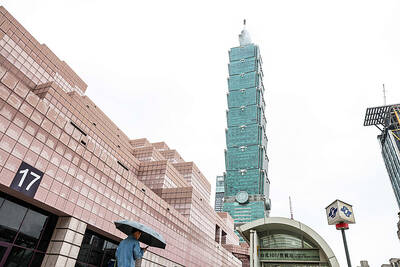
MANAGING RISKS: Taiwan has secured LNG sufficient to cover 95 percent of electricity demand for next month, UBS said, describing the government’s approach as proactive UBS Group AG has raised its forecast for Taiwan’s economic growth this year to 8 percent, up from 6.9 percent previously, and said expansion could reach as high as 8.6 percent if external energy shocks are avoided. The upgrade reflects a stronger-than-expected first-quarter performance and sustained momentum in artificial intelligence (AI)-driven exports, which UBS said are providing a firm foundation for growth despite geopolitical and energy risks. Taiwan’s GDP expanded 13.69 percent year-on-year in the first quarter, the fastest growth since the second quarter of 1987, the Directorate-General of Budget, Accounting and Statistics (DGBAS) reported on Thursday. On a seasonally
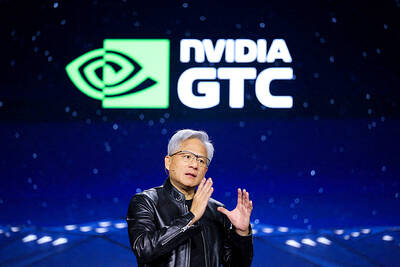
The list of Asian stocks that benefit from business partnership with Nvidia Corp is getting longer, as the region further integrates into the artificial intelligence (AI) chip giant’s business ecosystem. Just in the past week, South Korea’s LG Electronics Inc, Taiwan’s Nanya Technology Corp (南亞科技), as well as China’s Huizhou Desay SV Automotive Co (德賽西威) and Pateo Connect Technology Shanghai Corp (博泰車聯) have become the latest to rally on news of tie-ups, supply-chain participation or product collaboration with the US chip designer. Asian suppliers account for about 90 percent of Nvidia’s production costs, up from about 65 percent last year, data compiled
The Fair Trade Commission’s (FTC) ongoing review of Grab Holdings Ltd’s US$600 million acquisition of Foodpanda Taiwan’s operations, announced on March 23, has taken on fresh urgency as industry experts warn that the transaction could embed significant Chinese cybersecurity vulnerabilities into Taiwan’s digital infrastructure through Grab’s deep ties to autonomous-driving firm WeRide (文遠知行). Less than 16 months after the FTC blocked Uber Eats’ direct attempt to acquire Foodpanda Taiwan — citing potential combined market shares of 80 to 90 percent — the emergence of Grab as the buyer has prompted questions about whether the same competitive harm is simply being rerouted


 RSS
RSS