


Sales of imported vehicles last month surpassed those of domestically assembled vehicles for the first time as importers intensified inventory depletion and began introducing new models to the nation.
Sales of imported vehicles last month reached 12,918 units, or 53.9 percent of total sales, compared with 11,046 units manufactured in Taiwan, data compiled by the Directorate-General of Highways’ motor vehicles offices showed.
Better sales of imported models, such as Hotai Motor Co Ltd’s (和泰汽車) Toyota RAV4 sport utility vehicle (SUV), Mazda Motor Taiwan’s (台灣馬自達) Mazda 3 sedans and Audi Volkswagen Taiwan Co’s (台灣福斯) Tiguan SUV, lent support to the rising market share of foreign vehicles, the data showed.
“The market share of imported vehicles has been on the rise since 2017, after importers introduced more affordable choices to consumers,” a Yulon Nissan Motor Co (裕隆日產) official said by telephone yesterday.
The official, who asked to remain anonymous, said that Yulon Nissan would later this month introduce imported Leaf electric vehicles and Altima sedans to maintain its market share, while improving the price-performance ratio of locally assembled vehicles.
Increasing RAV4 sales last month drove up Hotai’s vehicle sales by 6.4 percent year-on-year to 6,762 units, with the company remaining the biggest vehicle seller in Taiwan with a market share of 28.2 percent, the data showed.
Yulon Nissan last month secured a market share of 9 percent after vehicle sales climbed 31.8 percent annually to 2,152 units, thanks to robust sales of domestically made Kicks SUVs and Livina compacts.
China Motor Corp (中華汽車), which distributes Mitsubishi Motors Corp vehicles and its own commercial vehicles, was third with a 7.9 percent market share and vehicle sales of 1,892 units, down 42 percent year-on-year.
A China Motor official attributed the decline to renovation of production lines in Taoyuan’s Yangmei District (楊梅) last month, which are to return to normal this month.
Mercedes-Benz Taiwan Ltd (台灣賓士) was fourth by selling 1,843 units, followed by Ford Lio Ho Motor Co’s (福特六和) 1,397 units and Honda Taiwan Co’s (台灣本田) 1,017 units, the data showed.
Overall vehicle sales last month dropped 8 percent annually and 50.5 percent monthly to 23,964 units likely due to the Mid-Autumn Festival holiday, with cumulative vehicle sales in the first eight months of this year decreasing 4.1 percent year-on-year to 279,315 units, the data showed.
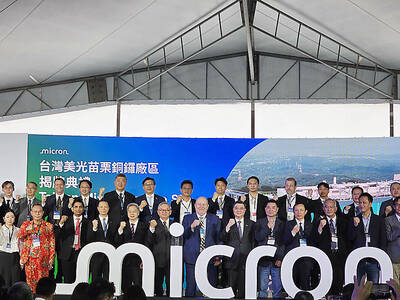
UNPRECEDENTED PACE: Micron Technology has announced plans to expand manufacturing capabilities with the acquisition of a new chip plant in Miaoli Micron Technology Inc unveiled a newly acquired chip plant in Miaoli County yesterday, as the company expands capacity to meet growing demand for advanced DRAM chips, including high-bandwidth memory chips amid the artificial intelligence boom. The plant in Miaoli County’s Tongluo Township (銅鑼), which Micron acquired from Powerchip Semiconductor Manufacturing Corp (力積電) for US$1.8 billion, is expected to make a sizeable capacity contribution to the company from fiscal 2028, the company said in a statement. It would be an extended production site of Micron’s large-scale manufacturing hub in Taichung, the company said. As the global semiconductor industry is racing to reach US$1 trillion

Singapore-based ride-hailing and delivery giant Grab Holdings Ltd has applied for regulatory approval to acquire the Taiwan operations of Germany-based Delivery Hero SE's Foodpanda in a deal valued at about US$600 million. Grab submitted the filing to the Fair Trade Commission on Friday last week, with the transaction subject to regulatory review and approval, the company said in a statement yesterday. Its independent governance structure would help foster a healthy and competitive market in Taiwan if the deal is approved, Grab said. Grab, which is listed on the NASDAQ, said in the filing that US-based Uber Technologies Inc holds about 13 percent of

Taiwan’s food delivery market could undergo a major shift if Singapore-based Grab Holdings Ltd completes its planned acquisition of Delivery Hero SE’s Foodpanda business in Taiwan, industry experts said. Grab on Monday last week announced it would acquire Foodpanda’s Taiwan operations for US$600 million. The deal is expected to be finalized in the second half of this year, with Grab aiming to complete user migration to its platform by the first half of next year. A duopoly between Uber Eats and Foodpanda dominates Taiwan’s delivery market, a structure that has remained intact since the Fair Trade Commission (FTC) blocked Uber Technologies Inc’s

Memory chip stocks extended their losses yesterday after Alphabet Inc’s Google publicized research that could allow more efficient use of the storage needed for artificial intelligence (AI) development. SK Hynix Inc and Samsung Electronics Co, South Korean leaders in the market, fell more than 6 percent and about 5 percent respectively in Seoul. In the US, Micron Technology Inc, Western Digital Corp and Sandisk Corp slid more than 2 percent in pre-market trading, after they all closed lower on Wednesday. Memory companies have been on a tear in recent months as the rapid development of AI infrastructure triggered a spike in chip


 RSS
RSS