


State-run Chang Hwa Commercial Bank (CHB, 彰化銀行) yesterday issued a new credit card that offers up to 6 percent in cash rewards for online spending as it seeks to tap into digital banking and woo younger customers.
The scheme made CHB the most generous in cash rewards among card issuers in Taiwan as people increasingly transact via computers or smartphones.
“The latest card falls in line with our strategy to court young customers, who do not visit physical banks nowadays,” CHB chairwoman Joanne Ling (凌忠嫄) told a news conference.
With 185 branches, CHB cannot afford to ignore the trend, but has made adjustments to stay competitive, Ling said, adding that the century-old bank decided to launch a credit card with higher cash rewards.
Credit card spending rose by a double-digit percentage in the first half of the year, despite an ongoing economic slowdown, MasterCard Inc country manager in Taiwan Eva Chen (陳懿文) said, attributing the fast increase to the popularity of credit cards featuring cash rewards.
CHB expects to issue 100,000 of the cards by the end of this year, raising its total number of cards in circulation to half a million, Ling said.
The goal is achievable as cardholders do not have much loyalty, Ling said.
The card is aiming to boost retail banking at CHB that used to focus on corporate lending, but now favors a more balanced contribution of income sources.
Retail banking generates 35 percent of revenue, suggesting room for improvement, compared with corporate banking’s 65 percent, Ling said.
The card would particularly appeal to people who enjoy traveling, and shopping at home and abroad, as it offers cash rewards of 3.5 percent on overseas spending without restrictions on outlets, Ling said.
Other banks limit cash rewards to a modest amount, she said.
The card would allow CHB to integrate its electronic payment system and digital savings accounts, and hopefully the convenience would attract and retain younger customers, Ling said.
The strategy is also part of the bank’s answer to the arrival of Web-only banks, she said.
The number of digital banking accounts hit 1.5 million last year, surging 2.8 times from a year earlier, thanks to the prevalence of smartphones, Chen said.
Mobile payments reached NT$19.8 billion (US$636.84 million) in the first quarter of this year, higher than the whole of 2017, Chen said.
Cross-border shopping accounted for about half of overall transactions, lending support to credit card spending, she added.
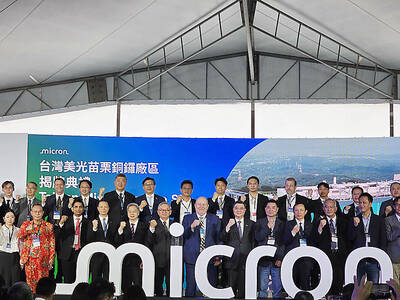
UNPRECEDENTED PACE: Micron Technology has announced plans to expand manufacturing capabilities with the acquisition of a new chip plant in Miaoli Micron Technology Inc unveiled a newly acquired chip plant in Miaoli County yesterday, as the company expands capacity to meet growing demand for advanced DRAM chips, including high-bandwidth memory chips amid the artificial intelligence boom. The plant in Miaoli County’s Tongluo Township (銅鑼), which Micron acquired from Powerchip Semiconductor Manufacturing Corp (力積電) for US$1.8 billion, is expected to make a sizeable capacity contribution to the company from fiscal 2028, the company said in a statement. It would be an extended production site of Micron’s large-scale manufacturing hub in Taichung, the company said. As the global semiconductor industry is racing to reach US$1 trillion

Singapore-based ride-hailing and delivery giant Grab Holdings Ltd has applied for regulatory approval to acquire the Taiwan operations of Germany-based Delivery Hero SE's Foodpanda in a deal valued at about US$600 million. Grab submitted the filing to the Fair Trade Commission on Friday last week, with the transaction subject to regulatory review and approval, the company said in a statement yesterday. Its independent governance structure would help foster a healthy and competitive market in Taiwan if the deal is approved, Grab said. Grab, which is listed on the NASDAQ, said in the filing that US-based Uber Technologies Inc holds about 13 percent of

Taiwan’s food delivery market could undergo a major shift if Singapore-based Grab Holdings Ltd completes its planned acquisition of Delivery Hero SE’s Foodpanda business in Taiwan, industry experts said. Grab on Monday last week announced it would acquire Foodpanda’s Taiwan operations for US$600 million. The deal is expected to be finalized in the second half of this year, with Grab aiming to complete user migration to its platform by the first half of next year. A duopoly between Uber Eats and Foodpanda dominates Taiwan’s delivery market, a structure that has remained intact since the Fair Trade Commission (FTC) blocked Uber Technologies Inc’s

Memory chip stocks extended their losses yesterday after Alphabet Inc’s Google publicized research that could allow more efficient use of the storage needed for artificial intelligence (AI) development. SK Hynix Inc and Samsung Electronics Co, South Korean leaders in the market, fell more than 6 percent and about 5 percent respectively in Seoul. In the US, Micron Technology Inc, Western Digital Corp and Sandisk Corp slid more than 2 percent in pre-market trading, after they all closed lower on Wednesday. Memory companies have been on a tear in recent months as the rapid development of AI infrastructure triggered a spike in chip


 RSS
RSS