


Singapore is discussing the possibility of allowing virtual banks to operate in the city-state, the Monetary Authority of Singapore (MAS) said yesterday.
“MAS is studying whether to admit such digital-only banks with non-bank parentage,” the financial regulator said in an e-mailed reply to questions from Bloomberg News. “We have been engaging relevant stakeholders to ascertain the unique value that such entrants could bring to our banking landscape, and understand how potential risks will be managed and contained.”
The MAS said in the statement that digitalization is not new to Singapore’s banking industry, adding that local lenders have been allowed to pursue digital-only business models since 2000.
DBS Group Holdings Ltd (星展銀行), Oversea-Chinese Banking Corp (OCBC, 華僑銀行) and United Overseas Bank Ltd (大華銀行) all have digital strategies, and compete with home-grown financial-technology firms as well as the local branch networks of HSBC Holdings PLC, Citigroup Inc and other foreign banks.
DBS chief executive officer Piyush Gupta downplayed the competitive threat for the local banks of the possible entry of digital-only banks in a recent interview with Bloomberg News.
“To my mind, that’s just basically giving a few more banking licenses,” he said.
Gupta said he would only see a problem in Singapore if virtual banks are allowed to operate on more lenient terms than the incumbents, for example in terms of the capital they are required to hold.
“The real challenge is if the regulators create an unlevel playing field, and let the new bank licensees come in and do banking on different terms,” he said.
However, he said that most regulators “don’t seem to be inclined” to do that.
Virtual banks typically have lower operational costs than traditional lenders that rely on brick-and-mortar branch networks.
Last month, Gupta told DBS’ annual shareholder meeting that a new digital bank could generate US$100 of income from a cost base a little above US$30.
In contrast, DBS’ cost-to-income ratio stood at 44 percent last year.
OCBC, Singapore’s second-largest bank by assets, said that it is unavoidable that digital-only banks would want to operate in the city-state.
“However, the operating model of such banks cannot be a one-size-fits-all regardless of the operating environment” especially for a small, well-banked country like Singapore, OCBC chief executive officer Samuel Tsien (錢乃驥) said in an e-mailed reply to questions.
“Whilst it’s too early to speculate on MAS’s review, we welcome any initiative from the MAS that supports healthy competition and benefits consumers,” a HSBC spokesman said in an e-mailed response.
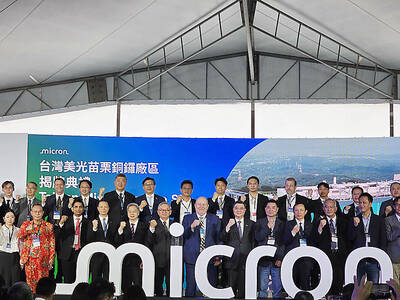
UNPRECEDENTED PACE: Micron Technology has announced plans to expand manufacturing capabilities with the acquisition of a new chip plant in Miaoli Micron Technology Inc unveiled a newly acquired chip plant in Miaoli County yesterday, as the company expands capacity to meet growing demand for advanced DRAM chips, including high-bandwidth memory chips amid the artificial intelligence boom. The plant in Miaoli County’s Tongluo Township (銅鑼), which Micron acquired from Powerchip Semiconductor Manufacturing Corp (力積電) for US$1.8 billion, is expected to make a sizeable capacity contribution to the company from fiscal 2028, the company said in a statement. It would be an extended production site of Micron’s large-scale manufacturing hub in Taichung, the company said. As the global semiconductor industry is racing to reach US$1 trillion

Singapore-based ride-hailing and delivery giant Grab Holdings Ltd has applied for regulatory approval to acquire the Taiwan operations of Germany-based Delivery Hero SE's Foodpanda in a deal valued at about US$600 million. Grab submitted the filing to the Fair Trade Commission on Friday last week, with the transaction subject to regulatory review and approval, the company said in a statement yesterday. Its independent governance structure would help foster a healthy and competitive market in Taiwan if the deal is approved, Grab said. Grab, which is listed on the NASDAQ, said in the filing that US-based Uber Technologies Inc holds about 13 percent of

Taiwan’s food delivery market could undergo a major shift if Singapore-based Grab Holdings Ltd completes its planned acquisition of Delivery Hero SE’s Foodpanda business in Taiwan, industry experts said. Grab on Monday last week announced it would acquire Foodpanda’s Taiwan operations for US$600 million. The deal is expected to be finalized in the second half of this year, with Grab aiming to complete user migration to its platform by the first half of next year. A duopoly between Uber Eats and Foodpanda dominates Taiwan’s delivery market, a structure that has remained intact since the Fair Trade Commission (FTC) blocked Uber Technologies Inc’s

Memory chip stocks extended their losses yesterday after Alphabet Inc’s Google publicized research that could allow more efficient use of the storage needed for artificial intelligence (AI) development. SK Hynix Inc and Samsung Electronics Co, South Korean leaders in the market, fell more than 6 percent and about 5 percent respectively in Seoul. In the US, Micron Technology Inc, Western Digital Corp and Sandisk Corp slid more than 2 percent in pre-market trading, after they all closed lower on Wednesday. Memory companies have been on a tear in recent months as the rapid development of AI infrastructure triggered a spike in chip


 RSS
RSS