


Fu Sheng Industrial Co (復盛應用), a leading producer of gold club heads, said it expects gradual revenue growth in the second half of the year, when it is to expand production capacity in Vietnam and receive new orders from golf equipment brand Titleist.
The company this year plans to invest more than US$20 million to increase its Vietnamese factories’ revenue contribution to 50 percent, compared with 35 percent last year, Fu Sheng spokesperson Hsu Ting-yi (許廷儀) said at a sales presentation in Taipei on Wednesday.
Fu Sheng has moved some of its production lines to Vietnam, where labor costs are 40 percent less than China, Hsu said, adding that production efficiency has gradually improved over the past few years
“The installation of about 60 automated facilities in our Vietnamese factories will help lower production costs, starting this quarter,” Hsu said.
Fu Sheng molds and cuts club heads in Taiwan, and sends them to China and Vietnam for machining, polishing and painting.
Its operations in China accounted for 65 percent of overall revenue last year, the company said.
First-quarter revenue fell 0.1 percent year-on-year to NT$4.21 billion (US$136.2 million) from NT$4.22 billion.
Normally the first and fourth quarters are high seasons for Fu Sheng, but Hsu attributed last quarter’s flat performance to clients’ order adjustments.
Club heads, which have a higher gross margin than the firm’s other products, contributed to 83 percent of sales last year, compared with aviation and vehicle components at 5 percent, and carbon fiber club heads and club head accessories at 4 percent.
Orders from Titleist are expected to help boost revenue this year, Hsu said.
Orders from other clients such as Callaway Golf Co and PING Golf seem steady, he said.
Revenue for this quarter is forecast to be flat from last quarter, but the company’s performance this year would be “not as bad as last year,” he added.
The global golf market is predicted to grow by 2 to 3 percent annually over the next five to six years, with the US taking the lead at 46 percent and Japan with 24 percent, the company said.
Fu Sheng has not yet released its bottom line results for the first quarter.
The company reported net profit of NT$2.01 billion for last year, up 44.97 percent year-on-year, with earnings per share of NT$16.85.
Gross margin improved to 24.59 percent from from 23.7 percent a year earlier, while revenue rose 32.44 percent year-on-year to NT$14.86 billion.
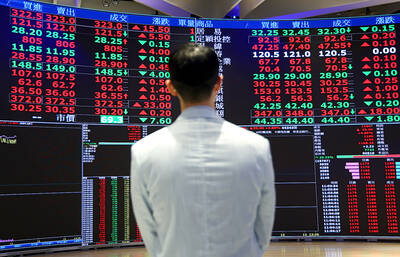
Shares in Taiwan closed at a new high yesterday, the first trading day of the new year, as contract chipmaker Taiwan Semiconductor Manufacturing Co (TSMC, 台積電) continued to break records amid an artificial intelligence (AI) boom, dealers said. The TAIEX closed up 386.21 points, or 1.33 percent, at 29,349.81, with turnover totaling NT$648.844 billion (US$20.65 billion). “Judging from a stronger Taiwan dollar against the US dollar, I think foreign institutional investors returned from the holidays and brought funds into the local market,” Concord Securities Co (康和證券) analyst Kerry Huang (黃志祺) said. “Foreign investors just rebuilt their positions with TSMC as their top target,
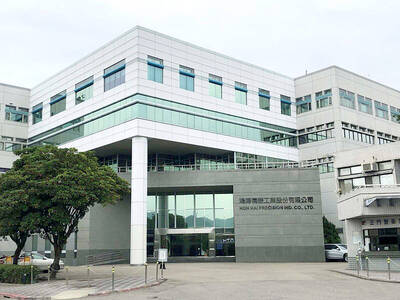
REVENUE PERFORMANCE: Cloud and network products, and electronic components saw strong increases, while smart consumer electronics and computing products fell Hon Hai Precision Industry Co (鴻海精密) yesterday posted 26.51 percent quarterly growth in revenue for last quarter to NT$2.6 trillion (US$82.44 billion), the strongest on record for the period and above expectations, but the company forecast a slight revenue dip this quarter due to seasonal factors. On an annual basis, revenue last quarter grew 22.07 percent, the company said. Analysts on average estimated about NT$2.4 trillion increase. Hon Hai, which assembles servers for Nvidia Corp and iPhones for Apple Inc, is expanding its capacity in the US, adding artificial intelligence (AI) server production in Wisconsin and Texas, where it operates established campuses. This
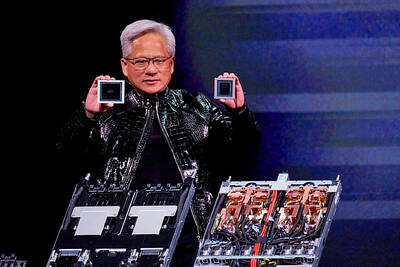
Nvidia Corp chief executive officer Jensen Huang (黃仁勳) on Monday introduced the company’s latest supercomputer platform, featuring six new chips made by Taiwan Semiconductor Manufacturing Co (TSMC, 台積電), saying that it is now “in full production.” “If Vera Rubin is going to be in time for this year, it must be in production by now, and so, today I can tell you that Vera Rubin is in full production,” Huang said during his keynote speech at CES in Las Vegas. The rollout of six concurrent chips for Vera Rubin — the company’s next-generation artificial intelligence (AI) computing platform — marks a strategic
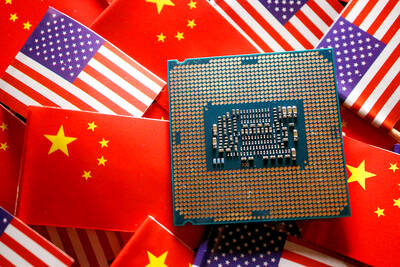
US President Donald Trump on Friday blocked US photonics firm HieFo Corp’s US$3 million acquisition of assets in New Jersey-based aerospace and defense specialist Emcore Corp, citing national security and China-related concerns. In an order released by the White House, Trump said HieFo was “controlled by a citizen of the People’s Republic of China” and that its 2024 acquisition of Emcore’s businesses led the US president to believe that it might “take action that threatens to impair the national security of the United States.” The order did not name the person or detail Trump’s concerns. “The Transaction is hereby prohibited,”


 RSS
RSS