


Apple Inc yesterday said that it has nearly doubled the number of suppliers using only “clean” energy for production work, including two that assemble and make the processor chips for the iPhone.
Apple last year said that it meets all of its needs with renewable energy, such as solar farms that power data centers.
However, a large part of its carbon footprint comes from its supply chain, and since 2015, Apple has worked directly with those companies to use “clean” energy for Apple production.
Forty-four companies are now in the program, including Hon Hai Precision Industry Co Ltd (鴻海精密), which makes iPhones, and Taiwan Semiconductor Manufacturing Co Ltd (TSMC, 台積電), which supplies the A-series chips that power all of Apple’s mobile devices, Apple said.
Apple had previously disclosed 23 suppliers in the program.
The company defines “clean” energy as coming from wind, solar or bio-gas fuel cells, as well as what it calls “low-impact” hydroelectric projects such as a site in Oregon that captures energy from water in irrigation canals to power one of its data centers.
Apple did not specify where the new suppliers in the program would get the energy.
It encourages suppliers to build their own renewable energy projects, such as when iPad assembler Compal Electronics Inc (仁寶電腦) last year built rooftop solar installations on its factories in China.
When those options are not available, Apple says that it aims to have suppliers sign power-purchase agreements with new renewable energy projects and uses purchases of renewable energy credits only when there are no other options.
In an interview, Apple vice president of environment, policy and social initiatives Lisa Jackson said that the company is also on track to pass its goal of adding 4 gigawatts of renewable energy to the grids of its supply chain by next year and has a “sight line” to “well over” 5 gigawatts.
Jackson declined to say whether Apple would drop suppliers such as Hon Hai and TSMC — whose capabilities few others in the global electronics supply chain can match — if they fail to meet their commitments to the program.
“It took a while for them to come on board, and so we believe that now that they have, they’re fully committed to doing it,” Jackson said. “And obviously, if they fall down on the job, we’ll be right there on their chase. I can’t tell you what will happen, but I hope it never does.”
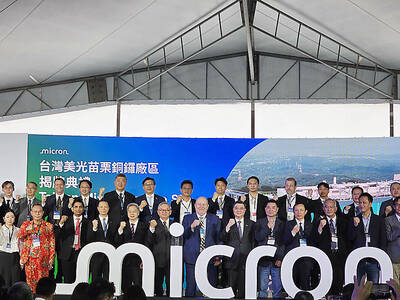
UNPRECEDENTED PACE: Micron Technology has announced plans to expand manufacturing capabilities with the acquisition of a new chip plant in Miaoli Micron Technology Inc unveiled a newly acquired chip plant in Miaoli County yesterday, as the company expands capacity to meet growing demand for advanced DRAM chips, including high-bandwidth memory chips amid the artificial intelligence boom. The plant in Miaoli County’s Tongluo Township (銅鑼), which Micron acquired from Powerchip Semiconductor Manufacturing Corp (力積電) for US$1.8 billion, is expected to make a sizeable capacity contribution to the company from fiscal 2028, the company said in a statement. It would be an extended production site of Micron’s large-scale manufacturing hub in Taichung, the company said. As the global semiconductor industry is racing to reach US$1 trillion

Singapore-based ride-hailing and delivery giant Grab Holdings Ltd has applied for regulatory approval to acquire the Taiwan operations of Germany-based Delivery Hero SE's Foodpanda in a deal valued at about US$600 million. Grab submitted the filing to the Fair Trade Commission on Friday last week, with the transaction subject to regulatory review and approval, the company said in a statement yesterday. Its independent governance structure would help foster a healthy and competitive market in Taiwan if the deal is approved, Grab said. Grab, which is listed on the NASDAQ, said in the filing that US-based Uber Technologies Inc holds about 13 percent of

Taiwan’s food delivery market could undergo a major shift if Singapore-based Grab Holdings Ltd completes its planned acquisition of Delivery Hero SE’s Foodpanda business in Taiwan, industry experts said. Grab on Monday last week announced it would acquire Foodpanda’s Taiwan operations for US$600 million. The deal is expected to be finalized in the second half of this year, with Grab aiming to complete user migration to its platform by the first half of next year. A duopoly between Uber Eats and Foodpanda dominates Taiwan’s delivery market, a structure that has remained intact since the Fair Trade Commission (FTC) blocked Uber Technologies Inc’s

Memory chip stocks extended their losses yesterday after Alphabet Inc’s Google publicized research that could allow more efficient use of the storage needed for artificial intelligence (AI) development. SK Hynix Inc and Samsung Electronics Co, South Korean leaders in the market, fell more than 6 percent and about 5 percent respectively in Seoul. In the US, Micron Technology Inc, Western Digital Corp and Sandisk Corp slid more than 2 percent in pre-market trading, after they all closed lower on Wednesday. Memory companies have been on a tear in recent months as the rapid development of AI infrastructure triggered a spike in chip


 RSS
RSS