


Mighty AI Inc spent much of its first five years building software that helps self-driving cars recognize real-world objects. The Seattle start-up went so far as to open a Detroit office to cozy up to the US auto industry.
Then in February last year, Mighty AI’s sales team received an unusual request: Instead of identifying pedestrians and cars, could they track items plucked from store shelves by shoppers?
A few months later, Mighty AI signed a deal to do just that, joining the race to help brick-and-mortar retailers keep pace with Amazon.com Inc.
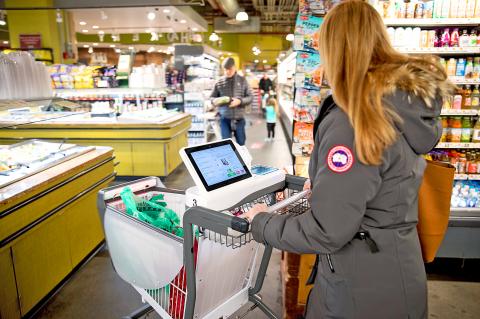
Photo: Bloomberg
A year ago, the e-commerce giant opened a cashierless convenience store called Amazon Go, marking its biggest effort yet to change the way people shop in the physical world.
Today, a fleet of companies are working to replicate elements of Go or invent other ways of streamlining store operations.
Many are start-ups like Mighty AI, but established giants are wading in, too. Walmart Inc has been testing Go-style technology, and Kroger Co and Microsoft Corp have announced a joint venture to bring elements of the e-commerce shopping experience to the grocery store.
Amazon Go showed “how far you can go,” Mighty AI chief executive Daryn Nakhuda said.
Very quickly, the state-of-the-art went from you-scan checkout technology to Amazon’s “just walk out” approach and everything in between, he said.
Amazon, which operates nine Go stores in three US cities, has announced no plans to sell the proprietary technology to other retailers.
Even if the Seattle leviathan did offer to license the system, fierce competition with other retailers would probably preclude most partnerships.
“What we are seeing is Silicon Valley at large, venture capital at large, trying to come up with some solutions” to sell to retailers, said Steve Sarracino, founder of Activant Capital, a Greenwich, Connecticut, investment firm that has stakes in retail technology start-ups.
“There will be a huge market” for other technology firms to capitalize on, he said.
That was on display at the National Retail Foundation’s trade show in New York last week, where one such hopeful showed off a blue shipping-container-sized experiment called the NanoStore.
Built by AiFi, a Santa Clara, California, start-up, the 15m2 store’s limited inventory put it somewhere between a vending machine and small convenience store.
Like Amazon Go, it was packed with cameras and shelf sensors that track customers as they browse and pick up items. On the way out, shoppers tap an app or swipe a credit card to pay.
AiFi chief executive officer Steve Gu said his company is following a similar technological route as Amazon, but favors more automation.
While Go is staffed by clerks stocking shelves and assisting customers, AiFi’s prototype is designed to be completely autonomous in its day-to-day operation.
Last week, AiFi said Carrefour SA, the French retail giant, and Zabka Polska sp. z o.o, a Polish convenience store operator, had committed to testing the technology.
AiFi has plenty of competition in the effort to eliminate checkout lines. During a four-week stretch beginning in August last year, three different start-ups opened pilot cashierless stores in the San Francisco Bay Area.
One was Standard Cognition Corp, whose inquiry started Mighty AI’s shift to working with retail technology companies.
“This technology was coming regardless” of Amazon’s moves, Standard Cognition cofounder Michael Suswal said.
“However, Amazon gave the space validity and forced competitors to look for a way to compete.” Investors have also taken interest, he said.
Venture capital firms last year backed US companies working on store automation with US$111 million, a record in Pitchbook data going back to 2003. About half of that sum went to Standard Cognition.
The technology behind such pilots is largely unproven.
AiFi last year said it would unveil a pilot project at a full-sized grocery store belonging to an unnamed retailer before the end of last year.
However, the calendar flipped without any such launch.
A spokeswoman said the system was not ready and that confidentiality agreements prevent the company from discussing the matter further.
Amazon’s own well-funded research-and-development operation missed its announced deadline for opening the first Go store to the public in Seattle.
The company spent more than a year tinkering with the technology during an employee trial.
“Whether or not these pilots turn into full-scale rollouts in the near-term is unclear,” Scott Jacobson, a managing director with Madrona Venture Group in Seattle, said of Go’s imitators. “Too soon to say.”
Others are taking a different approach, aiming to offer customers a bit of high-tech convenience without the expense of shutting down the store for a retrofit to install cameras and sensors.
Lindon Gao started experimenting with retail technology after getting frustrated with long lines in apparel stores on Black Friday.
His first effort, in 2016, let shoppers use a code on their smartphones to remove anti-theft tags on clothing and simultaneously pay for the item so they did not have to see a cashier.
Retailers balked at the idea since it required a big investment of time and money tagging inventory with new devices.
He shifted his attention to supermarkets, combing grocery stores in New York to ask owners and managers what they wanted in a new system. The prevailing answer was something simple they could use in existing stores without spending a lot of money to knock holes in walls, run wires and install expensive devices.
So he reinvented the shopping cart by adding a scanner and payment system. The cart built by Caper Inc, the start-up he cofounded, looks like a shopping cart with a laptop and credit card reader mounted to it.
Shoppers scan barcodes as they fill their carts, which also has a scale for produce and other items sold by weight.
The cart gets smarter with use thanks to cameras that shoot pictures after each item is scanned, Gao said.
The plan is that ultimately it will recognize items placed in the cart without scanning.
He has been showcasing the cart at trade shows, and said he has received interest from grocers looking to bring their stores into the digital age.
“The Amazon Go rollout and the Whole Foods acquisition made people think they really have to innovate and if they don’t innovate they’ll get left behind,” Gao said.
Foodcellar & Co, an all-natural grocer in Queens, New York, has been using Caper smartcarts for about a year at its Long Island City store.
Customers love the technology and some even take selfies with them, store cofounder Metin Mangut said.
The carts appealed to him since he did not have to install cameras and sensors. If one breaks, he can just get a new cart. The screens direct shoppers to products they want and flash alerts when they are close to items on sale, which helps encourage customers to spend more.
He is still negotiating the price since he was in a trial, but said the carts are worth it to eliminate lines and free up cashiers to help shoppers.
“A frictionless experience is part of the future,” he said. “It will be a hybrid. Some people like the interaction. Some people don’t want to deal with anyone and just get what they want and leave.”
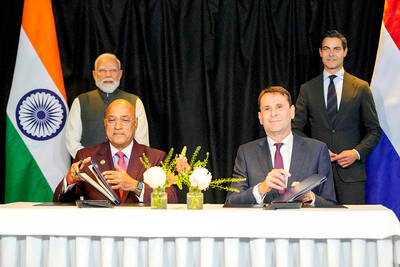
NEW MARKET: The partnership opens up India to the Dutch company, which already has a strong hold in the semiconductor market of South Korea, Taiwan and China ASML Holding NV entered into a partnership agreement with Tata Electronics Pvt Ltd aimed at ramping up India’s goal to develop domestic chip-manufacturing capabilities. The Dutch company’s technology would help power Tata Electronics’ planned 300 millimeter (mm) semiconductor foundry in Gujarat, according to a joint statement from the two companies on Saturday. The signing of a memorandum of understanding coincides with a visit by Indian Prime Minister Narendra Modi to the Netherlands, which is looking to deepen bilateral relations with New Delhi. ASML, whose top customers include Taiwan Semiconductor Manufacturing Co (台積電) and Samsung Electronics Co, makes lithography machines that can print
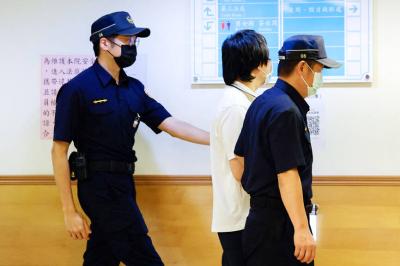
Tokyo Electron's Taiwan unit today said in a written response that it respects the judicial process, takes the court ruling seriously and would not appeal in the Taiwan Semiconductor Manufacturing Co (TSMC, 台積電) trade secrets case. Last month, a court fined the Taiwan unit of Japan's Tokyo Electron NT$150 million (US$4.74 million) in a case involving trade secrets related to TSMC's sensitive chip technology.
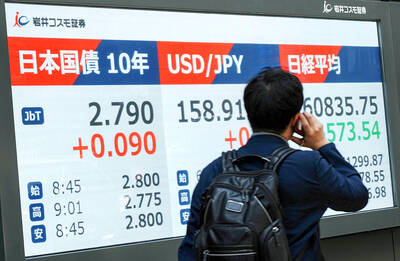
ROUGH RECORDS: Bonds in Japan, as well is in New Zealand, Australia and the US, are seeing the effects of a nervy market as stock exchanges across Asia edge down A deepening slump in Japanese government bonds added fuel to the selloff in global debt markets as rising oil prices stoked inflation fears and pushed yields to multi-decade highs. Japan’s 30-year yield yesterday surged as much as 20 basis points to the highest level since the tenor’s debut in 1999, before paring some of the move. Shorter-maturity Japanese debt was also under pressure, underscored by weak demand at a sale of five-year notes that offered a record-high coupon of 2 percent. Concerns over inflation and government spending rippling through markets including the US, Australia and New Zealand are being amplified in Japan,
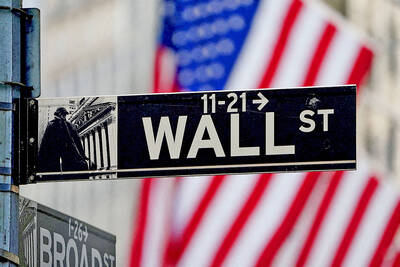
Wall Street is licking its chops over an unprecedented slate of massive initial public offerings (IPOs) set to arrive in the coming months, beginning with Elon Musk’s Space Exploration Technologies Corp (SpaceX) next month. That is expected to be followed by artificial intelligence (AI) rivals OpenAI and Anthropic PBC. The trio of mega listings, each eyeing valuations around US$1 trillion or more, constitutes a heady period of elevated risk and reward. SpaceX is targeting an IPO that would raise up to US$80 billion — about double the funds generated from all IPOs last year. OpenAI and Anthropic are eyeing IPOs raising US$60 billion. “We’re


 RSS
RSS