


CTBC Bank (中信銀行) on Tuesday announced that starting next year, it is halving the rewards for cobranded Line Pay credit cards, with cardholders earning 1 credit point for every NT$100 (US$3.25) spent, instead of 2 points.
It is the second time that the bank is cutting Line Pay card’s rewards, which started with 3 points for every NT$100 spent when the card was launched in 2016.
However, the bank also announced new partners in hopes of expanding its client base.
Cardholders who use Line Pay at Hotels.com or Showtime’s movie theaters (秀泰影城) would earn 15 and 10 points respectively for every NT$100 spent, it said.
They would earn 5 points for payments at designated fitness stores, cosmetics and beauty shops, gas stations, and Line TV and the Line store run by Line Taiwan Ltd (台灣連線), it said.
The credit points are also known as “Line points,” with each Line point equivalent to NT$1, the bank said.
The bank’s move is likely to affect the number of Line Pay cards issued next year, as many cardholders were attracted to the card because of its lucrative rewards, one female cardholder told the Taipei Times yesterday, adding that she would not use the credit card as frequently as before.
With 1.83 million issued since its launch in December 2016 to September this year, Line Pay card is the bank’s fastest-growing credit card, data from parent company CTBC Financial Holding Co (中國信託金控) showed.
The bank did not explain why it was cutting its reward program, but its third-quarter fee income declined 1.5 percent annually due to the high cost of providing rewards for Line Pay credit cards, CTBC Financial said at an investors’ conference last month.
“The bank is reviewing its rewards policy and plans to set up a different strategy,” CTBC Financial president Daniel Wu (吳一揆) said at the time.
The bank last month said it expects the number of Line Pay cards issued to hit 2 million by the end of this year, with total card spending reaching NT$200 billion.
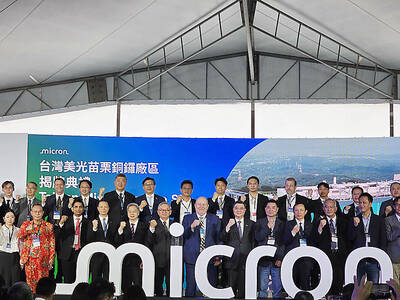
UNPRECEDENTED PACE: Micron Technology has announced plans to expand manufacturing capabilities with the acquisition of a new chip plant in Miaoli Micron Technology Inc unveiled a newly acquired chip plant in Miaoli County yesterday, as the company expands capacity to meet growing demand for advanced DRAM chips, including high-bandwidth memory chips amid the artificial intelligence boom. The plant in Miaoli County’s Tongluo Township (銅鑼), which Micron acquired from Powerchip Semiconductor Manufacturing Corp (力積電) for US$1.8 billion, is expected to make a sizeable capacity contribution to the company from fiscal 2028, the company said in a statement. It would be an extended production site of Micron’s large-scale manufacturing hub in Taichung, the company said. As the global semiconductor industry is racing to reach US$1 trillion

Singapore-based ride-hailing and delivery giant Grab Holdings Ltd has applied for regulatory approval to acquire the Taiwan operations of Germany-based Delivery Hero SE's Foodpanda in a deal valued at about US$600 million. Grab submitted the filing to the Fair Trade Commission on Friday last week, with the transaction subject to regulatory review and approval, the company said in a statement yesterday. Its independent governance structure would help foster a healthy and competitive market in Taiwan if the deal is approved, Grab said. Grab, which is listed on the NASDAQ, said in the filing that US-based Uber Technologies Inc holds about 13 percent of

Taiwan’s food delivery market could undergo a major shift if Singapore-based Grab Holdings Ltd completes its planned acquisition of Delivery Hero SE’s Foodpanda business in Taiwan, industry experts said. Grab on Monday last week announced it would acquire Foodpanda’s Taiwan operations for US$600 million. The deal is expected to be finalized in the second half of this year, with Grab aiming to complete user migration to its platform by the first half of next year. A duopoly between Uber Eats and Foodpanda dominates Taiwan’s delivery market, a structure that has remained intact since the Fair Trade Commission (FTC) blocked Uber Technologies Inc’s

Memory chip stocks extended their losses yesterday after Alphabet Inc’s Google publicized research that could allow more efficient use of the storage needed for artificial intelligence (AI) development. SK Hynix Inc and Samsung Electronics Co, South Korean leaders in the market, fell more than 6 percent and about 5 percent respectively in Seoul. In the US, Micron Technology Inc, Western Digital Corp and Sandisk Corp slid more than 2 percent in pre-market trading, after they all closed lower on Wednesday. Memory companies have been on a tear in recent months as the rapid development of AI infrastructure triggered a spike in chip


 RSS
RSS