


Silicon Valley technology giants such as Facebook Inc and Google have grown so dominant they may need to be broken up, unless challengers or changes in taste reduce their clout, the inventor of the World Wide Web said.
The digital revolution has spawned a handful of US-based technology companies since the 1990s that now have a combined financial and cultural power greater than most sovereign states.
Tim Berners-Lee, a London-born computer scientist who invented the Web in 1989, said that he was disappointed with the current state of the Internet, following scandals over the abuse of personal data and the use of social media to spread hate.
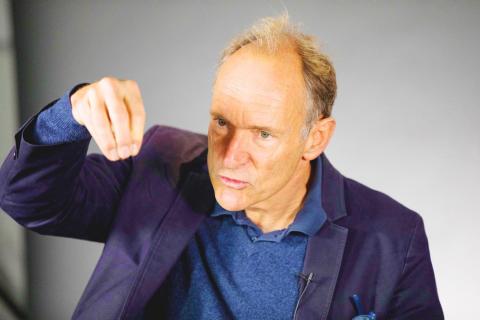
Photo: Reuters
“What naturally happens is you end up with one company dominating the field so through history there is no alternative to really coming in and breaking things up,” Berners-Lee, 63, said in an interview. “There is a danger of concentration.”
However, he urged caution too, saying the speed of innovation in technology and tastes could ultimately cut some of the biggest technology firms down to size.
“Before breaking them up, we should see whether they are not just disrupted by a small player beating them out of the market, but by the market shifting, by the interest going somewhere else,” Berners-Lee said.
Apple Inc, Microsoft Corp, Amazon.com Inc, Google and Facebook have a combined market cap of US$3.7 trillion, equal to Germany’s GDP last year.
Berners-Lee came up with the idea for what he initially called “Mesh” while working at the European Organization for Nuclear Research, calling it the World Wide Web in 1990.
When asked who had the biggest intellectual influence on him, he said: “Mom and dad.”
“They were building computers, so I grew up living in a world where everything was mathematics and the excitement of being able to program something was very fresh,” he said.
There was no “eureka” moment, he said.
Instead, it was hard work, the experience of working in computer science and an attempt to overcome the frustrations of trying to share information with colleagues and students.
“Eureka moments are complete nonsense. I don’t even believe the one about Archimedes. He had been thinking about it for a long time,” he said.
Now a professor at the Massachusetts Institute of Technology and the University of Oxford, Berners-Lee expressed dismay at the way consultancy Cambridge Analytica obtained the personal data of 87 million Facebook users from a researcher.
That scandal was a tipping point for many, he said.
“I am disappointed with the current state of the Web,” he said. “We have lost the feeling of individual empowerment and to a certain extent also I think the optimism has cracked.”
Facebook CEO Mark Zuckerberg apologized after the Cambridge Analytica scandal and pledged to do more to protect users’ data.
However, social media is still being used to propagate hate, Berners-Lee said.
“If you put a drop of love into Twitter it seems to decay, but if you put in a drop of hatred you feel it actually propagates much more strongly. And you wonder: ‘Well is that because of the way that Twitter as a medium has been built?’” he said.
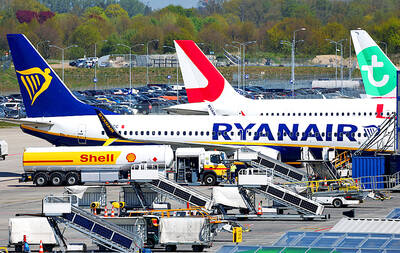
Ryanair, Transavia, Volotea and other low-cost airlines are feeling the financial pain from high jet fuel prices as a result of the Middle East war and are cutting flights. The closure of the Strait of Hormuz has taken a huge chunk of oil supplies off the market, sending the price of jet fuel soaring and triggering fears of shortages that could force airlines to cancel flights. Airlines are not waiting for a lack of supplies to react. “Travel alert: Airlines are cutting thousands of flights right now,” Travel Therapy host Karen Schaler said in an Instagram reel this past weekend.

MANAGING RISKS: Taiwan has secured LNG sufficient to cover 95 percent of electricity demand for next month, UBS said, describing the government’s approach as proactive UBS Group AG has raised its forecast for Taiwan’s economic growth this year to 8 percent, up from 6.9 percent previously, and said expansion could reach as high as 8.6 percent if external energy shocks are avoided. The upgrade reflects a stronger-than-expected first-quarter performance and sustained momentum in artificial intelligence (AI)-driven exports, which UBS said are providing a firm foundation for growth despite geopolitical and energy risks. Taiwan’s GDP expanded 13.69 percent year-on-year in the first quarter, the fastest growth since the second quarter of 1987, the Directorate-General of Budget, Accounting and Statistics (DGBAS) reported on Thursday. On a seasonally
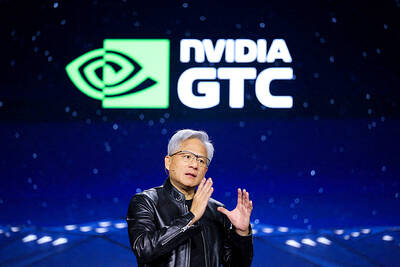
The list of Asian stocks that benefit from business partnership with Nvidia Corp is getting longer, as the region further integrates into the artificial intelligence (AI) chip giant’s business ecosystem. Just in the past week, South Korea’s LG Electronics Inc, Taiwan’s Nanya Technology Corp (南亞科技), as well as China’s Huizhou Desay SV Automotive Co (德賽西威) and Pateo Connect Technology Shanghai Corp (博泰車聯) have become the latest to rally on news of tie-ups, supply-chain participation or product collaboration with the US chip designer. Asian suppliers account for about 90 percent of Nvidia’s production costs, up from about 65 percent last year, data compiled

The Fair Trade Commission’s (FTC) ongoing review of Grab Holdings Ltd’s US$600 million acquisition of Foodpanda Taiwan’s operations, announced on March 23, has taken on fresh urgency as industry experts warn that the transaction could embed significant Chinese cybersecurity vulnerabilities into Taiwan’s digital infrastructure through Grab’s deep ties to autonomous-driving firm WeRide (文遠知行). Less than 16 months after the FTC blocked Uber Eats’ direct attempt to acquire Foodpanda Taiwan — citing potential combined market shares of 80 to 90 percent — the emergence of Grab as the buyer has prompted questions about whether the same competitive harm is simply being rerouted


 RSS
RSS