


You have seen them if you have been to New York recently or are one of the city’s harried commuters. Bright, colorful, funny, cheeky ads for start-ups selling everything from insurance to mattresses, plastered in every subway car and station.
The New York City Subway had long been known for ads hawking questionable services from plastic surgeons and personal-injury lawyers. Then, young, well-funded companies, such as Casper Co and Seamless realized that even in the age of Facebook Inc and Google, subway ads are a cost-effective way to grab attention.
In a testament to the growing power of the city’s start-up scene, these upstarts have helped push up the price of certain subway campaigns sevenfold in the past five years and chased away many of the surgeons and lawyers.
“It’s become a rite of passage for start-ups and tech companies in New York,” said Jennifer Fitzgerald, chief executive officer of PolicyGenius Inc, an insurance-comparison start-up. “You’ve made it when you’ve got your subway ads.”
In a recent four-week campaign, PolicyGenius spent about US$250,000 to buy a “brand train,” which involves covering with ads half of the inside of about 550 randomly selected subway cars, or about 9 percent of the total fleet.
Five years ago, the home services platform Handy paid less than US$50,000 for the same thing, chief executive officer Oisin Hanrahan said.
John Laramie, who runs the tech-focused marketing agency Project X, said brand trains are almost sold out for the rest of the year and are now going for US$345,000.
Outfront Media Inc, which sells ads on behalf of the subway system, declined to comment on pricing, but said it launched campaigns with 100 venture-backed companies last month, 30 percent more than it did in 2016.
Not all of the space has been gobbled up by local start-ups, of course; big established brands, including Google’s YouTube and Twitter Inc, have taken over trains and stations, too. Late last month, Spotify Technology SA ads blanketed Union Square station in Manhattan.
The rising cost of subway marketing is crowding out long-time advertisers. One is Manhattan Mini Storage, famous locally for sassy ads featuring such quips as: “Why leave a city that has six professional sports teams, and also the Mets?”
“We’ve had a great run with the subway part of our campaign and I think we would continue to consider it, but price is always a factor, you want to get the best reach for the best value,” said Jason Morros, who runs marketing for Manhattan Mini’s parent, Edison Properties. “To have an impact you really have to have those big buys that these start-ups have been doing.”
After years of false starts, New York’s tech scene is growing up. Venture capital investment is ballooning, tech giants, such as Google, are adding thousands of jobs in the city, and former bankers, advertisers and retail executives are lining up to disrupt their former industries.
These consumer-focused companies use New York’s population of 8.5 million as a testing ground for new products and ideas, from electronic toothbrush subscriptions to food delivery services.
The subway is ground zero for many of them.
Not so long ago, new brands were deeply skeptical of advertising on the trains; they thought long and hard before putting an ad next to controversial campaigns, such as one for breast augmentation that ran a couple of years ago.
Among the first to take the leap was Handy. It had recruited hundreds of cleaners and was trying to find customers.
Handy bought 10 percent of the subway for less than US$50,000, and it worked.
“It drove thousands and thousands of new customers,” Hanrahan said. “We were very happy.”
However, it was Oscar, the health insurance start-up founded by Josh Kushner, that took it to the next level soon after. In 2013, the company made a massive ad buy across New York as it pitched people to switch over during open enrollment season.
“They had every single subway, they had every single taxi top,” Laramie said. “Oscar is the one who made subway known for what it is in the tech community.”
New York’s subway caters to a broader demographic than most US mass transit systems, with wealthier people who might drive a car in Los Angeles, Atlanta or Dallas more likely to take the train in New York.
The audience is captive too, with people spending long stretches of time in the same subway car — often thanks to frequent delays on the aging system.
“New Yorkers have a ‘special’ relationship with their commutes — they average nearly two hours with us, among the highest in the nation, each day,” Outfront Media chief executive officer Jeremy Male said in an e-mail. “It is the best way to reach a young, upscale audience, as well as consumers more broadly.”
Another key factor behind the subway advertising boom: the ever-rising price of using Facebook and Google to target people online. Web ads still consume most of tech marketing budgets, but “out of home” advertising, such as billboards and subways, is not going away.
“Digital channels are just becoming more and more saturated, more and more expensive,” Fitzgerald said. “The word ‘insurance’ is the most expensive adword on Google,” she said, referring to the Google product that lets companies place ads on top of search results for certain keywords.
Then there is that ineffable New York factor.
“Because New York is home to journalists and the Twitterati, they see you on the subway and it’s actually more powerful than TV,” Fitzgerald said.
Her company’s ads spoofed the “poetry in motion” posters beloved by commuters.
The campaign was designed to get people to think they were enjoying real verse until they suddenly realize they are reading an insurance ad.
Some found this hilarious; others deemed the ads an insult to one of the last vestiges of civic art. In the end, the outpouring of articles and tweets won the brand more attention.
“We got a write-up in New York magazine: ‘Why I found those PolicyGenius ads so annoying,’” Fitzgerald said. “I was like: ‘Guys, we’ve made it.’”
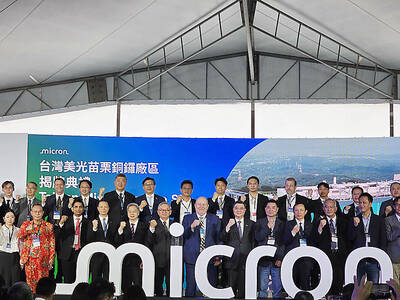
UNPRECEDENTED PACE: Micron Technology has announced plans to expand manufacturing capabilities with the acquisition of a new chip plant in Miaoli Micron Technology Inc unveiled a newly acquired chip plant in Miaoli County yesterday, as the company expands capacity to meet growing demand for advanced DRAM chips, including high-bandwidth memory chips amid the artificial intelligence boom. The plant in Miaoli County’s Tongluo Township (銅鑼), which Micron acquired from Powerchip Semiconductor Manufacturing Corp (力積電) for US$1.8 billion, is expected to make a sizeable capacity contribution to the company from fiscal 2028, the company said in a statement. It would be an extended production site of Micron’s large-scale manufacturing hub in Taichung, the company said. As the global semiconductor industry is racing to reach US$1 trillion

Singapore-based ride-hailing and delivery giant Grab Holdings Ltd has applied for regulatory approval to acquire the Taiwan operations of Germany-based Delivery Hero SE's Foodpanda in a deal valued at about US$600 million. Grab submitted the filing to the Fair Trade Commission on Friday last week, with the transaction subject to regulatory review and approval, the company said in a statement yesterday. Its independent governance structure would help foster a healthy and competitive market in Taiwan if the deal is approved, Grab said. Grab, which is listed on the NASDAQ, said in the filing that US-based Uber Technologies Inc holds about 13 percent of

Taiwan’s food delivery market could undergo a major shift if Singapore-based Grab Holdings Ltd completes its planned acquisition of Delivery Hero SE’s Foodpanda business in Taiwan, industry experts said. Grab on Monday last week announced it would acquire Foodpanda’s Taiwan operations for US$600 million. The deal is expected to be finalized in the second half of this year, with Grab aiming to complete user migration to its platform by the first half of next year. A duopoly between Uber Eats and Foodpanda dominates Taiwan’s delivery market, a structure that has remained intact since the Fair Trade Commission (FTC) blocked Uber Technologies Inc’s

Memory chip stocks extended their losses yesterday after Alphabet Inc’s Google publicized research that could allow more efficient use of the storage needed for artificial intelligence (AI) development. SK Hynix Inc and Samsung Electronics Co, South Korean leaders in the market, fell more than 6 percent and about 5 percent respectively in Seoul. In the US, Micron Technology Inc, Western Digital Corp and Sandisk Corp slid more than 2 percent in pre-market trading, after they all closed lower on Wednesday. Memory companies have been on a tear in recent months as the rapid development of AI infrastructure triggered a spike in chip


 RSS
RSS