


Chunghwa Telecom Co (中華電信) on Friday reported that its first-quarter revenue declined from a year earlier, but analysts are more concerned with whether the company’s recently launched unlimited service plan is to have a detrimental effect on its average revenue per user (ARPU) performance this year.
The company last week became the latest telecom provider in Taiwan to offer an unlimited 4G service plan at NT$499 (US$16.84) a month, targeting civil servants, teachers and military personnel, after messaging app Line Corp on Tuesday last week introduced its low-priced, unlimited data service package, priced according to connection speed requirements.
Other players such as Taiwan Mobile Co (台灣大哥大), Asia Pacific Telecom Co (亞太電信), Taiwan Star Telecom Co (台灣之星) and Far EasTone Telecommunications Co (遠傳電信) have introduced similar packages with unlimited access to mobile Internet and unlimited phone calls between subscribers of the same network to attract subscribers.
As mobile service revenue remains the largest contributor to telecoms’ overall revenue, the offering of unlimited data and call services at low prices — while helping them hold on to market share — poses risks for their long-term revenue and growth.
“This kind of NT$499 price plan has been offered by our peers for a while, although not officially,” Chunghwa Telecom president Sheih Chi-mau (謝繼茂) told analysts in a conference call, adding that the company simply reacted to retain its customers. “We needed to fight back to stabilize the market condition.”
The company views the NT$499 service plan as a short-term promotion, Sheih said, adding that it would need to stay nimble, to respond to market dynamics.
Although telecoms continue to provide various packages to meet customer demand, Chunghwa Telecom’s advantage is its network coverage and its number of base stations, he said.
“We don’t rule out the possibility of offering our customers a service plan with a speed cap rather than a data cap, if the demand is there. We will continue to closely monitor developments in the market,” Sheih said.
Shen Fu-fu (沈馥馥), director of the company’s investor relations department, said Chunghwa Telecom would like its customers to upgrade to higher-end service packages, but “market share is still important.”
Responding to an analyst who asked how the company views offering a low-priced mobile package with unlimited data when its revenue has not grown for 15 months, Shen said the market has been really dynamic, and the company needed to have different strategies for different target subscribers.
However, the unlimited service plan is likely to have a negative effect on the company’s APRU, which already declined to NT$581 last quarter from NT$588 the previous quarter, because the firm adopted International Financial Reporting Standards (IFRS) 15, she said.
“The ARPU is likely to show incremental decreases in coming quarters,” Shen added.
In the first quarter, Chunghwa Telecom’s net income attributable to the parent company declined 9 percent year-on-year to NT$8.73 billion, with earnings per share of NT$1.13.
Over the same period, earnings before interest, taxes, depreciation and amortization decreased 0.7 percentage points to 35.26 percent, while consolidated revenue fell 1.7 percent to NT$53.63 billion, according to the company’s financial statement.
As of last month, the company had more than 8.2 million 4G subscribers, with mobile Internet adopters reaching 84.4 percent of total post-paid subscriptions, driving up the company’s mobile Internet revenue by 3.04 percent year-on-year.
However, the company’s overall mobile service revenue for the first quarter decreased annually due to changes in accounting procedures following the IFRS 15 adoption and an increasingly competitive market landscape, it said.
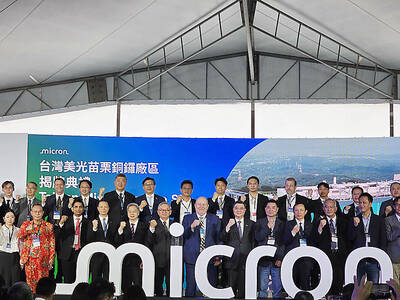
UNPRECEDENTED PACE: Micron Technology has announced plans to expand manufacturing capabilities with the acquisition of a new chip plant in Miaoli Micron Technology Inc unveiled a newly acquired chip plant in Miaoli County yesterday, as the company expands capacity to meet growing demand for advanced DRAM chips, including high-bandwidth memory chips amid the artificial intelligence boom. The plant in Miaoli County’s Tongluo Township (銅鑼), which Micron acquired from Powerchip Semiconductor Manufacturing Corp (力積電) for US$1.8 billion, is expected to make a sizeable capacity contribution to the company from fiscal 2028, the company said in a statement. It would be an extended production site of Micron’s large-scale manufacturing hub in Taichung, the company said. As the global semiconductor industry is racing to reach US$1 trillion

Singapore-based ride-hailing and delivery giant Grab Holdings Ltd has applied for regulatory approval to acquire the Taiwan operations of Germany-based Delivery Hero SE's Foodpanda in a deal valued at about US$600 million. Grab submitted the filing to the Fair Trade Commission on Friday last week, with the transaction subject to regulatory review and approval, the company said in a statement yesterday. Its independent governance structure would help foster a healthy and competitive market in Taiwan if the deal is approved, Grab said. Grab, which is listed on the NASDAQ, said in the filing that US-based Uber Technologies Inc holds about 13 percent of

Taiwan’s food delivery market could undergo a major shift if Singapore-based Grab Holdings Ltd completes its planned acquisition of Delivery Hero SE’s Foodpanda business in Taiwan, industry experts said. Grab on Monday last week announced it would acquire Foodpanda’s Taiwan operations for US$600 million. The deal is expected to be finalized in the second half of this year, with Grab aiming to complete user migration to its platform by the first half of next year. A duopoly between Uber Eats and Foodpanda dominates Taiwan’s delivery market, a structure that has remained intact since the Fair Trade Commission (FTC) blocked Uber Technologies Inc’s

Memory chip stocks extended their losses yesterday after Alphabet Inc’s Google publicized research that could allow more efficient use of the storage needed for artificial intelligence (AI) development. SK Hynix Inc and Samsung Electronics Co, South Korean leaders in the market, fell more than 6 percent and about 5 percent respectively in Seoul. In the US, Micron Technology Inc, Western Digital Corp and Sandisk Corp slid more than 2 percent in pre-market trading, after they all closed lower on Wednesday. Memory companies have been on a tear in recent months as the rapid development of AI infrastructure triggered a spike in chip


 RSS
RSS