


China announced plans to merge regulators responsible for US$43 trillion of financial assets, creating a new body with enhanced oversight of its banking and insurance industries.
The China Insurance Regulatory Commission (CIRC), established in 1998 and overseeing 17 trillion yuan (US$2.69 trillion) of insurance assets, is to be merged with the China Banking Regulatory Commission (CBRC), which supervises more than 4,000 banks with US$40 trillion in assets, according to a Chinese State Council reform plan submitted yesterday to the annual session of the Chinese National People’s Congress.
It is the biggest overhaul in the regulation of the industry since the creation of the CBRC in 2003.
The new entity is to be central to Chinese President Xi Jinping’s (習近平) campaign to curb risks in China’s financial sector, which culminated last month in the unprecedented government takeover of Anbang Insurance Group Co (安邦保險集團).
With the stage now set for Xi to rule beyond 2023, his policy of reducing debt — which stands at about 260 percent of output — might extend over a longer time horizon.
At the same time, the combined banking and insurance regulator is losing some powers to the People’s Bank of China, another sign of the growing regulatory power of the country’s central bank.
Certain CBRC and CIRC functions, including drafting key regulations and prudential oversight, are to be moved to the central bank, the proposal said.
“Finance is core to a modern economy and we must pay high attention to prevent financial risks and safeguard national financial security,” the proposal said, adding that it is intended to fix any overlaps in regulatory oversight.
China in July last year announced the creation of the Financial Stability and Development Committee, and since then watchdogs overseeing banks, insurers and the stock market have intensified efforts to clamp down on shadow financing and other perceived risks.
The regulators have focused on curbing the growth of wealth management products, trust products and interbank liabilities, which fuel a vast parallel financing industry in China.
Other signs of the growing power of the central bank include its adoption of a so-called macro-prudential assessment framework to better gauge risks in the entire financial system, as well as the health of individual institutions.
Off-balance sheet wealth management products and other shadow banking activities were later included in the assessment.
The CBRC under Chairman Guo Shuqing (郭樹清) has also shown its teeth by slapping a record number of punishments on financial institutions for offenses, including concealing the true extent of their bad loans.
On the other hand, the CIRC’s chairmanship has been vacant since its former head, Xiang Junbo (項俊波), was removed in April last year amid a corruption probe.
Some insurers, including Anbang, boosted sales by selling high-yield, short-term products in the past few years and used the proceeds to fund a buying spree in listed companies and overseas trophy assets.
That prompted the nation’s top securities regulator to slam those using leverage to acquire shares as “robbers.”
Since 2016, the CIRC has tightened scrutiny on short-term products and restricted acquisitions by insurers.
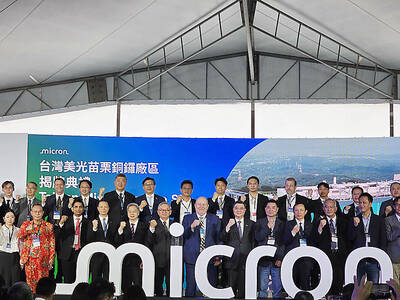
UNPRECEDENTED PACE: Micron Technology has announced plans to expand manufacturing capabilities with the acquisition of a new chip plant in Miaoli Micron Technology Inc unveiled a newly acquired chip plant in Miaoli County yesterday, as the company expands capacity to meet growing demand for advanced DRAM chips, including high-bandwidth memory chips amid the artificial intelligence boom. The plant in Miaoli County’s Tongluo Township (銅鑼), which Micron acquired from Powerchip Semiconductor Manufacturing Corp (力積電) for US$1.8 billion, is expected to make a sizeable capacity contribution to the company from fiscal 2028, the company said in a statement. It would be an extended production site of Micron’s large-scale manufacturing hub in Taichung, the company said. As the global semiconductor industry is racing to reach US$1 trillion

Singapore-based ride-hailing and delivery giant Grab Holdings Ltd has applied for regulatory approval to acquire the Taiwan operations of Germany-based Delivery Hero SE's Foodpanda in a deal valued at about US$600 million. Grab submitted the filing to the Fair Trade Commission on Friday last week, with the transaction subject to regulatory review and approval, the company said in a statement yesterday. Its independent governance structure would help foster a healthy and competitive market in Taiwan if the deal is approved, Grab said. Grab, which is listed on the NASDAQ, said in the filing that US-based Uber Technologies Inc holds about 13 percent of

Taiwan’s food delivery market could undergo a major shift if Singapore-based Grab Holdings Ltd completes its planned acquisition of Delivery Hero SE’s Foodpanda business in Taiwan, industry experts said. Grab on Monday last week announced it would acquire Foodpanda’s Taiwan operations for US$600 million. The deal is expected to be finalized in the second half of this year, with Grab aiming to complete user migration to its platform by the first half of next year. A duopoly between Uber Eats and Foodpanda dominates Taiwan’s delivery market, a structure that has remained intact since the Fair Trade Commission (FTC) blocked Uber Technologies Inc’s

Memory chip stocks extended their losses yesterday after Alphabet Inc’s Google publicized research that could allow more efficient use of the storage needed for artificial intelligence (AI) development. SK Hynix Inc and Samsung Electronics Co, South Korean leaders in the market, fell more than 6 percent and about 5 percent respectively in Seoul. In the US, Micron Technology Inc, Western Digital Corp and Sandisk Corp slid more than 2 percent in pre-market trading, after they all closed lower on Wednesday. Memory companies have been on a tear in recent months as the rapid development of AI infrastructure triggered a spike in chip


 RSS
RSS