


Taipei Garden Hotel (台北花園大酒店), a business hotel near Ximending (西門町), is adjusting pricing strategies at its restaurants to boost the number of guests, as dining revenue has proved relatively resilient in an increasingly competitive landscape.
Food and beverage sales generated 55.1 percent of total revenue in the first half of the year, up from 52.76 percent in the same period last year, Tourism Bureau data showed.
“We are seeking to introduce friendlier pricing at our restaurants so guests can visit more often, not just for birthday or anniversary celebrations,” assistant director of marketing and communication Blythe Chao (趙芝綺) said.
The company recently updated its menus with slightly less expensive dishes at the Prime One Steak House and Japanese restaurant Hanazono.
The adjustment came after Caesar Park Hotels and Resorts (凱撒飯店) last month opened the Caesar Metro Taipei Hotel (台北凱達大飯店) in neighboring Wanhua District (萬華), aiming to draw guests away from other parts of the city.
In addition, the fall in inbound tourists persisted, with a 3.11 percent fall in arrivals in the first seven months of the year, according to government tallies.
Taipei Garden achieved occupancy rates of 86.93 percent between January and June, a 2.42 percent drop from the same period last year, but higher than the 70.83 percent average at other Taipei hotels, official statistics showed.
Average room rates slumped 13.52 percent to NT$2,142, from NT$2,477 a year earlier, while the F&B arm fared better with a 1.03 percent drop in revenue.
The retreat warrants price adjustments to expand the clientele, even though such a move could squeeze profitability, Chao said.
“We are trying to cope with an ever more crowded arena,” she said.
Image Taiwan Hotel Group (印象台灣飯店集團), a young entrant to the hospitality market, is about to launch a new upscale property five minutes’ walk away.
A member of Cosmos Hotel & Resorts Group (天成飯店集團), Taipei Garden markets itself as an oasis in a bustling part of the city.
The firm’s Cosmos Hotel Taipei (台北天成大飯店) fared better with 93.47 percent occupancy in the first six months, but it was down from 96.26 percent and lost its top position to San Want Hotel (神旺大飯店), with 93.53 percent, official data showed.
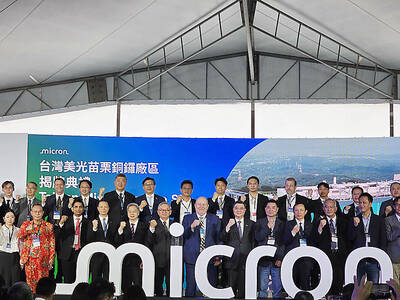
UNPRECEDENTED PACE: Micron Technology has announced plans to expand manufacturing capabilities with the acquisition of a new chip plant in Miaoli Micron Technology Inc unveiled a newly acquired chip plant in Miaoli County yesterday, as the company expands capacity to meet growing demand for advanced DRAM chips, including high-bandwidth memory chips amid the artificial intelligence boom. The plant in Miaoli County’s Tongluo Township (銅鑼), which Micron acquired from Powerchip Semiconductor Manufacturing Corp (力積電) for US$1.8 billion, is expected to make a sizeable capacity contribution to the company from fiscal 2028, the company said in a statement. It would be an extended production site of Micron’s large-scale manufacturing hub in Taichung, the company said. As the global semiconductor industry is racing to reach US$1 trillion

Singapore-based ride-hailing and delivery giant Grab Holdings Ltd has applied for regulatory approval to acquire the Taiwan operations of Germany-based Delivery Hero SE's Foodpanda in a deal valued at about US$600 million. Grab submitted the filing to the Fair Trade Commission on Friday last week, with the transaction subject to regulatory review and approval, the company said in a statement yesterday. Its independent governance structure would help foster a healthy and competitive market in Taiwan if the deal is approved, Grab said. Grab, which is listed on the NASDAQ, said in the filing that US-based Uber Technologies Inc holds about 13 percent of

Taiwan’s food delivery market could undergo a major shift if Singapore-based Grab Holdings Ltd completes its planned acquisition of Delivery Hero SE’s Foodpanda business in Taiwan, industry experts said. Grab on Monday last week announced it would acquire Foodpanda’s Taiwan operations for US$600 million. The deal is expected to be finalized in the second half of this year, with Grab aiming to complete user migration to its platform by the first half of next year. A duopoly between Uber Eats and Foodpanda dominates Taiwan’s delivery market, a structure that has remained intact since the Fair Trade Commission (FTC) blocked Uber Technologies Inc’s

Memory chip stocks extended their losses yesterday after Alphabet Inc’s Google publicized research that could allow more efficient use of the storage needed for artificial intelligence (AI) development. SK Hynix Inc and Samsung Electronics Co, South Korean leaders in the market, fell more than 6 percent and about 5 percent respectively in Seoul. In the US, Micron Technology Inc, Western Digital Corp and Sandisk Corp slid more than 2 percent in pre-market trading, after they all closed lower on Wednesday. Memory companies have been on a tear in recent months as the rapid development of AI infrastructure triggered a spike in chip


 RSS
RSS